Zero Hour: The Greatest Political and Economic Revolution Since Democracy Itself


A look into Harry Dent’s brand new book, Zero Hour: Turn the Greatest Political and Financial Upheaval in Modern History to Your Advantage
I’ve written 10 books since 1989. Zero Hour, now available on Amazon and in book stores, is one of my most innovative, groundbreaking works yet.
The Great Boom Ahead put me on the map with breakthrough demographic indicators and forecasts that tagged the whole decade of the 1990s.
The Roaring 2000s sold over 800,000 copies and introduced its own breakthrough concept: the “network corporation,” characterized by bottom-up, not top down, management.
Zero Hour brings together all of the breakthroughs I’ve had over the years, and then adds to them with, among other things, the discovery of a rare convergence of three-long term cycles that point to a revolution. A true revolution, like the Industrial and American Revolutions that brought together the twin breakthrough concepts of democracy and free-market capitalism.
It was a discovery only possible with extensive collaboration with my co-author Andrew Pancholi – the only other guy in the world who knows as much about cycles as I do.
Chart: Megatrend #1: The Three Harbingers of Revolution
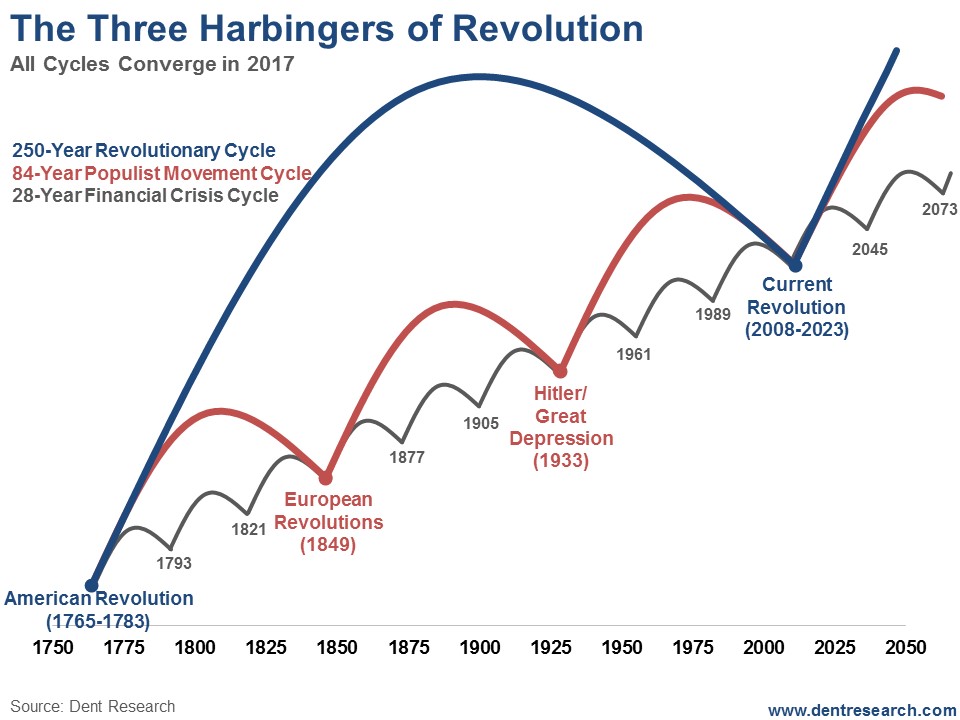
Today, we’re seeing the greatest political polarization since the Civil War, a debt and financial asset bubble that makes the Roaring 20s look like child’s play, and income inequality greater than that experienced in 1929.
But most important, we’re seeing breakthrough technologies, like the internet, and blockchain to come, that will change business and politics as we know them. Biotech and related technologies promise to greatly extend life spans and finally reverse the never-ending demographic decline the world is now facing.
No mainstream economists saw the greatest boom in history before it struck, nor the dramatic collapse of Japan.
None have seen this sweeping revolution, which will go down in history as the one that literally reshaped the world map, politics, economies, stock markets, and lives!
Trump and Brexit are only the first signs of much more to come – and this revolution will not end like it starts – trust me on this.
And as if that weren’t enough, look at this megatrend that’s about to descend on the global economy. The second great surge in globalization has peaked and will see a major retrenchment for decades (not just years) ahead.
Chart: Megatrend #2: The Second Explosion in Globalization Has Peaked
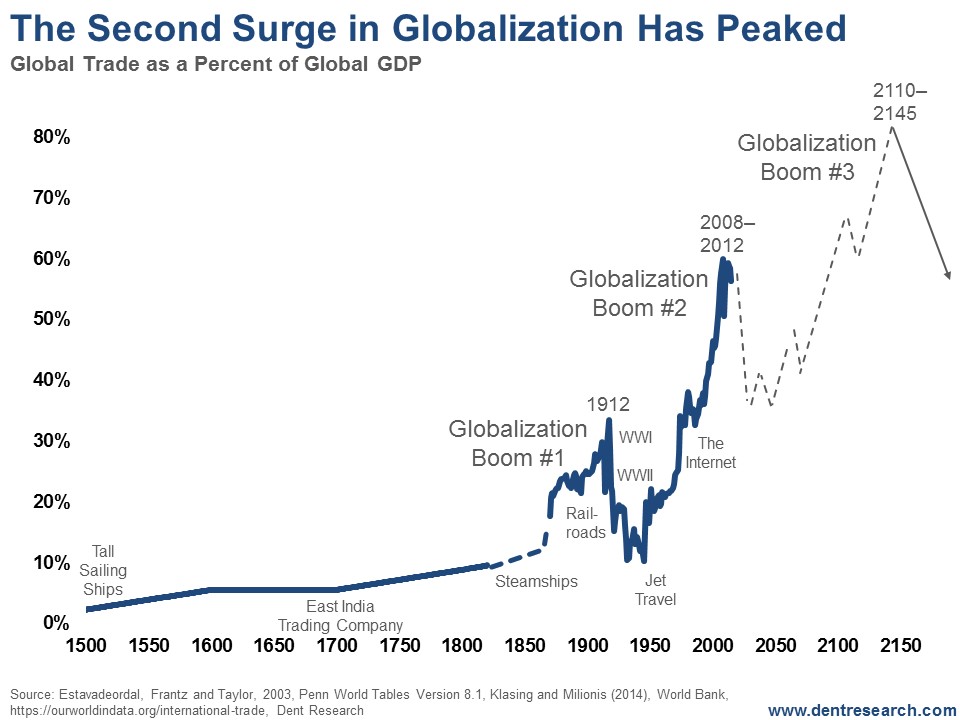
The first surge occurred with steamships and then railroads before colliding with World War I, the Great Depression, and World War II… all major political and economic events that no one saw coming!
Global trade retrenched 60% over 33 years – that’s a big deal!
The technological and network revolution ahead driven the internet and blockchain technologies will finally create the breakthroughs for the third and final great globalization surge that will take the world to 90% urban and middle class.
That’s the economy your kids and grandkids will live in. And it will be dominated by the emerging countries.
You may retire while this revolution unfolds, and at Dent Research we’re here to help you preserve and expand your wealth through it all. To retire well!
But your kids are going to be the ones that become part of this great shift and the potential recipients of the massive opportunities to follow. There’s a caveat though.
There’ll be money to make during the next stock market crash, but the global boom that follows will be nothing like what we experienced between 1983 and 2017.
Everything will not boom largely together as it occurred since World War II. Rather, you’ll need to understand our unique demographic and globalization forecasting tools to know where to set your sites for the groundbreaking opportunities. And I detail those in Zero Hour.
Author
Harry S. Dent, MBA
Dent Research
Harry S. Dent Jr. studied economics in college in the ’70s, but found it vague and inconclusive. He became so disillusioned by the state of his chosen profession that he turned his back on it.