Will the USD/CAD keep rising this week?

The most important event that took place over the weekend was unquestionably the decision made by President Joe Biden to withdraw from the run for the US presidency in 2024. This decision is expected to have repercussions across the world's financial markets, beginning with the United States Dollar (USD). Investors examined the possible ramifications of President Joe Biden's decision to withdraw from the re-election campaign, which would open the door for another Democrat to face Donald Trump.
As a result, the United States Dollar (USD) saw a modest decline against the majority of the major currencies on Monday. A number of important economic statistics for the United States are scheduled to be released this week, which may have an impact on the tone of the market. In the meanwhile, the Bank of Canada is going to have a meeting and is going to make a decision about its monetary policy, which will most likely have an effect on the Canadian Dollar (CAD).
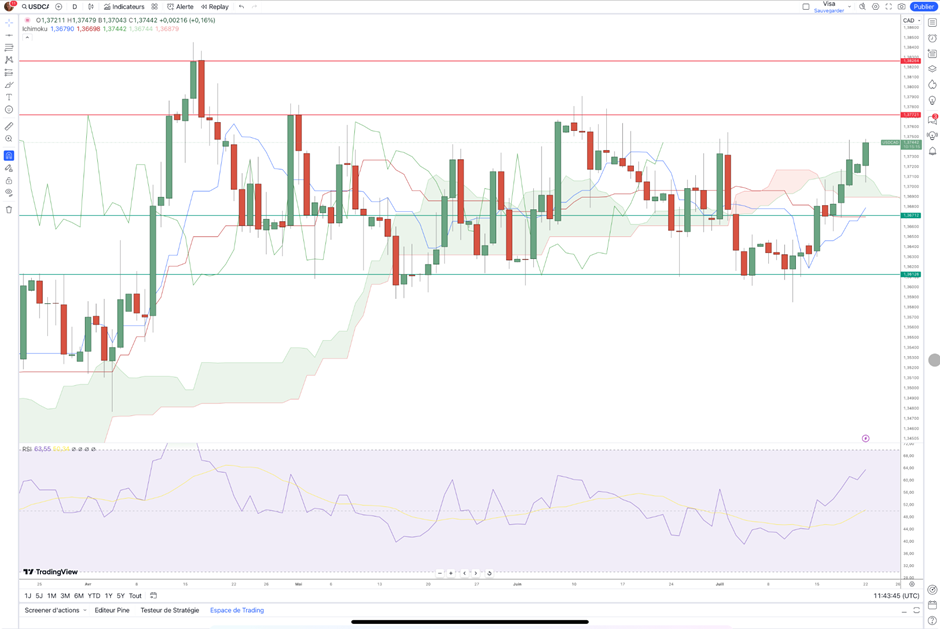
USD/CAD Daily Chart - Source: ActivTrades Data on TradingView
The USD/CAD currency pair has surged over 3.70% so far in 2024, with a recent uptick over the last few days. In light of this movement, let's dive into some key market drivers that could impact the Forex pair throughout this week.
Bank of Canada likely to cut rates again in July, despite mixed signals on Wednesday 24 July
ING analysts predict the Bank of Canada (BoC) will deliver a second consecutive rate cut in July. This comes as unemployment rises and inflation approaches the target level. They anticipate further reductions totaling 50 basis points (bp) throughout the year.
Previously, ING expected the BoC to follow its June rate cut with an additional 75 bp reduction in the second half of the year. However, recent developments suggest they might hold off a similar cut in July.
These developments include a slight rise in the unemployment rate and lower-than-anticipated inflation figures in June.
Canada's unemployment rate climbed to 6.4% in June 2024, exceeding analyst predictions of 6.3% and marking the highest level since January 2022. This increase comes after a previous rate of 6.2% in May.
Inflation in the country cooled down in June. In a welcome surprise, the annual inflation rate dipped to 2.7% in June 2024, down from 2.9% the previous month. This defied market expectations that inflation would hold steady at 2.9%, matching the three-year low seen in April.
With financial markets now heavily anticipating a 25bp cut on July 24th, a decision to maintain rates would be a surprise. In line with these market expectations, economists from Reuters also predict a 25bp decrease in the overnight interest rate, bringing it down to 4.50%. This move reflects the widespread belief that inflation will continue its downward trend.
The impact of a rate cut on the Canadian dollar (CAD) might be limited. Offsetting factors, such as global economic conditions, uncertainty around the US Presidential election and the next Fed meeting, could keep volatility in the USD/CAD exchange rate subdued. While a slight depreciation of the CAD is still expected later in 2024, the exact timing and extent will depend on broader economic developments.
US Business Activity Surged in June with Service Sector Leading the Way. What Will the PMI for July Say on Wednesday 24 July?
The S&P Global US Composite PMI for June was revised upwards to 54.8, indicating a stronger-than-expected positive trend. This marks the fastest rate of business activity growth since April 2022, exceeding the initial estimate of 54.6 and surpassing May's reading of 54.5.
Service sector powers growth: The service sector played a key role in this expansion of the Composite PMI figure. The PMI for services jumped to 55.3 in June, up from 54.8 in May and exceeding the preliminary estimate of 55.1.
Manufacturing holds steady: While not leading the charge, the manufacturing sector also showed improvement. The PMI for manufacturing was revised slightly down to 51.6 in June from the preliminary reading of 51.7. However, this still represents an improvement from the 51.3 of May and the 50 in April, as well as the highest reading in three months, which indicates continued growth within the sector since April.
Demand drives expansion: The increase in output across both sectors was fueled by a surge in new orders. New business saw a rise for the second consecutive month, reaching its highest level in a year. This positive trend comes despite a decrease in new export orders. Companies responded to the higher demand by adding to their workforce for the first time in three months, suggesting confidence in the ongoing expansion.
Inflationary pressures ease slightly: While inflation remains a concern in the United States, there was a slight easing of input cost and output price inflation rates in June compared to May, which could be a positive sign for future price stability.
Overall, the revised PMI data paints a picture of a robust US economy in June, with the service sector leading the charge and manufacturing maintaining a positive trajectory. The upward revision and faster growth suggest a potentially stronger economic performance than initially anticipated.
US economy showed surprising resilience despite headwinds in Q1 2024, what about Q2 2024 published on Thursday 25 July?
The US economy continues to defy expectations, expanding at a moderate pace despite a challenging environment.
Deloitte reports that the first quarter of 2024 saw a slightly revised annualised growth of 1.4%, slightly higher than previous estimates. While this marks the lowest growth since the contractions of early 2022, it's still positive territory.
Economists predict a further rise to 1.9% in the second quarter, indicating a possible trend of gradual improvement.
This resilience comes in the face of several headwinds spotted by Deloitte:
-
High interest rates: The Federal Reserve's year-long commitment to a 23-year high interest rate aims to curb inflation.
-
Global slowdown: Weakness in major economies creates a ripple effect impacting the US.
-
Savings depletion: Consumers are spending down on the excess savings accumulated during the pandemic.
The Federal Reserve faces a delicate balancing act. While inflation has shown signs of decline due to their efforts, they remain cautious. Policymakers are waiting for more conclusive evidence that inflation is on a sustained downward trajectory towards their 2% target before considering rate cuts. Additionally, they need to be mindful of the increased risk to economic growth compared to earlier projections.
The information provided does not constitute investment research. The material has not been prepared in accordance with the legal requirements designed to promote the independence of investment research and as such is to be considered to be a marketing communication.
All information has been prepared by ActivTrades (“AT”). The information does not contain a record of AT’s prices, or an offer of or solicitation for a transaction in any financial instrument. No representation or warranty is given as to the accuracy or completeness of this information.
Any material provided does not have regard to the specific investment objective and financial situation of any person who may receive it. Past performance is not a reliable indicator of future performance. AT provides an execution-only service. Consequently, any person acting on the information provided does so at their own risk.
Stay up to date with what's moving and shaking on the world's markets and never miss another important headline again! Check ActivTrades daily news and analyses here.
Author
Carolane de Palmas
ActivTrades
Carolane graduated with a Masters in Corporate Finance & Financial Markets and got the AMF Certification (Financial Markets Regulator in France). Afterward, she became an independent trader, investing mostly in European and American stocks/indices.