Will Oil and Gold prices continue to climb?


The ongoing tensions in the Middle East and the threat of a broader conflict could lead to sustained high oil prices. This is reflected in the recent price surge, with Light Crude Oil prices rising by approximately 4.50% and Brent Oil prices increasing by around 4% in the past three days. Meanwhile, gold prices have remained near their all-time highs, supported by the anticipation of lower interest rates in the United States beginning in September. Given these developments, how should traders position themselves in relation to both oil and gold?
Middle East tensions: Re-escalation or wider conflict?
Hezbollah fired hundreds of missiles and drones into Israel on Sunday, while Israel's Air Force used roughly 100 fighter planes to hit targets in Lebanon, according to the most recent reports regarding the tensions in the Middle East.
Supported by Iran, Hezbollah claimed that their activities were a response to Israel's murder of senior commander Fuad Shukr in Beirut one month ago. According to Reuters, Israel justified its attacks as preventative steps meant to avert a Hezbollah attack.
Vivek Dhar, a mining and energy commodities strategist at the Commonwealth Bank of Australia, believes that market participants will closely watch how Iran's attack affects Israel, whether the situation escalates into a broader regional conflict, and how Israel's response might impact Iran's oil infrastructure. He warns that Israel's retaliation could disrupt 3-4% of global oil supply, potentially driving Brent prices up to $75-$85 per barrel in September.
On the other hand, Cedric Chehab, a global risk expert at BMI, doesn't see an immediate threat of a full-scale war, despite the recent tensions. He believes there is still a possibility of de-escalation, although the risk of escalation remains.
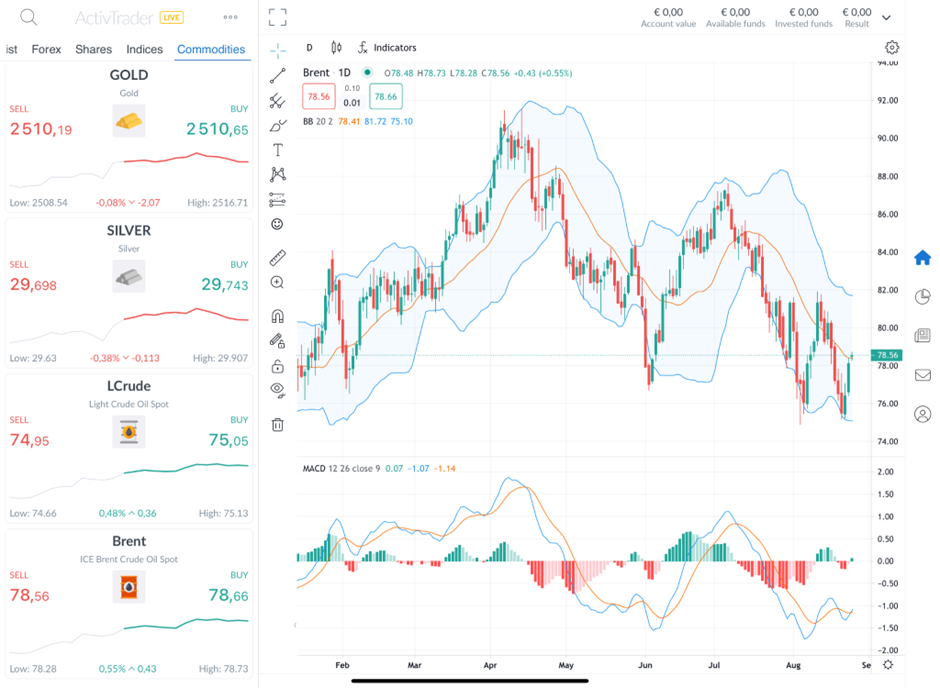
Brent Prices Daily Chart - Source: ActivTrader
Can Gold prices go higher?
Gold prices have recently hit a new all-time high at around $2,531 an ounce, as speculation around an upcoming rate cut in the United States intensified.
The yellow metal, which does not generate interest, tends to become more appealing to investors when interest rates are low, as the opportunity cost of holding gold compared to interest-yielding assets like bonds decreases. With the Federal Reserve hinting at possible rate cuts, gold prices seem to be benefiting from this development.
Additionally, lower interest rates often lead to a decline in the value of the U.S. dollar (USD). Since gold is priced in USD, changes in the dollar's value can significantly influence gold prices. A weaker USD typically drives gold prices higher.
Federal Reserve Chair Jerome Powell indicated on Friday that interest rate cuts are likely in the near future, though he did not provide specifics on their timing or magnitude.
Markets currently expect a 25 basis point reduction at the Fed’s September meeting, which would bring rates down to 5-5.25%. Minutes from the July Federal Open Market Committee meeting revealed that a “vast majority” of FOMC members are in favour of a September rate cut, assuming no major shifts occur in economic data. The outlook for U.S. monetary policy will continue to hinge on incoming data and the evolving balance of risks.
Powell also highlighted the progress in reducing inflation, allowing the Fed to shift its focus equally to the other side of its dual mandate—maintaining full employment. The Personal Consumption Expenditures index recently recorded an inflation rate of 2.5%, down from 3.2% a year ago. At the same time, the unemployment rate has inched up to 4.3%.
Gold's traditional role as a safe-haven asset has become increasingly relevant amid recent geopolitical tensions, especially in the Middle East, as investors often seek refuge in gold during times of uncertainty.
Central banks also have been significant contributors to gold's price appreciation. Following a record-breaking year of purchases in 2022, central banks continued to accumulate gold reserves in 2023, adding 1,037 tonnes. A survey by the World Gold Council suggests that this trend is likely to continue in 2024.
Aakash Doshi, head of commodities at Citi Research, anticipates further price increases for gold. He forecasts prices to reach $2,600 per ounce by the end of 2024 and potentially $3,000 per ounce by mid-2025.
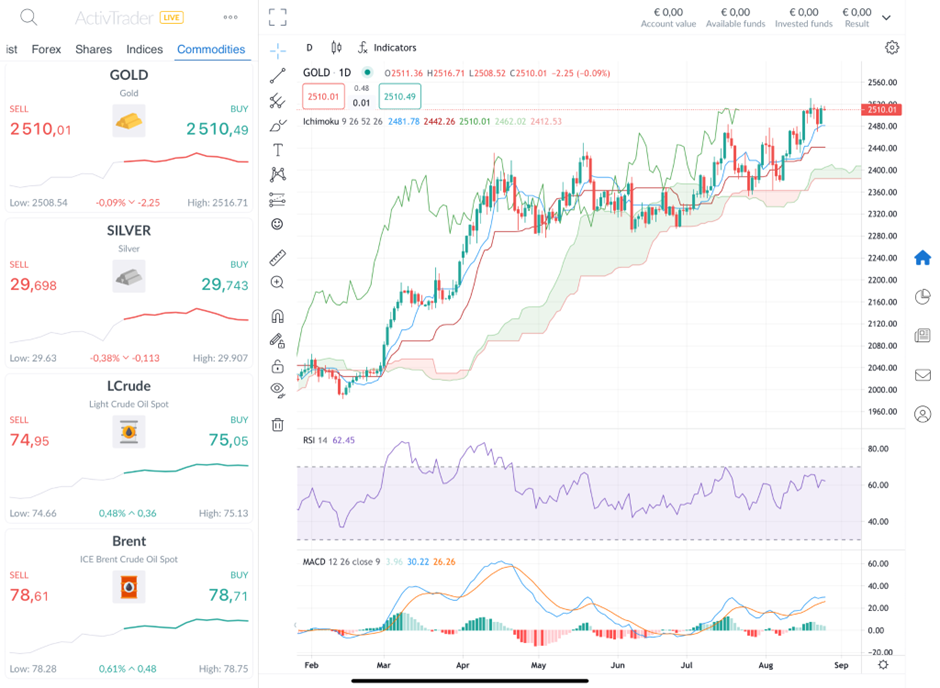
Gold Prices Daily Chart - Source: ActivTrader
Conclusion
Given the possible escalating tensions in the Middle East and the anticipation of upcoming lower interest rates in the United States, both oil and gold prices could be poised for further gains.
The potential disruption of global oil supply due to the Middle East conflict could significantly drive up oil prices, while the decline in interest rates and the weakening U.S. dollar could support the continued rise in gold prices.
Stay up to date with what's moving and shaking on the world's markets and never miss another important headline again! Check ActivTrades daily news and analyses here.
Author
Carolane de Palmas
ActivTrades
Carolane graduated with a Masters in Corporate Finance & Financial Markets and got the AMF Certification (Financial Markets Regulator in France). Afterward, she became an independent trader, investing mostly in European and American stocks/indices.