Will emerging market stocks play catch up after the Fed?

The ripple effects of tonight’s Federal Reserve decision will spread far and wide, including in the EM space. Traditionally, some emerging market and Asian economies have moved closely with the Federal Reserve’s monetary policy cycles. This means that in recent years, some have ramped up interest rates at the same pace as the Fed in order to protect their currencies. In EM and across Asia, central bankers are sensitive to the level of their currencies, especially against the dollar. This is for multiple reasons: dollar denominated debt, inflation concerns and export concerns.
EM may synchronize with the Fed as they cut interest rates
While EM central banks took the lead from the Fed as it hiked interest rates, they are expected to do the same as the Fed cuts interest rates. For example, on Wednesday, the Bank of Indonesia cut interest rates by 25bps to 6% ahead of tonight’s FOMC meeting. Outside of emerging markets, some G10 countries are also following the Fed closely. The Bank of New Zealand also cut interest rates last month for the first time, and they are expected to cut rates by nearly 50bp at their meeting in October. The RBNZ is expected to continue to ease policy through to May next year, however, the actual length of their cutting cycle could be dependent on what the Fed says later tonight. The swaps market currently expects a further 8 interest rate cuts from the RBNZ in the coming months, which is roughly the same level as the Federal Reserve.
What the Fed does next
If the Fed does cut by 50bp as a precautionary measure designed to protect a soft economic landing and to ward off a recession, we think that this move will extend the economic cycle and support growth. This would be bullish for stock markets in the short to medium term. Since emerging markets are likely to follow the Fed, then the prospect of large rate hikes in the emerging world may also boost emerging market stock indices.
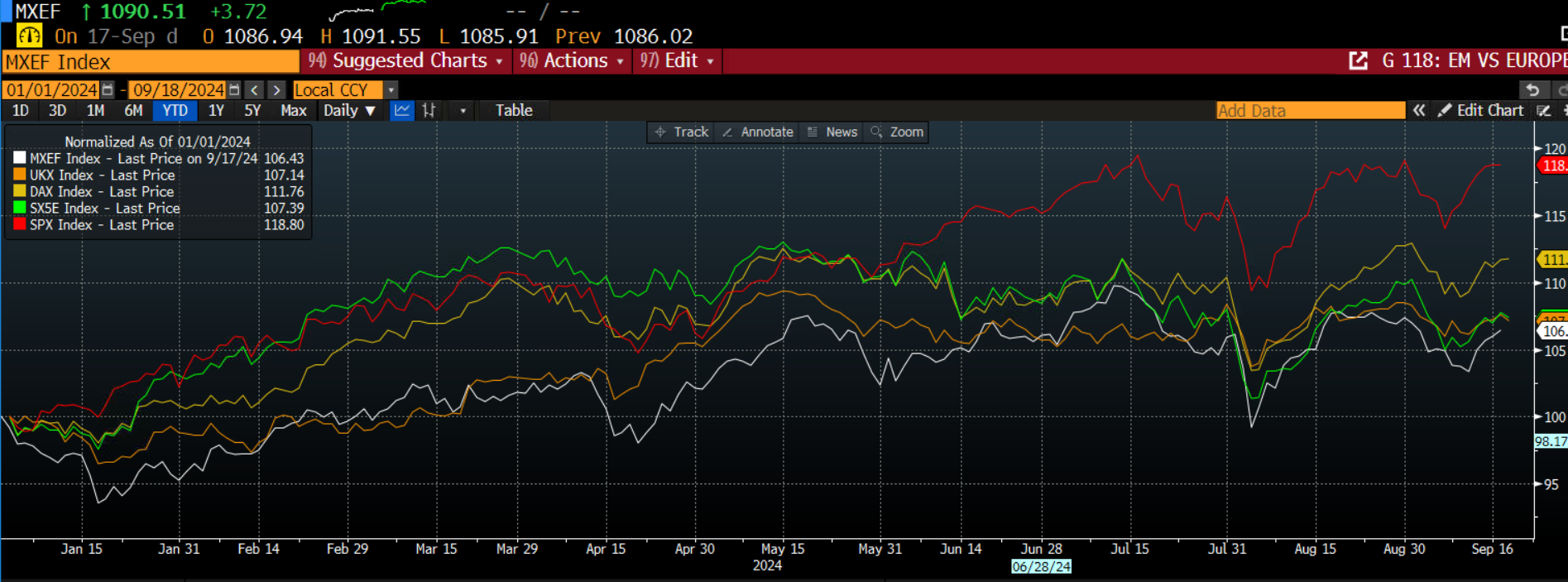
As you can see in the chart below, the MSCI EM index (the white line), has underperformed the S&P 500 (red line) and other major European indices so far this year. However, we think that the MSCI EM index may start to play catch up with the S&P 500, and could even outperform European indices like the Dax, the Eurotoxx and the FTSE 100.
MSCI EM index and Dax, S&P 500, FTSE 100 and Eurostoxx index, normalized to show how they have moved together YTD
Source: XTB and Bloomberg
Rate cut differentials are key for stock markets going forward
We think that EM stock markets may outperform Europe due to the difference in expectations of rate cuts between the US and Europe. The FOMC is expected to cut rates 10 times between now and the middle of next year. In contrast, the ECB and the BOE are both expected to cut rates less than 6 times over the same time period. Since EM countries are expected to follow the Fed, a deeper rate cutting cycle may support EM stocks, protect against recession and it could also help to boost corporate profits.
Sentiment turns negative on European stocks
Fundamentals are weighing on the outlook for European stocks, but sentiment is also turning negative. The Bank of America global fund manager survey suggests that investors are starting to turn bearish on the region. 20% of fund managers surveyed by Bank of America expect declines in European shares over the coming months, due to slowing economic momentum. Sentiment was particularly bad towards Germany. Due to this, it could be the time for EM stocks to shine.
Author
Kathleen Brooks
XTB UK
Kathleen has nearly 15 years’ experience working with some of the leading retail trading and investment companies in the City of London.