|

Why the Mexican peso surged against the USD?

On Wednesday, the US dollar decreased in value against other major currencies, including the Mexican peso, by over 1%, due to reports of slower than expected US inflation. This suggests that the Federal Reserve may pause its interest rate hikes. According to data from the US Labor Department, inflation in April decreased to 4.9%, which is the lowest year-over-year increase in two years and lower than market forecasts of 5%. The slower inflation was attributed to slower growth in food prices and a further decrease in energy costs.

However, core inflation remained high at 5.5%, indicating that interest rates may need to stay high for some time to control it. Fed funds futures traders are anticipating a pause before expected rate cuts in September, which might be a little optimistic, as the Fed's target range remains at 5% to 5.25%.

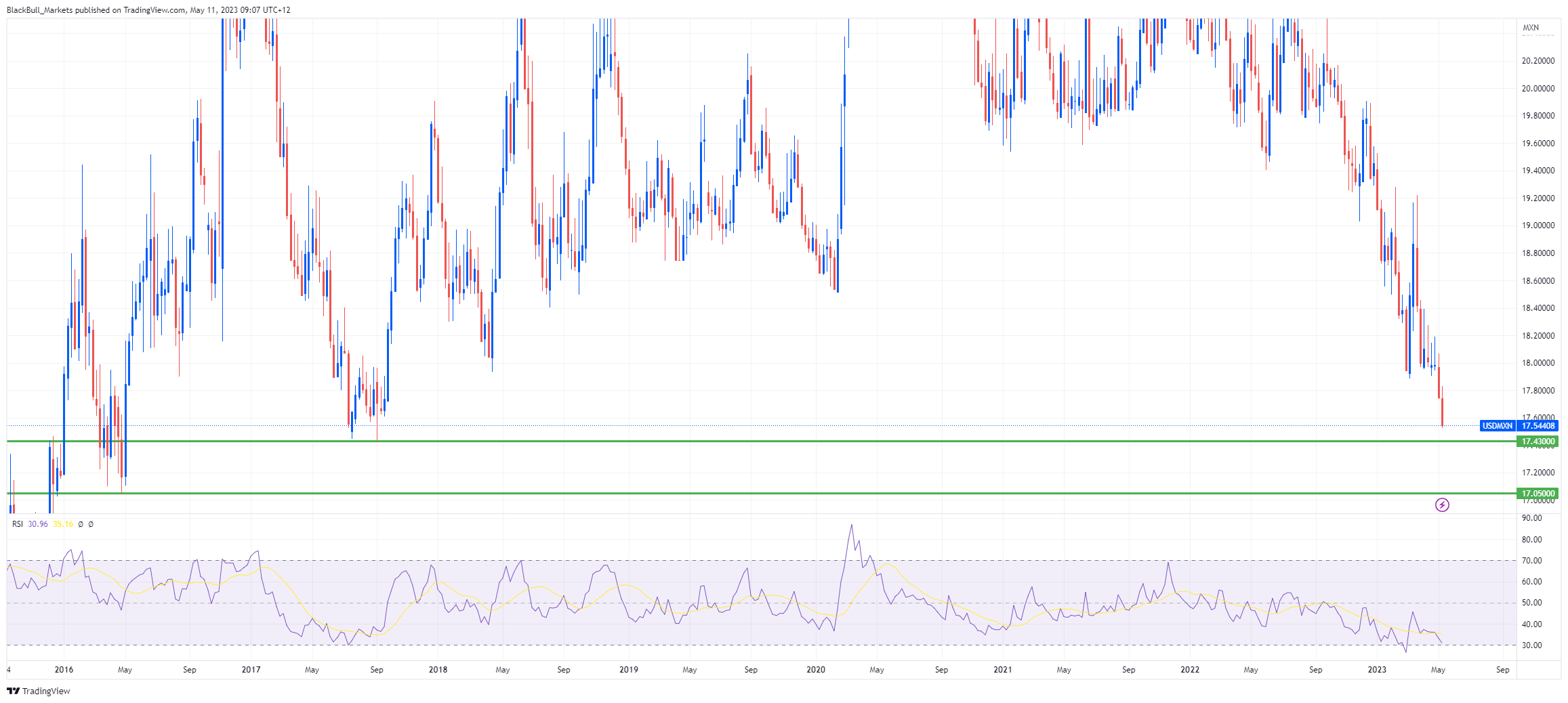
The Mexican peso gained strength to 17.544, its highest value since July 2017, as the difference between US and Mexican monetary policies became more pronounced. The RSI on the USDMXN suggests it is in an extreme oversold condition, so a pullback may be necessary. Resistance levels from 2017 for the pair may no longer be relevant, but the strongest value the peso reached in 2017 was $17.430, while the peak in 2016 was $17.050.

For fundamental context, Banxico increased rates to an all-time high of 11.25% in March, despite a decrease in annual headline inflation that was greater than expected. Mexico's proximity to the US has also made it an attractive location for foreign companies to open factories targeting the American market and diversifying production from China. Additionally, the US economy's robust state has led to a rise in remittances to Mexico from expats.
Author

Mark O’Donnell

Mark O’Donnell

Blackbull Markets Limited

Mark O’Donnell is a Research Analyst with BlackBull Markets in Auckland, New Zealand.

More from Mark O’Donnell
Share:

Editor's Picks

EUR/USD flat lines around 1.1900; looks to US NFP report for fresh directional impetus

The EUR/USD pair is seen oscillating in a narrow trading band around the 1.1900 mark during the Asian session on Wednesday as traders opt to wait for the release of US monthly employment details before placing fresh directional bets.

GBP/USD slips back to daily lows near 1.3640

GBP/USD drops to daily lows near 1.3640 as sellers push harder and the Greenback extends its rebound in the latter part of Tuesday’s session. Looking ahead, the combination of key US releases, including NFP and CPI, alongside important UK data, should keep the pound firmly in focus over the coming days.

Gold recovers to $5,050, focus shifts to US jobs data

Gold turns higher to test $5,050 in the Asian session on Wednesday. Traders assess whether Gold has found a floor following a historic sell-off. The delayed US employment report for January, which was pushed back due to the recently ended four-day government shutdown, will take center stage later on Wednesday.

Ethereum: Whales buy the dip amid rising short bets

Following one of Ethereum's largest weekly drawdowns, whales are slowly returning to action alongside a drop in retail selling pressure. After slightly selling into the decline at the start of the month, whales or wallets with a balance of 10K-100K ETH began buying the dip last Wednesday as prices crashed further. 

Dollar drops and stocks rally: The week of reckoning for US economic data

Following a sizeable move lower in US technology Stocks last week, we have witnessed a meaningful recovery unfold. The USD Index is in a concerning position; the monthly price continues to hold the south channel support.

XRP holds $1.40 amid ETF inflows and stable derivatives market

Ripple trades under pressure, with immediate support at $1.40 holding at the time of writing on Tuesday. A recovery attempt from last week’s sell-off to $1.12 stalled at $1.54 on Friday, leading to limited price action between the current support and the resistance.