USD/JPY Outlook: Bearish double-top pattern in the making ahead of US NFP on Friday
- USD/JPY drops to a fresh weekly low on Thursday and is weighed down by a combination of factors.
- Renewed Fears of a US banking crisis benefit the JPY and exerts some pressure amid a weaker USD.
- Declining US bond yields undermines the buck after the Fed’s less hawkish rate hike on Wednesday.


The USD/JPY pair adds to its heavy weekly losses and drifts lower for the third successive day on Thursday, hitting a fresh weekly low during the Asian session. The pair has now reversed a major part of last week's dovish Bank of Japan (BoJ)-inspired gains and is weighed down by a combination of factors. Signs of stress at another US regional bank, PacWest Bancorp, sparks fears of a full-blown banking crisis in the US and boosts demand for the safe-haven Japanese Yen (JPY). The US Dollar (USD), on the other hand, languishes near the weekly low in the wake of the Federal Reserve's (Fed) less hawkish outlook and contributes to the offered tone surrounding the major.
As was widely expected, the US central bank raised interest rates by 25 bps and opened the door for a possible pause in June. In the post-meeting presser, Powell signalled that the Fed was close to hitting the terminal rate of the current hiking cycle, though did not explicitly confirm a pause. Powell also warned that U. economic growth was cooling and noted that credit conditions were likely to tighten further in the wake of growing pressure on banks. The downbeat outlook, along with concerns over the US debt ceiling, keeps the US Treasury bond yields depressed. The resultant narrowing of the US-Japan rate differential further benefits the JPY and exerts pressure on the USD/JPY pair.
The downside, however, seems cushioned amid a more dovish stance adopted by the BoJ, leaving its ultra-loose monetary policy settings unchanged last week. The Japanese central bank also made no tweaks to its yield curve control (YCC) by a unanimous vote. Moreover, the new BoJ Governor Kazuo Ueda said that the risk from tightening too hastily is larger than monetary policy falling behind the curve and added that it will be appropriate to continue monetary easing to achieve the 2% inflation target. This, in turn, warrants some caution before placing aggressive bearish bets around the USD/JPY pair and positioning for any further near-term depreciating move.
Traders also seem to have moved to the sidelines and prefer to wait for the release of the closely-watched US monthly jobs data, popularly known as the NFP report on Friday. This could turn out to be the next big trigger that will influence the near-term USD price dynamics and help determine the next leg of a directional move for the USD/JPY pair. Heading into the key data risk, traders on Thursday might take cues from the release of the usual Weekly Initial Jobless Claims data from the US. Apart from this, the European Central Bank (ECB) decision should infuse some volatility in the markets and allow traders to grab short-term opportunities.
Technical Outlook
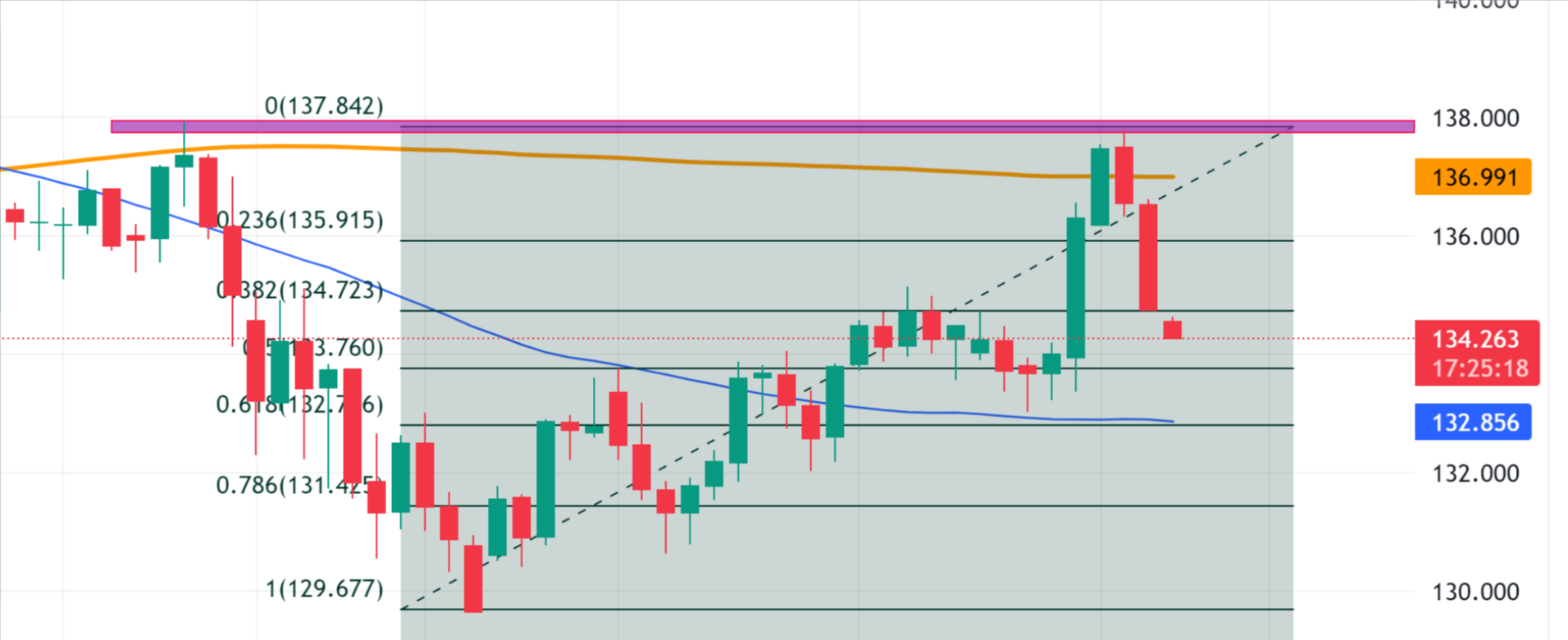
From a technical perspective, this week's pullback from the vicinity of the YTD peak touched in March constitutes the formation of a bearish double-top pattern on the daily chart. Moreover, the recent failure to find acceptance above the 200-day Simple Moving Average (SMA) and a subsequent slide below the 38.2% Fibonacci retracement level of the rally from the March low might have shifted the near-term bias back in favour of bearish traders.
That said, oscillators on the daily chart - though have been losing positive traction - are yet to confirm the negative outlook and warrant some caution. Hence, any further decline is more likely to find some support near the 134.00 round-figure mark, which is closely followed by the 50% Fibo. level, around the 133.75-133.70 region. Some follow-through selling could make the USD/JPY pair vulnerable to weaken further below the 133.00 mark, towards testing the 132.85-132.75 confluence, comprising the 100-day SMA and the 61.8% Fibo. level.
On the flip side, attempted recovery back above the 134.65-134.70 region (38.2% Fibo. level) now seems to confront resistance near the 135.00 psychological mark. A sustained strength beyond the latter might trigger a short-covering rally and lift the USD/JPY pair towards the 23.6% Fibo. level, around the 135.85 zone. Some follow-through buying beyond the 136.00 mark will negate the bearish bias and allow spot prices to make a fresh attempt to decisively break through a technically significant 200-day SMA, currently pegged just ahead of the 137.00 round figure.
Premium
You have reached your limit of 3 free articles for this month.
Start your subscription and get access to all our original articles.
Author
Haresh Menghani
FXStreet
Haresh Menghani is a detail-oriented professional with 10+ years of extensive experience in analysing the global financial markets.