|

USD/JPY: A potential reversal Elliott Wave pattern needs a catalyst

If you tuned into our FACE show yesterday, June 26th, you would have caught the discussion between Blake and me talking about USDJPY. As you know the pair is trading higher, breaking above 160.22 this week, which was the previous 2024 high.

We are seeing bull market in progress, with the possibility of slightly more upside in the near-term. However, Japan has expressed concerns about the current weakness of the Japanese Yen, which could lead to potential intervention threats, keeping this pair volatile during summer. There is a risk that Japan would take action, which would likely cause a sharp reversal in the pair, especially if they receive support from other countries.

From an Elliott Wave perspective, we see USDJPY forming a potential wedge pattern on the daily chart. In Elliott Wave terms, this wedge can represent an ending diagonal, known as a strong reversal pattern. The fifth  wave is already in its late stages, but in the short term, there can still be some extension towards 162, maybe even 164, to the upper trend line resistance. However, this pattern is worth monitoring for potential reversals still this year.
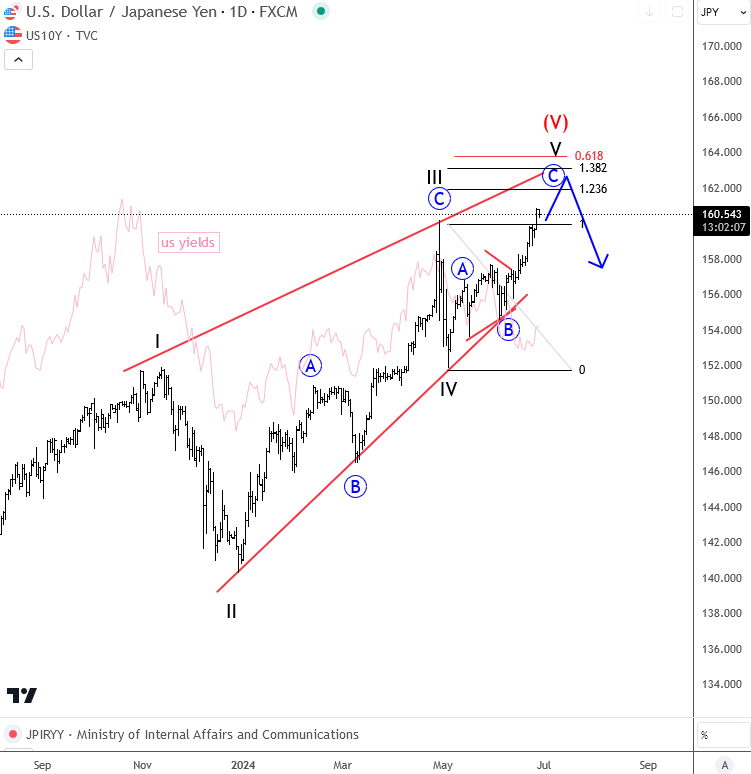
Chart

While no one knows for sure what can trigger a turning point, maybe it could be intervention by Japan. But normally, such actions have only a temporary impact. For a major reversal in the pair, we would need not only intervention , but also a weak dollar with lower US yields on dovish FED, while BoJ should be looking for higher rates.
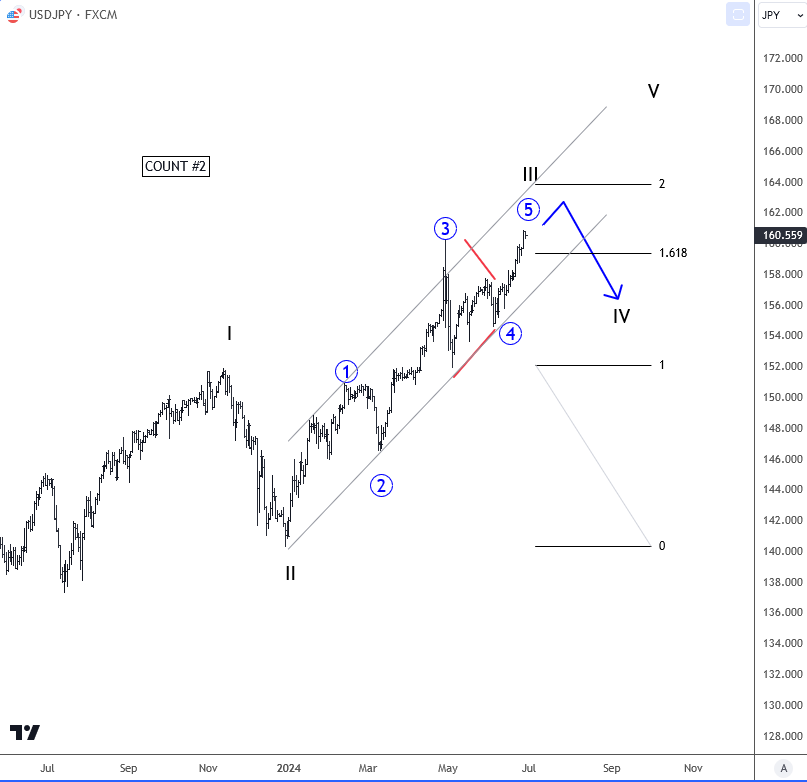
Chart

Author

Blake Morrow

Blake Morrow

Forex Analytix

Blake Morrow spent most of his professional career as the Chief Currency Strategist for Wizetrade group for 15 years, and then the Senior Currency Strategist for Ally Financial after the acquisition of Tradeking which owned the Wizetrade Group.


More from Blake Morrow
Share:

Markets move fast. We move first.

Orange Juice Newsletter brings you expert driven insights - not headlines. Every day on your inbox.

By subscribing you agree to our Terms and conditions.

Editor's Picks

EUR/USD holds steady above 1.1750 as traders await FOMC Minutes

The EUR/USD pair holds steady near 1.1770 during the early Asian session on Tuesday. Traders continue to price in the prospect of further rate cuts by the US Federal Reserve in 2026, following the 25-basis-point rate reduction delivered at the December meeting. The release of the Federal Open Market Committee Minutes will be in the spotlight later on Tuesday.

GBP/USD finds key support near 1.35 despite year-end grind

GBP/USD remains bolstered on the high end as markets grind through the last trading week of the year. Cable caught a bullish tilt to keep price action on the high side of the 1.3500 handle, though year-end holiday volumes are unlikely to see significant progress in either direction as 2025 draws to a close.

Gold gains on Fed rate cut bets, safe-haven demand

Gold price edges higher above $4,350 during the Asian trading hours on Tuesday. The precious metal recovers some lost ground after falling 4.5% in the previous session, which was gold's largest single-day loss since October. Increased margin requirements on gold and silver futures by the Chicago Mercantile Exchange Group, one of the world’s largest trading floors for commodities, prompted widespread profit-taking and portfolio rebalancing.

Crypto market outlook for 2026

Year 2025 was volatile, as crypto often is.  Among positive catalysts were favourable regulatory changes in the U.S., rise of Digital Asset Treasuries, adoption of AI and tokenization of Real-World-Assets.

Economic outlook 2026-2027 in advanced countries: Solidity test

After a year marked by global economic resilience and ending on a note of optimism, 2026 looks promising and could be a year of solid economic performance. In our baseline scenario, we expect most of the supportive factors at work in 2025 to continue to play a role in 2026.

Crypto market outlook for 2026

Year 2025 was volatile, as crypto often is.  Among positive catalysts were favourable regulatory changes in the U.S., rise of Digital Asset Treasuries (DAT), adoption of AI and tokenization of Real-World-Assets (RWA).