USD/CHF: Will Swiss National Bank act on CHF surge?
- The Swiss Franc has significantly risen against the USD, driven by safe-haven demand.
- Concerns are growing about potential intervention by the Swiss National Bank (SNB) due to the Franc's impact on exports.
- The SNB has stated they prioritize price stability and haven't ruled out negative rates.
- Technical analysis suggests USD/CHF found support, but bearish signals indicate possible retests of recent lows.


The Swiss Franc has been on a tear of late against the USD and a host of other currencies. The CHFs rapid rise has come about amid the rise in uncertainty and a demand for safe havens. The beneficiaries being the traditional havens like the Japanese Yen, the Swiss Franc and of course Gold.
The Swiss Franc is an interesting one though given the reliance of Swiss business on the export market. Swiss Franc gains last year already prompted businesses to bring up the idea of intervention by the Swiss National Bank to assist.
The Franc or Swissie as it is also known, has jumped about 9% against the dollar this month, marking its biggest monthly rise since the 2008 financial crisis. Last week, it reached its highest level since January 2015, when the SNB ended its minimum exchange rate policy.
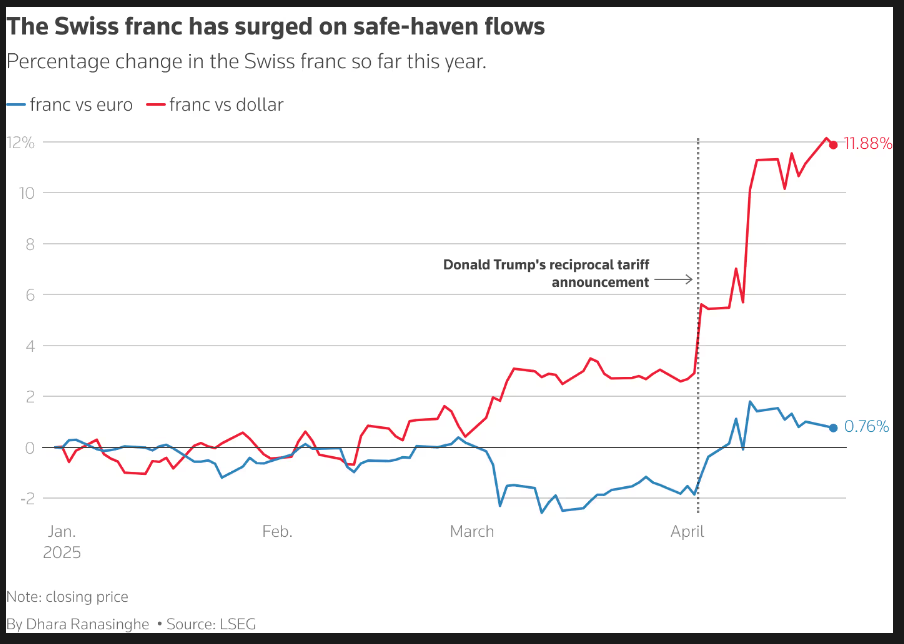
Source: LSEG
This begs the question, will the SNB step in and intervene?
Well voices on the matter are certainly growing with Jean-Philippe Kohl, vice director of industry association Swissmem saying he did not demand SNB action but would welcome any moves by the central bank to mitigate the franc's rise.
SNB response
The SNB stated this month that it doesn’t manipulate currency and only steps in to maintain price stability. It also mentioned the possibility of bringing back negative rates.
However, negative rates, used from 2014 to 2022, were unpopular with banks, savers, and pension funds, making interventions seem like a simpler option.
While a lot of the focus has been on the performance of the Swissie against the US Dollar, policymakers are likely focused on the Swiss currency's rise against the euro since most Swiss trade is with eurozone countries, making euro-priced imports a bigger factor in inflation.
In 2023, 57% of Swiss imports were in euros, compared to 13% in dollars. The central bank says it doesn’t focus on single currency pairs but looks at a range of currencies to guide its policy and ensure it meets its inflation target.
Irrespective of the comments thus far, the SNB may be running out of options. The rise of the Franc has put the Central Bank in a difficult situation with the likelihood of intervention growing.
Technical analysis: USD/CHF
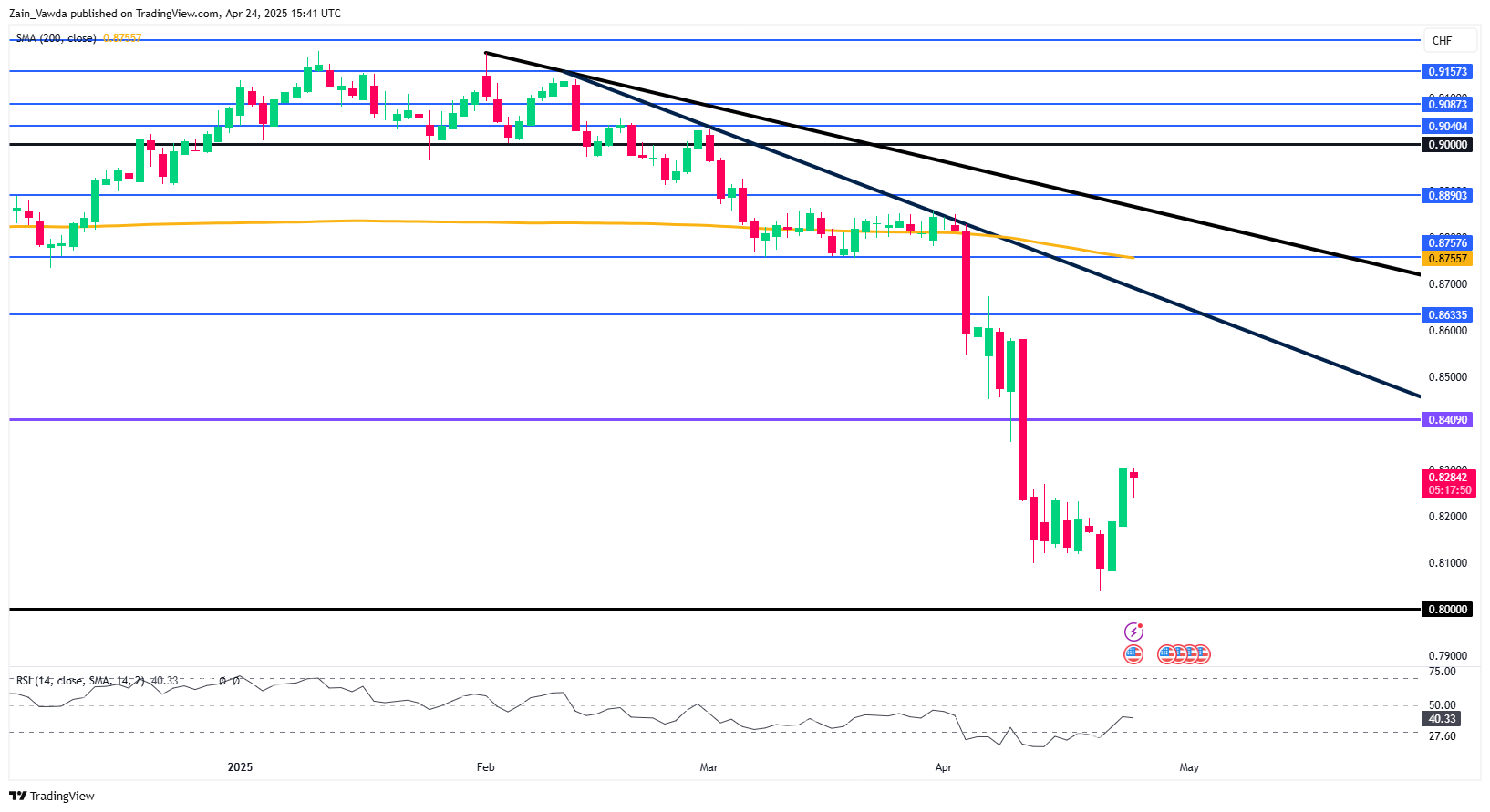
From a technical standpoint, USD/CHF appears to have found a bottom around the 0.8079 handle with the last two days of bullish daily candle closes a positive sign for further gains.
However, today's daily candle is on course for an inside bar handing man candle close which is a bearish sign and may spook market participants. Given that the moves are largely driven by tariff developments, a visit to recent lows cannot be ruled if the US-China stalemate drags on.
USD/CHF daily chart, April 24, 2025
Source: TradingView
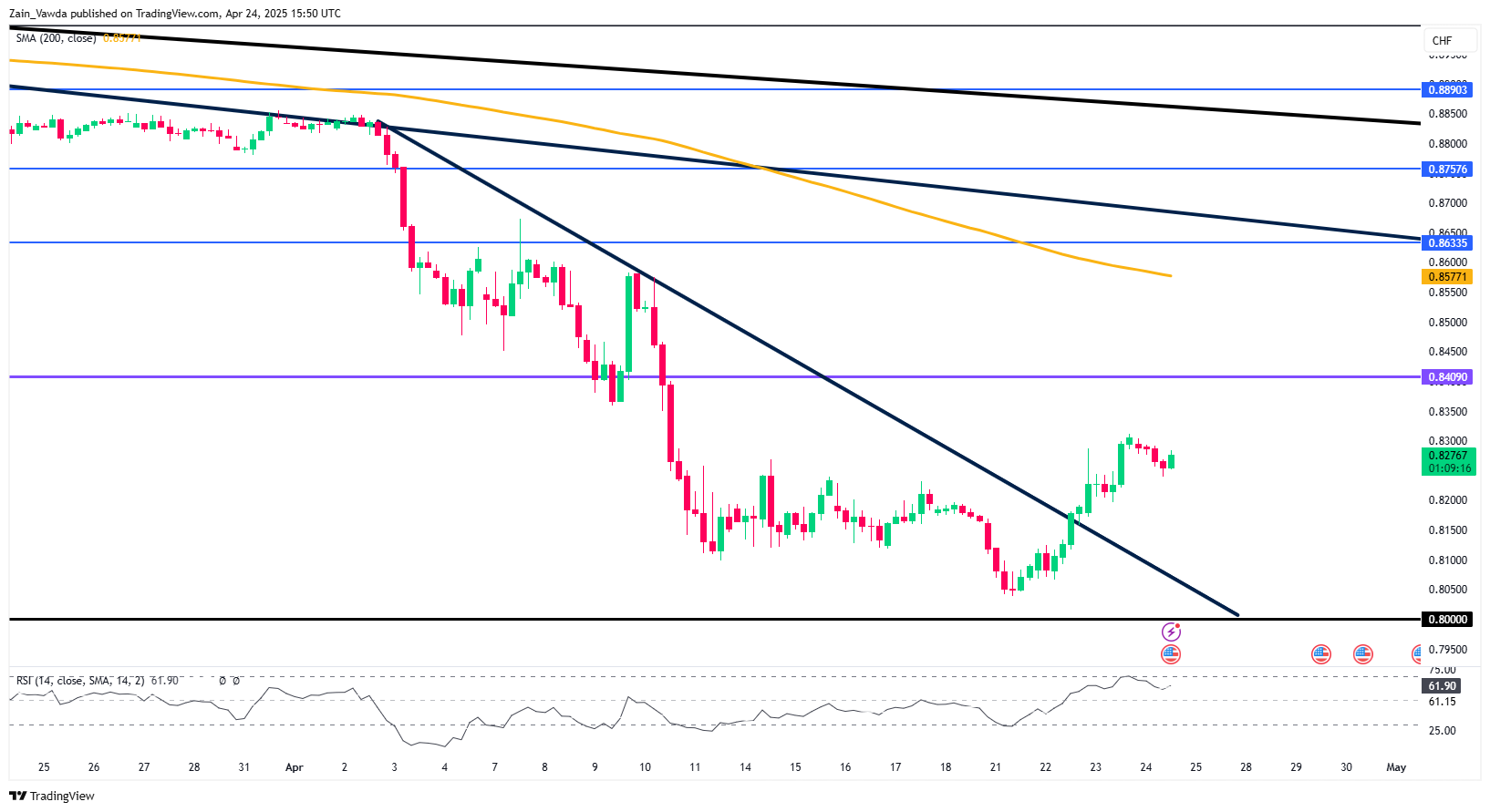
Dropping down to a four-hour chart and the trendline break does support further upside.
A move higher faces resistance at 0.8350 and 0.8409 handles before the 200-day MA and significant swing high at 0.8577 come into focus.
There is also a chance of a trendline retest if the tit-for -tat between the US and China continues.
In such a scenario, support rests at 0.8200 before the trendline becomes support and lastly we have the psychological 0.8000 handle which could finally come into play.
USD/CHF four-hour chart, April 24, 2025
Source: TradingView
Client sentiment data
Taking a look at client sentiment data and 86% of traders are currently net-long USD/CHF. I tend t take a contrarian view toward sentiment which means that USD/CHF could face a downside correction in the short-term.
Author
Zain Vawda
MarketPulse
Zain is a seasoned financial markets analyst and educator with expertise in retail forex, economics, and market analysis.