|

US: New home sales, a short-lived rebound?

The significant rise in American households’ mortgage rates - as illustrated by a 30-year fixed rate of 7.9% according to the Mortgage Bankers Associations (MBA, week of October 29th), a 23-year high, prompted a depletion of housing inventories on the existing real estate market. In 2023, the inventory is estimated at 1.05 million in average by the National Association of Realtors (NAR), against 2.2 million between 2010 and 2019, as households are reluctant to sell their home in order not to have to buy a new one and shift towards a higher debt service regime.

This “freezing” situation on the existing home segment enabled some demand redirection towards newly built houses, inducing previously unseen diverging trajectories between the two indicators since late 2022. In September 2023, new home sales (3-month moving average) increased by +24% y/y, whereas existing home sales are down by nearly 16%. So far, in average, in 2023, 1 newly built home had been sold for 6.2 existing homes, against a 1/10.9 average between 2010 and 2019.

The strength of newly built share of the market translated into the quarterly national accounts’ residential investment data, with a +1% q/q increase in Q3 2023, putting an end to a 9-quarter streak of contraction. However, this rebound is unlikely to prove sustainable, as the impact of higher rates on real estate demand is tangible. Indeed, the MBA index of mortgage applications has reached a 27-year low in September, which is explained by a nearly uninterrupted deterioration of affordability appearing in the related NAR index since the first Fed rate hike in March 2022. Supply-side indicators are also pointing to weakness, as homebuilder sentiment is sluggish (NAHB index standing at 64.5 in September), while housing starts and building permits remain on a downward trend.
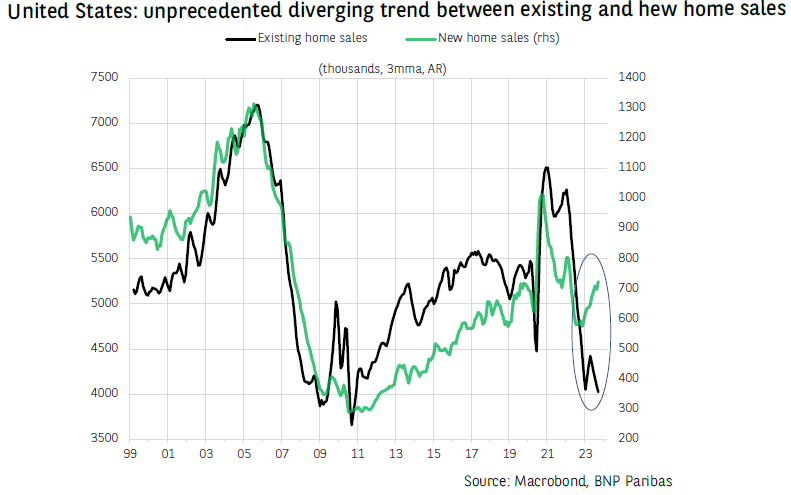
Chart

Download The Full Eco Flash

Author

BNP Paribas Team

BNP Paribas Team

BNP Paribas

BNP Paribas Economic Research Department is a worldwide function, part of Corporate and Investment Banking, at the service of both the Bank and its customers.


More from BNP Paribas Team
Share:

Editor's Picks

EUR/USD weakens to near 1.1900 as traders eye US data

EUR/USD eases to near 1.1900 in Tuesday's European trading hours, snapping the two-day winning streak. Markets turn cautious, lifting the haven demand for the US Dollar ahead of the release of key US economic data, including Retail Sales and ADP Employment Change 4-week average.

GBP/USD stays in the red below 1.3700 on renewed USD demand

GBP/USD trades on a weaker note below 1.3700 in the European session on Tuesday. The pair faces challenges due to renewed US Dollar demand, UK political risks and rising expectations of a March Bank of England rate cut. The immediate focus is now on the US Retail Sales data. 

Gold drifts lower as positive risk tone tempers safe-haven demand; downside seems limited

Gold drifts lower during the Asian session on Tuesday and snaps a two-day winning streak, though it lacks strong follow-through selling and shows some resilience below the $5,000 psychological mark amid mixed cues. The outcome of Japan's snap election on Sunday removes political uncertainty, which, along with signs of easing tensions in the Middle East, remains supportive of the upbeat market mood.

Bitcoin Cash trades lower, risks dead-cat bounce amid bearish signals

Bitcoin Cash trades in the red below $522 at the time of writing on Tuesday, after multiple rejections at key resistance. BCH’s derivatives and on-chain indicators point to growing bearish sentiment and raise the risk of a dead-cat bounce toward lower support levels.

Follow the money, what USD/JPY in Tokyo is really telling you

Over the past two Tokyo sessions, this has not been a rate story. Not even close. Interest rate differentials have been spectators, not drivers. What has moved USD/JPY in local hours has been flow and flow alone.

Bitcoin Cash trades lower, risks dead-cat bounce amid bearish signals

Bitcoin Cash (BCH) trades in the red below $522 at the time of writing on Tuesday, after multiple rejections at key resistance. BCH’s derivatives and on-chain indicators point to growing bearish sentiment and raise the risk of a dead-cat bounce toward lower support levels.