US Core PCE Preview: Why this is a lose-lose situation for the US Dollar
- Economists expect another moderate 0.3% increase in Core PCE, a critical inflation gauge.
- Such an outcome would reflect a deceleration in annual price rises, weighing on the US Dollar.
- Investors are convinced the Federal Reserve is gearing for a final rate hike, and that is unlikely to change.

A final scramble to the top, and it is all downhill from there – that is how markets see the path of the Federal Reserve's interest rate hikes. The upcoming May meeting will be the last in which the bank raises borrowing costs, and not even the Fed's favorite gauge of inflation could change it. That is the thinking, and it could lead to falls for the US Dollar.
Here is a preview of the Core Personal Consumption Expenditure (Core PCE) figures for March 2023, due out on Friday, April 28.
How Core PCE moves markets
The parallel Consumer Price Index (CPI) report is released before the PCE one, but the laggard inflation release still has substantial influence. First, and foremost, it is the one targeted by the world's most powerful central bank.
Secondly, it is considered to be more accurate – taking into account consumers' reactions to changes in prices. If high prices of pickup trucks push people to buy smaller vehicles, those compact cars will have a bigger weight in the PCE calculation, which is updated more frequently.
Third, this PCE report comes just five days before the Fed decision. Officials are forbidden to speak ahead of the upcoming publication, but markets will react.
Fourth, this is also the end of the week and the end of the month, which means higher volatility as money managers adjust their portfolios.
All in all, there is room for violent price action.
What Core PCE is expected to show and how markets may react
According to the economic calendar, Core PCE MoM, the most important figure, is expected to show an increase of 0.3% in March, repeating the rise from February. That represents an annualized increase of around 4%, below the recent YoY read of 4.6%, thus pointing to a decline. The yearly figure is set to fall from 4.6% to 4.5%.
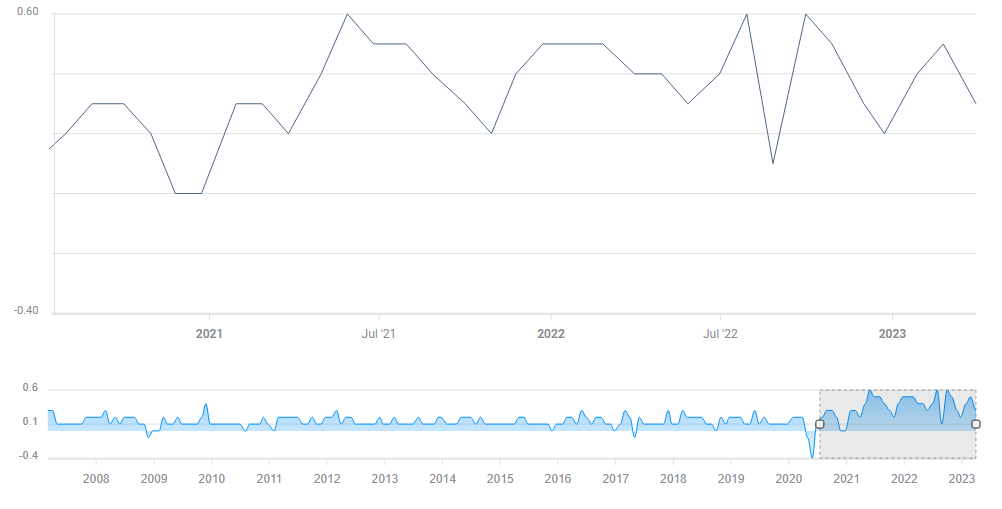
Source: FXStreet
The lagging nature of the PCE means that surprises are uncommon, and an outcome of 0.3% is likely. If it is not a shock, why would markets move? Apart from the reasons stated above, I think that a confirmation that inflation is falling would still be greeted with cheer.
It would also extend the trend of market calm following the banking crisis. And while weak PMIs, downbeat retail sales or poor home sales are bad news for the economy – while being good news for the path of rate hikes – falling inflation is 100% good news. Gold would also advance within range.
In case Core PCE surprises to the downside like in February, the rise in stocks and drop of the US Dollar would be more significant. A read of 0.2% would represent only 2.5% annualized underlying inflation. The precious metal would shine in such a scenario.
If my analysis is mistaken and inflation lifts its ugly head, the Greenback would advance and shares would struggle. Nevertheless, a 0.4% read would probably be insufficient to change minds. The Fed would still raise rates by 25 bps next week and refrain from blindly committing to a move in June. In such a case, any advance in the US Dollar would be limited. Gold would fall but then recover.
Final Thoughts
The "tortoise" of inflation reports tends to provide little surprises, but it still moves markets, even if it is not the "hare." There are good reasons to expect the US Dollar to fall and equities to rise in response to the data.
Premium
You have reached your limit of 3 free articles for this month.
Start your subscription and get access to all our original articles.
Author
Yohay Elam
FXStreet
Yohay is in Forex since 2008 when he founded Forex Crunch, a blog crafted in his free time that turned into a fully-fledged currency website later sold to Finixio.