US CB Consumer Confidence Preview: Focus on possible recession-related hints
- US Consumer Confidence, as measured by CB, is foreseen to improve in February to 108.5.
- Hotter-than-anticipated United States inflation maintains a fragile market sentiment.
- US Dollar Index’s positive momentum could accelerate once above 105.60.

The US Conference Board Consumer Confidence® metric will be released on Tuesday, February 28, and is expected to improve in February to 108.5 from 107.1 in January. The index decreased in January from an upwardly revised figure in December 2022, as consumers positively assessed the current situation but were gloomy about income, business and labor market conditions expectations. The Expectations index currently stands at 77.8, and a reading below 80 often signals a recession within the next year, according to the official report. Finally, it notes that “consumers’ expectations for inflation ticked up slightly from 6.6% to 6.8% over the next 12 months, but inflation expectations are still down from its peak of 7.9% last seen in June.”
Inflation in the United States, as measured by the Consumer Price Index (CPI), has declined sharply ever since peaking at 9.1% YoY in June 2022. That led to speculation the US Federal Reserve (Fed) could ease the pace of monetary tightening and even pivot. However, the latest CPI reading suggests that the pace of slowing pace prices pressure is not enough to put an end to Fed’s adjustments.
Furthermore, on Friday, the US published the January Personal Consumption Expenditures (PCE) Price Index, which rose 5.4% YoY and 0.6% MoM, surpassing expectations. The US Federal Reserve’s favorite inflation gauge, the core PCE Price Index, rose 4.7% YoY, missing the 4.3% expected and higher than the previous 4.6%. As inflation pressures remain high, the US central bank will maintain its tightening path, which in turn, lifts the odds for an economic setback.
USD possible scenarios
Worse-than-anticipated Consumer Confidence will likely fuel recession-related concerns and weigh on the market’s mood, which may lead to US Dollar gains. Monday’s positive mood seems quite fragile, moreover, after US Durable Goods Orders plunged in January by more than expected, down by 4.5% MoM. On the other hand, an upbeat figure should do little to boost the mood, as speculative interest will maintain the focus on higher-than-expected inflation data.
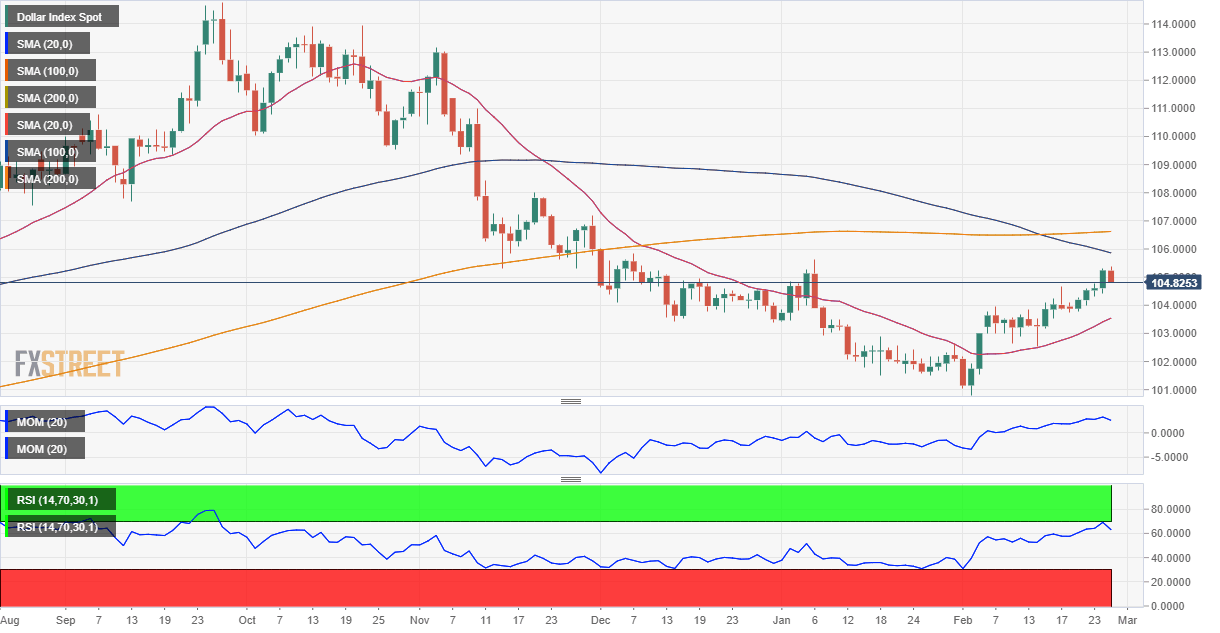
The Dollar Index is approaching its yearly high posted in early January at 105.62. The index has bottomed this year to 100.81, its lowest since April 2022, as the Greenback suffered in the last quarter of the year from speculation the US central bank was about to turn the corner. As the scene changes, so does the DXY trend.
A break through the mentioned yearly high could lead to substantial gains in the near term as the next relevant resistance comes at 107.25. A slide below 103.65, on the other hand, the immediate support area, could result in the DXY falling towards the 102.50 price zone.
Premium
You have reached your limit of 3 free articles for this month.
Start your subscription and get access to all our original articles.
Author
Valeria Bednarik
FXStreet
Valeria Bednarik was born and lives in Buenos Aires, Argentina. Her passion for math and numbers pushed her into studying economics in her younger years.