|

US banks: Reactivation of the Fed’s reverse repo facility, a factor in reducing balance sheets
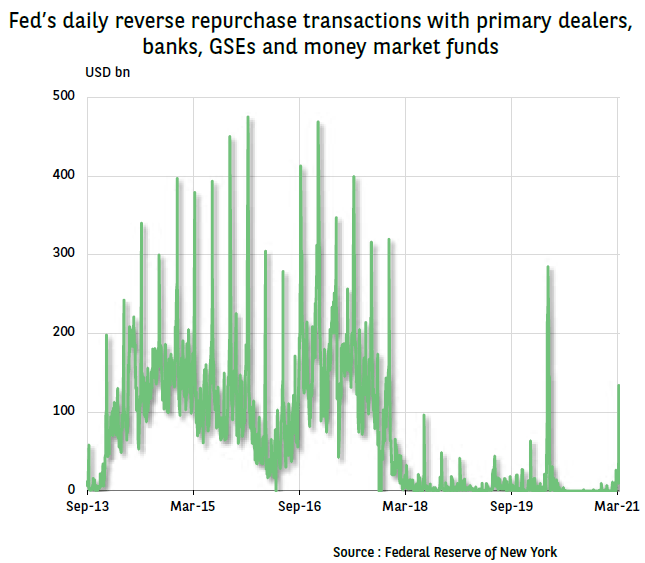
On 17 March, the US Federal Reserve (Fed) raised the ceiling on transactions under its Reverse Repo Program (RRP). Each eligible counterparty can now take, on each trading day, up to USD 80 billion in Treasuries held by the Fed on repo, from a limit of USD30 billion previously.
Fed

Introduced in the autumn of 2013, one year before the ending of QE3 (the Fed’s third quantitative easing programme) and two years before the beginning of the post-crisis monetary tightening, this facility saw high levels of participation by money market funds (with interest rates of between 0.01% and 0.07% up to the end of 2015) and helped establish a floor for short-term market interest rates. Against a background of abundant central bank liquidity, the programme has the effect of reducing downward pressure on short-term rates by encouraging money market funds and GSEs to “lend“ part of their cash to the Fed rather than on markets (repo, Fed Funds) where demand has dried up. Although the reactivated RRP has not so far seen much uptake (the interest rate paid is zero), it could allow, over the coming weeks, a slimming down of bank balance sheets. The penalty that certain banks are preparing to introduce on deposits from institutional clients, in a bid to reduce their balance sheets, could push this cash towards money market funds and from there, via the reactivation of the RRP, to the Fed.

Download The Full EcoFlash

Author

BNP Paribas Team

BNP Paribas Team

BNP Paribas

BNP Paribas Economic Research Department is a worldwide function, part of Corporate and Investment Banking, at the service of both the Bank and its customers.


More from BNP Paribas Team
Share:

Editor's Picks

EUR/USD stabilizes near 1.1800 as markets focus on geopolitics

EUR/USD stays defensive around 1.1800 in the second half of the day on Thursday. The US Dollar stabilizes, following the recent decline led by tariff uncertainty, capping the pair's upside. All eyes now remain on the US-Iran nuclear talks after ECB President Lagarde's testimony failed to impress Euro bulls. 

GBP/USD holds above 1.3500, struggles to gain traction

GBP/USD rebound from session lows but stays below 1.3550 on Thursday. The cautious market stance helps the US Dollar stay resilient against its rivals and makes it difficult for the pair gather recovery momentum. Investors await headlines that will come out of the US-Iran nuclear talks.

Gold clings to small gains near $5,200 ahead of US-Iran talks

Gold trades marginally higher on the day above $5,150 on Thursday as investors refrain from taking large positions. The US and Iran will hold the next round of nuclear talks in Geneva on Thursday, outcome of which could have significant implications for risk perception.

Stellar: Relief bounce fades as bearish undertone persists

Stellar is trading around $0.16 at the time of writing on Thursday after rebounding more than 8% in the previous day. Derivatives data paints a negative picture as XLM’s short bets hit a monthly high while Open Interest continues to decline.

The one thing everyone is on the lookout for is US action of some sort against Iran

The FX market is minestrone soup these days. It is befuddled by conflicting data, rumors and small stories exaggerated out of proportion, and Trump-generated uncertainty. 

Solana strikes key resistance with double-digit gains

Solana trades at $88 at press time on Thursday, after an 11% upswing the previous day within a broader consolidation range of roughly three weeks. Institutional demand for Solana heightens as US spot SOL Exchange Traded Funds record $30 million of inflow on Wednesday.