|

United States: Money supply slumps

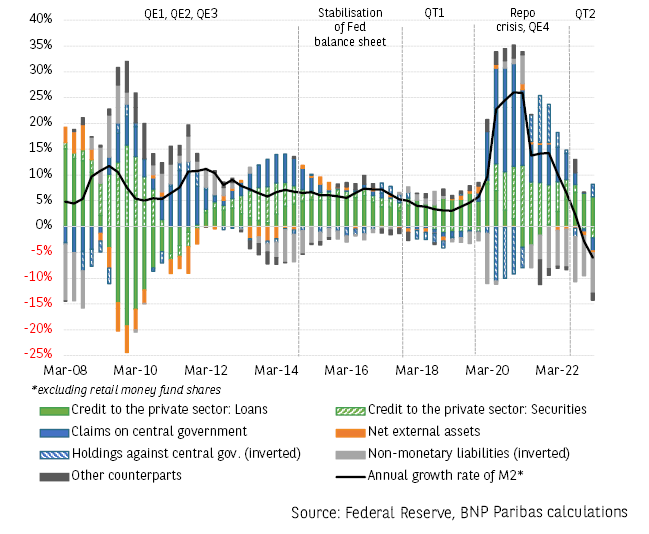
In March 2023, the M2 measure of money supply contracted for the fifth consecutive month in the United States (-4.5% over one year). The identification of the main sources of monetary creation/destruction reveals the impact of the restrictive monetary environment and the resulting trade-offs.

First, the credit channel (green histogram), the traditional engine of deposit creation, has been weakening for several months (tighter lending criteria and lower demand for bank loans). Second, US households are largely subscribing to new issues of Treasury debt and mortgage-backed securities, so that the Fed’s balance sheet reduction (Quantitative Tightening, QT) is destroying some of the bank deposits created by the latest quantitative easing (QE) (blue and hash green histograms). The tightening of monetary policy is also conducive to an expansion of commercial banks’ long-term resources (grey histogram): term deposits and secured loans (advances) from the Federal Home Loan Banks (FHLB). Finally, the Fed’s repurchase agreements with money market funds (Overnight Reverse Repo Facility), in return for generous remuneration, continue to sterilise part of the money previously created (grey histogram). In March, fears about the soundness of some regional banks led to the flight of USD 400 billion in cash from deposit accounts to shares in money market funds, which are better paid. However, 80% of these resources were “lent” by the funds to the Fed or invested in FHLB debt securities, and thus ultimately sterilised or converted into long-term bank debt through advances, thereby reducing the money supply.
Chart

Download The Full Eco Flash

Author

BNP Paribas Team

BNP Paribas Team

BNP Paribas

BNP Paribas Economic Research Department is a worldwide function, part of Corporate and Investment Banking, at the service of both the Bank and its customers.


More from BNP Paribas Team
Share:

Markets move fast. We move first.

Orange Juice Newsletter brings you expert driven insights - not headlines. Every day on your inbox.

By subscribing you agree to our Terms and conditions.

Editor's Picks

EUR/USD trades with negative bias around 1.1730 amid recovering USD; downside seems limited

The EUR/USD pair kicks off the new week on a softer note, though it remains within striking distance of the highest level since early October, touched last Thursday. Spot prices currently trade around the 1.1730 region, down less than 0.10% for the day.

GBP/USD holds steady above mid-1.3300s as traders await key data and BoE this week

The GBP/USD pair remains on the defensive during the Asian session on Monday, though it lacks bearish conviction and holds above the 200-day Simple Moving Average pivotal support. Spot prices currently trade around the 1.3360 region, nearly unchanged for the day.

Gold regains traction toward $4,350 in the final full week of 2025

Gold price picks up bids once again toward $4,350 in Asian trading on Monday. The precious metal extends its upside to the highest since October 21 amid the prospect of interest rate cuts by the US Federal Reserve next year. The delayed US Nonfarm Payrolls report for October will be in the spotlight later on Tuesday. 

Top Crypto Losers: DASH, SPX, PENGU – Privacy and meme coins lose ground

Altcoins, including Dash, SPX6900, and Pudgy Penguins, are leading losses as the broader cryptocurrency market remains cautious ahead of the macroeconomic data releases, such as the US Nonfarm payroll report, CPI data, and the Bank of Japan’s rate-hike decision.

Big week ends with big doubts

The S&P 500 continued to push higher yesterday as the US 2-year yield wavered around the 3.50% mark following a Federal Reserve (Fed) rate cut earlier this week that was ultimately perceived as not that hawkish after all. The cut is especially boosting the non-tech pockets of the market.

Aave Price Forecast: AAVE primed for breakout as bullish signals strengthen

Aave (AAVE) price is trading above $204 at the time of writing on Friday and approaching the upper boundary of its descending parallel channel; a breakout from this structure would favor the bulls.