Two signs stock market investors are preparing for (much?) higher interest rates

It's become a bit passé by now to highlight the big hawkish shift in the traders' expectations for next week's FOMC meeting; unless you've been living under a rock, you know the market-implied likelihood of a 25bps rate hike has shifted from relatively unlikely (<40%) to a nearly done deal (>85%) in the last couple of weeks, driven by a run of solid economic data and more importantly, essentially-unanimous hawkish "Fedspeak" in favor of such a move.
Perhaps a more important development has been the simultaneous increase in the amount of tightening priced in, not just the timing of the year's first interest rate rise. As of writing, the CME's FedWatch tool shows that Fed Funds Futures traders think it's more likely than not that the Fed will be able to raise interest rates thrice this year, making it the first time in years that the Fed has not been far more optimistic than the market as a whole!
So are these hawkish expectations warranted?
At Faraday Research, we don't necessarily feel that we have an edge interpreting the myriad economic reports that are released on a daily basis. Instead, we pride ourselves on integrating price information from multiple markets to confirm or deny our views. By utilizing the principles of intermarket analysis and relationships between different subsets of stocks, bonds, commodities and currencies, we increase the probability of successfully separating the signal from the noise in the markets' day-to-day price action.
Applying these principles to the short-term treasury market (SHY), which is most sensitive to Fed expectations, shows that, if anything, the bond market's expectations may be too conservative!
Certain sectors of the stock market tend to be closely correlated with the outlook for interest rates. For instance, banking stocks tend to make money on the "net interest margin" between their liabilities (checking and savings accounts, CDs, etc) and their assets (mortgages issued, car loans, etc). This margin tends to rise with the general level of interest rates, so outperformance of the banking sector (KBE) relative to the broader market can provide an indication of stock market investors' outlook for interest rates.
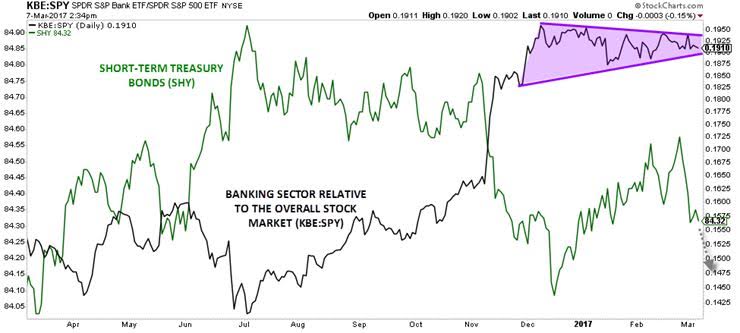
As the above chart shows, the banking sector has been outperforming the broader stock market since July. More importantly, the sector is coiling on a relative basis and could be on the verge of a big bullish breakout, which would suggest that stock investors are expecting an even more aggressive tightening timeline from the US central bank.
Another strong intermarket relationship with interest rates is the relative performance of Real Estate Investment Trusts (REITs) against the overall market. Because REITs are legally obligated to pay out a high proportion of their earnings as dividends, they tend to have higher yields than other stocks. The appeal of these high yields waxes and wanes depending on where stock investors think interest rates are headed. Right now, the weak relative performance of REITs (XLRE:SPY) suggests that short-term interest rates could be heading higher (SHY lower):
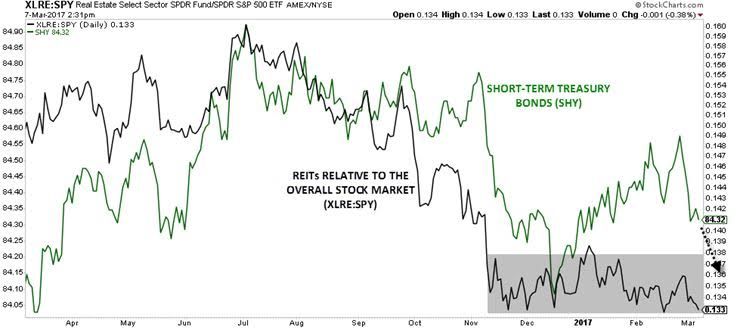
Of course, it's often said that the bond market is the world's "smartest" market, so there's definitely a chance that the hawkish intermarket signals offered up by the banking and REIT sectors are a false alarm. That said, as long as banks continue to outperform, and REITs continue to underperform, the overall stock market, the path of least resistance for interest rates will remain higher.
Author
Matt Weller, CFA, CMT
Faraday Research
Matthew is a former Senior Market Analyst at Forex.com whose research is regularly quoted in The Wall Street Journal, Bloomberg and Reuters. Based in the US, Matthew provides live trading recommendations during US market hours, c

















