Turkey sees an improvement in the underlying services inflation trend


While annual inflation in Turkey dropped further last month, the underlying trend remained elevated, albeit recording a drop in comparison to September thanks to a moderation in services inflation.
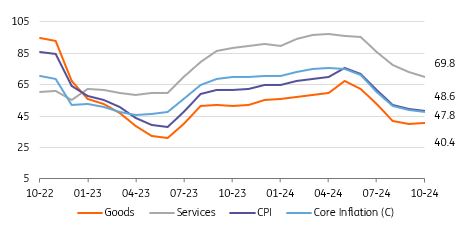
Turkish inflation was 2.9% in October, higher than the market consensus of 2.5%. The annual figure, however, has maintained its declining trend and fell to 48.6% from 49.4% a month ago, given that favourable base effects (as it was 3.43% in October 2023) were more apparent in the second half of this year. Cumulative inflation in the first 10 months of the year reached 39.8%, exceeding the Central Bank of Turkey's 38% forecast for the year (with a forecast range of 34-42%).
PPI stood at 1.3% month-on-month, reflecting a decrease to 32.2% year-on-year compared to the previous month. The data implies further moderation in cost pressures with supportive currency developments (USD/TRY up by slightly higher than 16% on a year-to-date basis). Global commodity prices, and particularly oil prices, in the current geopolitical backdrop will likely remain the key determinant of the PPI trend ahead.
Core inflation (CPI-C) came in at 2.8% MoM, moving down to 47.8% on an annual basis, supported by the relatively slow-moving FX basket and supportive base from the last year. While cost-push pressures are moderating as evidenced by the PPI data, pricing behaviour and inertia in services have remained key risk factors, for the pace of the current disinflation process.
Inflation outlook (%)
Source: TurkStat, ING
Regarding the underlying trend, the Turkish Statistical Institute will release seasonally adjusted headline CPI and core indicators tomorrow. According to our calculations, the October headline figure, on a seasonally adjusted basis, recorded a sequential decline, thanks to a marked slowdown in the services inflation underlying trend. However, the CBT expects a drop in seasonally adjusted monthly inflation to below 1.5% in the last quarter of this year, and to attain this level the monthly outcome should be less than 1% in November and December from above the 2.5% level in October.
The details of the breakdown include:
-
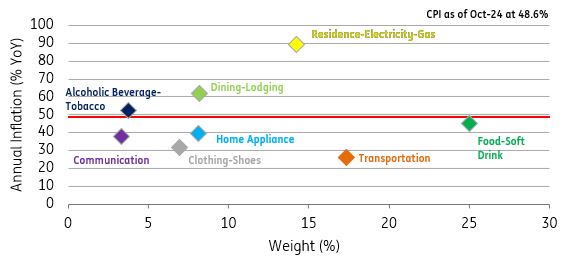
The food group was a major contributor to the headline with 1.03ppt. Compared to the same month of last year, unprocessed food inflation recorded a higher increase (6.8% vs 4.1% last year) and led to an upward move in food inflation, while processed food prices showed a deceleration (2.2% vs 2.5% last year). Accordingly, monthly food inflation at 4.3% was one of the factors that contributed to a higher-than-expected increase in October.
-
This was followed by clothing with a 0.85ppt impact given the highest October reading in the current inflation series, more than the usual seasonality.
-
Housing, pulling the headline up by 0.48ppt, was the third contributor, reflecting the impact of rents.
As a result, goods inflation inched up to 40.4% YoY, while core goods inflation, a better indicator of the trend, stood at 28.5% YoY. Services, which is less sensitive to currency movements but more impacted by domestic demand and minimum wage increases, is now below 70% YoY, down from 72.9% a month ago thanks to price drops in transportation services.
Annual inflation in expenditure groups
Source: TurkStat, ING
Read the original analysis: Turkey sees an improvement in the underlying services inflation trend
Author
Muhammet Mercan
ING Economic and Financial Analysis
Muhammet Mercan is Chief Economist at ING, Turkey. Previously, he was an economist at Yapi Kredi and HSBC Securities. He is a part-time lecturer at Bilgi University and holds a PhD degree in banking from Marmara University.