The prospects of the Oil market in light of OPEC's decisions


In June 2024, a pivotal OPEC+ meeting took place, leading to significant decisions that will shape the future of the global oil market. The group, which includes major oil-producing countries such as Saudi Arabia, Russia, and several others, agreed to reduce their collective oil production target to 40.46 million barrels per day, a cut of 1.4 million barrels from previous levels. This strategic move aims to stabilize the volatile oil market amidst various economic and geopolitical challenges.
Financial markets analysts from FBS dive into the ways these events can affect the energy market and highlight the factors traders and investors should pay attention to.
Key Decisions and Rationale
The June 2024 OPEC+ meeting made a critical decision to adjust oil production levels. The group agreed to reduce its target production volume to 40.46 million barrels daily, marking a significant cut of 1.4 million barrels compared to previous quotas. This decision encompasses substantial voluntary production cuts by several key member countries, including:
- Saudi Arabia: Committed to reducing output by 1 million barrels per day.
- Russia: Announced additional cuts totaling 500,000 barrels per day, including 200,000 barrels from oil and oil product exports.
- Other countries: Contributions from Iraq (220,000 barrels), UAE (163,000 barrels), Kuwait (135,000 barrels), Kazakhstan (82,000 barrels), Algeria (51,000 barrels), and Oman (42,000 barrels).
The primary objective of these cuts is to balance global supply and demand. By reducing output, OPEC+ aims to prevent an oversupply that could drive down prices, which is essential for the economies of oil-dependent countries like Saudi Arabia and Russia. Stabilizing prices helps these nations manage their budgets and economic policies more effectively.
Geopolitical considerations also play a crucial role in these decisions. OPEC+ must navigate a complex landscape marked by sanctions, conflicts, and the economic policies of major oil-producing countries outside the alliance, such as the USA, Brazil, and Iran. These external pressures require a coordinated response to maintain market stability and mitigate the impact of geopolitical challenges.
The United Arab Emirates was critical in the OPEC+ decision to extend deep oil production cuts into 2025. Recognizing its growing production capacity, OPEC+ agreed to increase the UAE's output target by 0.3 million barrels per day, gradually boosting production from its current level of 2.9 million barrels per day. This decision reflects the UAE's strategic importance and push for a more significant share of production. Additionally, the agreement deferred discussions on individual capacity targets until November 2025, a move necessitated by the complexities of assessing accurate production data from countries like Russia, which is impacted by ongoing sanctions.
Market Reaction
The market's reaction to OPEC+'s decision to extend oil production cuts into 2025 has been largely subdued, reflecting a mix of skepticism and cautious optimism. Following the announcement, Brent crude prices slightly declined, settling around $78 per barrel, down from the previous level of $80. WTI crude also experienced a drop, closing at approximately $76 per barrel from a recent high of $93.
The market largely anticipated Saudi Arabia and Russia's extension of cuts. Saudi Arabia confirmed it would maintain its voluntary reduction of 1 million barrels per day, while Russia would continue its cut of 500,000 barrels per day. This predictability meant traders had already factored in the impact on prices, leading to a muted response when the announcement was made.
According to FBS experts, concerns over global economic conditions, particularly the economic slowdown in China, a major oil importer, have heavily influenced market sentiment. Despite the significant production cuts, the market remains wary of slow demand growth. The International Energy Agency (IEA) projects that demand for OPEC+ oil will average 41.9 million barrels per day in 2024, lower than OPEC+'s expectations of 43.65 million barrels per day. This discrepancy underscores the uncertainty surrounding global demand forecasts.
Rising oil inventories in developed economies have also contributed to the subdued market reaction. Increased stock levels can buffer against supply disruptions, reducing the immediate impact of production cuts on prices. This factor has tempered the potential for a significant price increase following the OPEC+ announcement.
FBS financial markets analysts have highlighted a general skepticism about the efficacy and enforcement of the announced cuts. Historical issues with compliance among some OPEC+ members add to the market's cautious stance. This skepticism is reflected in the relatively flat response to oil prices despite the announcement of deep cuts.
Long-Term Prospects
The decision by OPEC+ to extend its deep oil production cuts into 2025 is poised to significantly influence the global oil market. This strategic move comes in response to ongoing economic uncertainties, slow demand growth, and high interest rates, which have collectively pressured oil prices. The cuts involve maintaining a total reduction of 5.86 million barrels per day (bpd), with 3.66 million bpd extended until the end of 2025 and an additional 2.2 million bpd of voluntary cuts continuing until September 2024 before being phased out gradually over the following year.
Analysts from major financial institutions have offered varied insights into the potential impacts of these extended cuts. Goldman Sachs projects that oil prices could remain robust, averaging between $90 and $100 per barrel through 2024. This forecast is predicated on the belief that the sustained cuts will help to draw down global inventories and support higher prices. However, this optimistic outlook is tempered by uncertainties in global demand recovery, particularly in key markets like China and Europe, which continue to face economic challenges.
JPMorgan Chase analysts have expressed a more cautious view, highlighting market skepticism about the effectiveness of these measures. The initial muted price response, with Brent crude settling around $78 per barrel, reflects doubts about compliance among OPEC+ members and the potential for increased production from non-OPEC+ countries, especially the US Historical issues with adherence to production quotas and the agility of US shale producers to quickly ramp up output in response to higher prices contribute to this skepticism.
The US Energy Information Administration (EIA) has adjusted its forecasts following the OPEC+ announcement. It predicts that Brent crude prices will stabilize around $90 per barrel through 2024 before declining to an average of $85 per barrel in 2025 as global production increases. This forecast acknowledges the stabilizing effect of the cuts but also considers potential supply increases from other regions.
This OPEC+ decision is crucial for several reasons. First, it provides a clearer framework for market stability over the next 18 months, essential for better planning and forecasting in the energy sector. The cuts aim to balance global supply and demand, preventing an oversupply that could further depress prices. Additionally, the phased approach to ending the cuts gives the market a predictable timeline, helping to mitigate price volatility.
Technical analysis
XBRUSD broke the downtrend line in a long-term bearish trend, but the price has fallen again and is testing it. The price dropped to MA200, an important support area, creating two possible scenarios.
- If Brent breaks the MA200 and falls below the 80.00 support area, a fall to 70.00 will start;
- However, in case of a bounce from support, the price will recover to the resistance level of 90.00;
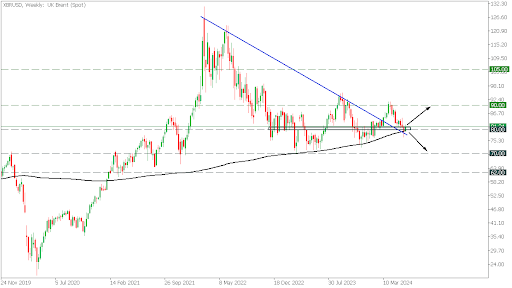
XBRUSD, Weekly
FBS underlines that for the global energy market, the implications are significant. Sustained higher oil prices, supported by these cuts, can increase revenues for oil-exporting countries, aiding their economic stability and funding critical national projects. However, these higher prices could contribute to inflationary pressures for energy-importing nations, potentially slowing economic growth. This dynamic is particularly challenging for countries still recovering from the economic impacts of the COVID-19 pandemic.
Conclusion
The decisions made by OPEC+ in June 2024 to cut oil production by 1.4 million barrels per day aim to stabilize the global oil market amidst various economic and geopolitical challenges. While immediate market reactions have shown skepticism, with oil prices dropping initially, long-term forecasts suggest a potential stabilization with prices averaging around $90 per barrel for Brent crude, contingent on strict compliance by member countries and external economic conditions. Significant production increases from non-OPEC+ countries and evolving geopolitical dynamics will also play critical roles in shaping the future oil market, necessitating traders' vigilant monitoring and strategic planning.
Disclaimer: This material does not constitute a call to trade, trading advice or recommendation and is intended for informational purposes only.
Author
FBS Team
FBS
FBS team is a group of professional analysts focused on Forex, stock, and commodity markets. Each expert possesses a years-long experience in fundamental and technical analysis.