|

The effects of the labour-market reforms in Spain are clearly visible

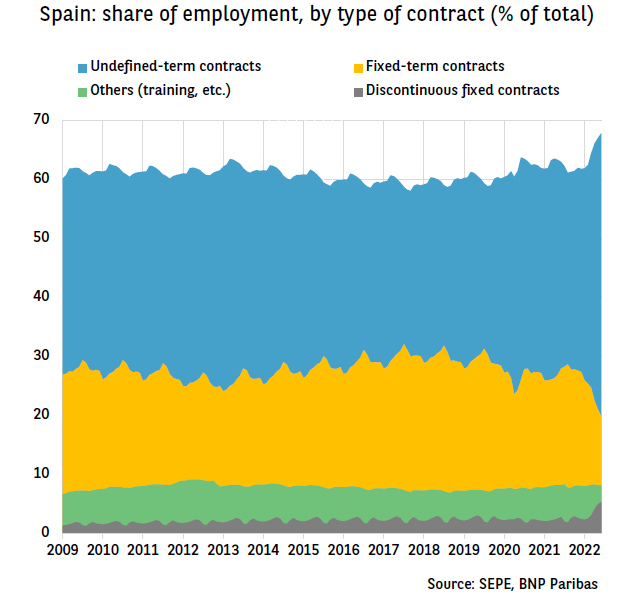
Spain’s labour market is still delivering pleasant surprises, with a net job creation rate of almost 263,000 during the first half of 20221. However, beyond these rising numbers, the major change on the labour market was in recruitment processes in February as a result of employment law reforms, which most notably set out to tighten the conditions for using precarious short-term contracts.

These reforms have produced immediate results, with a leap of more than 1,130,000 in the number of permanent contracts since the beginning of the year, which is an increase of 12%. These increases have been particularly large in the accommodation/restaurant (+32.5% over the last six months), construction (+30.8%) and arts and leisure activity (+18.9%) sectors, which have traditionally been the main users of these precarious short-term contracts. By contrast, the number of fixed-term contract jobs has fallen by 1,083,000 (-26%) during the first half-year. « Discontinuous fixed contracts » also grew very strongly (+118%), with this type of contract offering more flexibility around organising working time than permanent contracts. Against the current challenging economic backdrop, tightening recruitment conditions could have been an obstacle to recruitment. However, this has not happened and shows how well the Spanish economy is holding up against the economic shocks so far.
Chart

Download The Full Eco Flash

Author

BNP Paribas Team

BNP Paribas Team

BNP Paribas

BNP Paribas Economic Research Department is a worldwide function, part of Corporate and Investment Banking, at the service of both the Bank and its customers.


More from BNP Paribas Team
Share:

Editor's Picks

EUR/USD hovers around 1.1850 ahead of FOMC Minutes

EUR/USD stays on the back foot around 1.1850 in the European session on Wednesday, pressured by renewed US Dollar demand. Traders now look forward to the Minutes of the Fed's January monetary policy meeting for fresh signals on future rate cuts. 

GBP/USD defends 1.3550 after UK inflation data

GBP/USD is holding above 1.3550 in Wednesday's European morning, little changed following the UK Consumer Price Index (CPI) data release. The UK inflation eased as expected in January, reaffirming bets for a March BoE interest rate cut, especially after Tuesday's weak employment report. 

Gold retains bullish bias amid Fed rate cut bets, ahead of Fed Minutes

Gold sticks to modest intraday gains through the early European session, reversing a major part of the previous day's heavy losses of more than 2%, to the $4,843-4,842 region or a nearly two-week low. That said, the fundamental backdrop warrants caution for bulls ahead of the FOMC Minutes, which will look for more cues about the US Federal Reserve's rate-cut path. 

Pi Network rally defies market pressure ahead of its first anniversary

Pi Network is trading above $0.1900 at press time on Wednesday, extending the weekly gains by nearly 8% so far. The steady recovery is supported by a short-term pause in mainnet migration, which reduces pressure on the PI token supply for Centralized Exchanges. The technical outlook focuses on the $0.1919 resistance as bullish momentum increases.

Mixed UK inflation data no gamechanger for the Bank of England

Food inflation plunged in January, but service sector price pressure is proving stickier. We continue to expect Bank of England rate cuts in March and June. The latest UK inflation read is a mixed bag for the Bank of England, but we doubt it drastically changes the odds of a March rate cut.

Top 3 Price Prediction: Bitcoin, Ethereum, and Ripple face downside risk as bears regain control

Bitcoin, Ethereum, and Ripple remain under pressure on Wednesday, with the broader trend still sideways. BTC is edging below $68,000, nearing the lower consolidating boundary, while ETH and XRP also declined slightly, approaching their key supports.