The 70-Year Globe Buster is Almost Over


Conspiracy theorists are out in force, proclaiming the Notre Dame Cathedral fire an intentional act against the Catholic faith just days before Easter. Paris officials denounced the idea, pointing to the more likely cause being an unfortunate accident during the $6.8 million renovation project that was under way in the landmark.
I don’t believe the fake news either, but it speaks volumes that everyone and their uncle was so eager to jump on the conspiracy train. It’s exactly what I’d expect during this negative arm of the geopolitical cycle, which has been ongoing since 2001.
And one thing I learned from my co-author of Zero Hour, Andrew Pancholi, is that in many cycles, every other iteration is more powerful. Basically, the next cycle builds on its predecessor to create a crescendo.
The 90-year Bubble Buster that I’ve talked of often since identifying the Dark Window last year, is the perfect example. It’s the result of the second iteration of the 45-year Technology Cycle.
The 70-year Globe Buster is another, being born out of the second iteration of the 35-year Geopolitical Cycle.
This cycle has truly been brutal…
Do yourself a favor: look at the timeline of geopolitical events in Sale of a Lifetime. It doesn’t contain every event, there simply wasn’t room. And it only dates to 2016, when we published the book. Still, it’s shocking to see.
That’s the double Geopolitical Cycle – the 70-year Globe Buster – at work.
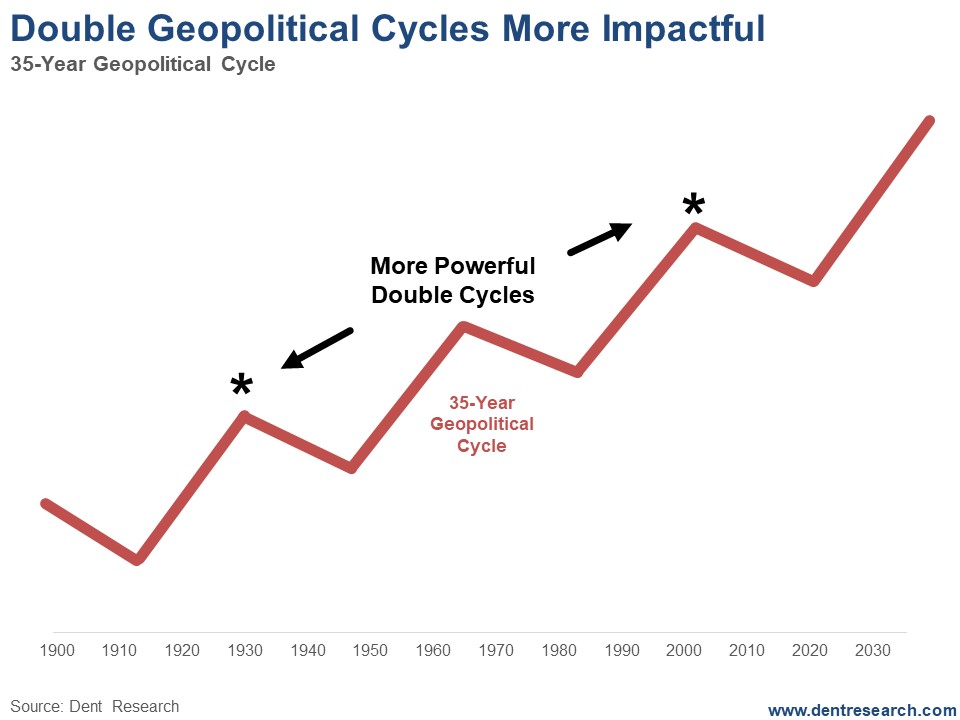
This cycle has a positive rise for about 17 or 18 years, which we enjoyed between 1983 and 2000. During that time, nothing significant went wrong in the world.
Then its negative arm began in 2001. What hasn’t gone wrong since then?
The first shock was 9/11. Since then, endless terrorist events have rocked the globe. There’s been one civil war after the next in the Middle East. There was the Arab Spring. Mass shootings seem to have become common place in the U.S. And, in recent years, we’ve witnessed a barrage of white supremacist terror events, with the recent New Zealand one being the worse.
The good news is…
This cycle bottoms out in late 2019 or early 2020. As it shifts back into the upswing, things will start to get better again… like the slow lifting of the Cold War with Gorbachev from 1983 forward.
The road to the crescendo…
The previous Geopolitical Cycle that peaked in 1965 and turned down around 1966 into 1982 saw the Cold War with Russia, the Vietnam War, and the Civil Rights Movement. All challenging and disruptive, but not as terrifying as terrorism.
Go back to the last double cycle and we see a peak in 1930 that turned down from 1931 into 1947. During that negative arm, we saw the Great Depression, major trade wars, and World War II. Talk about a crescendo.
So, like I said, the good news is that we’re nearly through the worst of this 70-year Globe Buster. And it can’t come soon enough. I’m sick of the Islamic radicals and the white supremacists who react to them. Both groups are angry for their own reasons, but enough is enough.
We’re on the cusp of the greatest reforms that will arise from the confluence of a crashing economy in 2020 and a return to power of the democrats as a result.
Big changes are coming, especially between 2021 and 2024, in the next administration… changes that make history, just like those the world saw at the end of the last 250-year Revolution Cycle.
And through it all, we’ll take advantages of the opportunities that come along with it, from those the Dark Window will hand us this year, to the fire sale we’ll enjoy after the next crash.
Buckle in… and stay tuned.
Author
Harry S. Dent, MBA
Dent Research
Harry S. Dent Jr. studied economics in college in the ’70s, but found it vague and inconclusive. He became so disillusioned by the state of his chosen profession that he turned his back on it.