|

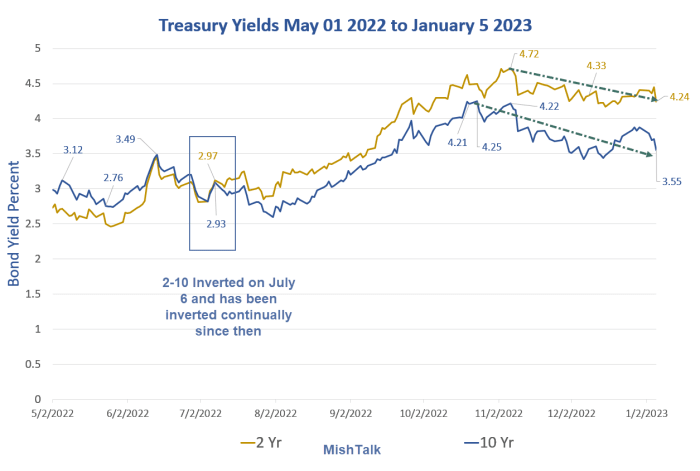
The 2-10 treasury yield spread note has been inverted since July 6, 2022

Let's explore continual inversions on the 2-year to 10-year and 3-month to 10-year treasuries.
3-Month to 30-Year
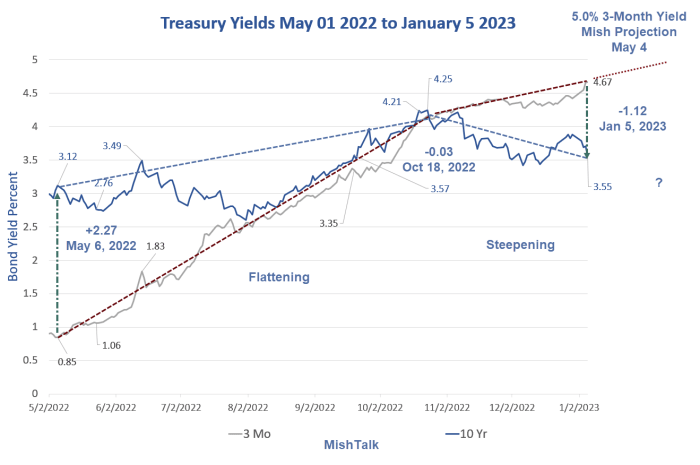
The 3-month to 30-year inverted on October 18, 2022 and has been inverted ever since.

Treasury Yield Spreads May 01 2022 to January 5 2023
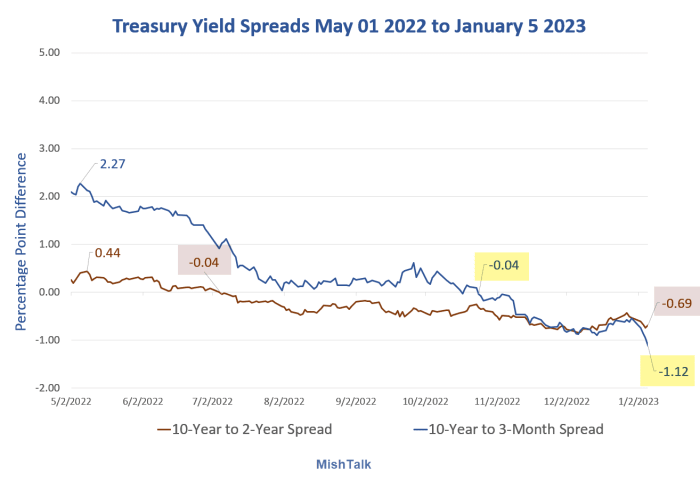
The 2-year to 10-year inversion is one of the most widely followed recession indicators. It has been inverted continually since July 6, 2022.

The 3-month to 10-year inversion is even more extreme. It has been continually inverted since October 18, 2022. 

Terrible Economic Data

The December jobs report was anemic and the ISM services PMI was an outright disaster.

  • December Jobs: Employment Rises by 717,000 All of Them Part Time
  • ISM Services Plunges 6.9 Points Into Contraction, Another Recession Warning
  • Stock Market Cheers Weak Job Report, But Big Picture Still Looks Grim
 

Although housing in the gutter and the rest of the economy sinking fast, the Fed is committed to a course of action to maintain credibility.

To steepen in the traditional sense first requires the curve to flatten. With the Fed holding rates higher for longer, that won't easily happen unless the Fed panics due to a credit event.

Given that the Fed has repeatedly vowed to keep rates higher for longer regardless of economic slowing, do not expect the curve to steepen other than by deeper inversions until recession hits. 

For more discussion on this idea please see Hello Curve Watchers, the Yield Curve is Steepening, Just Not in the Normal Sense

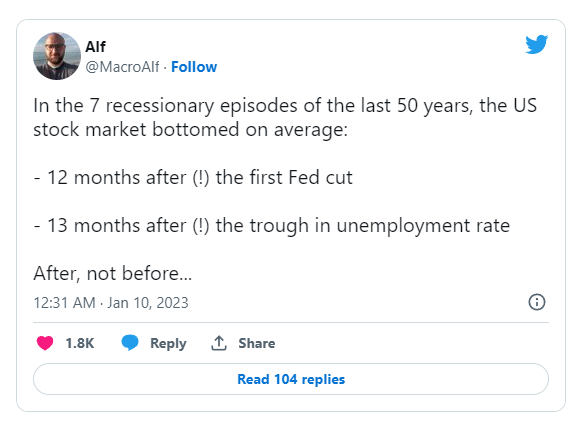
Here is a key idea regarding the stock market:
fxsoriginal

Author

Mike “Mish” Shedlock's

Mike “Mish” Shedlock's

Sitka Pacific Capital Management,Llc

More from Mike “Mish” Shedlock's
Share:

Markets move fast. We move first.

Orange Juice Newsletter brings you expert driven insights - not headlines. Every day on your inbox.

By subscribing you agree to our Terms and conditions.

Editor's Picks

EUR/USD gathers strength above 1.1750 as Fed rate cut prospects pressure US Dollar

The EUR/USD pair trades in positive territory around 1.1775 during the early Asian session on Monday. The prospect of a US Federal Reserve rate cut in 2026 weighs on the US Dollar against the Euro. Markets brace for US President Donald Trump to nominate a Fed chair to replace Jerome Powell, whose term ends in May. 

GBP/USD edges lower near 0.7400, eyes Fed rate cut outlook

GBP/USD edges lower after a gap-up open, trading around 0.7410 during the Asian hours on Monday. However, the pair may gain ground as the US Dollar faces challenges, which could be attributed to growing expectations of two more rate cuts by the Federal Reserve in 2026.

Gold retreats from record highs, trades below $4,500

Gold retreats after setting a new record-high above $4,520 earlier in the day and trades in a tight range below $4,500 as trading volumes thin out ahead of the Christmas break. The US Dollar selling bias remains unabated on the back of dovish Fed expectations, which continues to act as a tailwind for the bullion amid persistent geopolitical risks.

Bitcoin slips below $87,000 as ETF outflows intensify, whale participation declines

Bitcoin price continues to trade around $86,770 on Wednesday, after failing to break above the $90,000 resistance. US-listed spot ETFs record an outflow of $188.64 million on Tuesday, marking the fourth consecutive day of withdrawals.

Economic outlook 2026-2027 in advanced countries: Solidity test

After a year marked by global economic resilience and ending on a note of optimism, 2026 looks promising and could be a year of solid economic performance. In our baseline scenario, we expect most of the supportive factors at work in 2025 to continue to play a role in 2026.

Avalanche struggles near $12 as Grayscale files updated form for ETF

Avalanche trades close to $12 by press time on Wednesday, extending the nearly 2% drop from the previous day. Grayscale filed an updated form to convert its Avalanche-focused Trust into an ETF with the US Securities and Exchange Commission.