|

Technical analysis – GBP/USD sellers take a breather but bearish bias rules

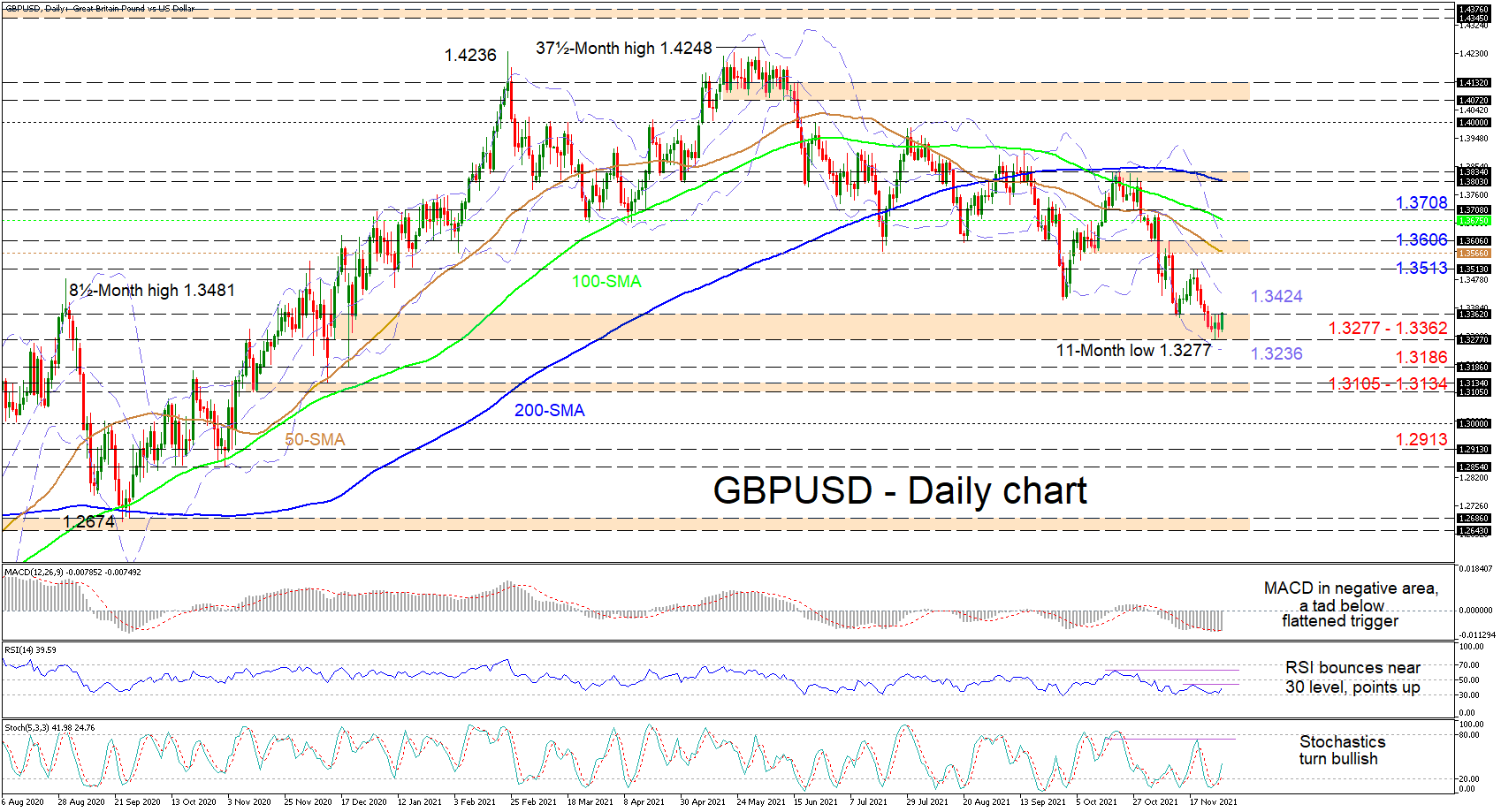
GBPUSD is consolidating around the 1.3300 mark, within the 1.3277-1.3362 support zone that has managed to mute negative forces for now. The falling simple moving averages (SMAs) are presently backing the bearish picture in the pair.

The short-term oscillators are suggesting a moderate waning in negative momentum. The MACD, some distance in the negative zone, is holding beneath its red trigger line. The RSI, in bearish territory, is improving from the 30 level, while the stochastic oscillator is promoting advances in the pair.

In the positive scenario, immediate constraints could originate from the 1.3362 mark and the approaching mid-Bollinger band at 1.3424 ahead of the 1.3513 barrier. Overstepping the latter obstacle, buyers may encounter a fortified section of resistance from the 50-day SMA at 1.3566 until the upper Bollinger band, residing at the 1.3606 high. Conquering this crucial border, the bulls could then eye a region of resistance existing between the 100-day SMA at 1.3675 and the 1.3708 level.

Otherwise, if sellers resurface, initial downside friction could transpire from the 1.3277 boundary of the current buffer zone, which happens to also be the 11-month low. Sliding past this, the neighboring lower Bollinger band at 1.3236 and the 1.3186 low could delay the test of the 1.3105-1.3134 support band. Piercing below this key barricade, the price may then plunge towards the 1.3000 handle before targeting the 1.2913 obstacles.

Summarizing, GBPUSD’s medium-term outlook is growing increasingly negative, as the pair logs lower highs and lows. That said, buyers are fighting back but they would need to drive the price above the 1.3513 high to start to gain some upside momentum.
GBPUSD

Author

Anthony Charalambous, CFTe

Anthony Charalambous joined XM in 2019 and specializes in preparing daily technical analysis, using his years of trading experience to provide detailed forecasting for all major asset classes such as forex, indices, commodities and equities.


More from Anthony Charalambous, CFTe
Share:

Editor's Picks

EUR/USD flirts with daily highs, retargets 1.1900

EUR/USD regains upside traction, returning to the 1.1880 zone and refocusing its attention to the key 1.1900 barrier. The pair’s slight gains comes against the backdrop of a humble decline in the US Dollar as investors continue to assess the latest US CPI readings and the potential Fed’s rate path.

GBP/USD remains well bid around 1.3650

GBP/USD maintains its upside momentum in place, hovering around daily highs near 1.3650 and setting aside part of the recent three-day drop. Cable’s improved sentiment comes on the back of the Greenback’s  irresolute price action, while recent hawkish comments from the BoE’s Pill also collaborate with the uptick.

Gold clings to gains just above $5,000/oz

Gold is reclaiming part of the ground lost on Wednesday’s marked decline, as bargain-hunters keep piling up and lifting prices past the key $5,000 per troy ounce. The precious metal’s move higher is also underpinned by the slight pullback in the US Dollar and declining US Treasury yields across the curve.

Crypto Today: Bitcoin, Ethereum, XRP in choppy price action, weighed down by falling institutional interest 

Bitcoin's upside remains largely constrained amid weak technicals and declining institutional interest. Ethereum trades sideways above $1,900 support with the upside capped below $2,000 amid ETF outflows.

Week ahead – Data blitz, Fed Minutes and RBNZ decision in the spotlight

US GDP and PCE inflation are main highlights, plus the Fed minutes. UK and Japan have busy calendars too with focus on CPI. Flash PMIs for February will also be doing the rounds. RBNZ meets, is unlikely to follow RBA’s hawkish path.

Ripple Price Forecast: XRP potential bottom could be in sight

Ripple edges up above the intraday low of $1.35 at the time of writing on Friday amid mixed price actions across the crypto market. The remittance token failed to hold support at $1.40 the previous day, reflecting risk-off sentiment amid a decline in retail and institutional sentiment.