|

Spain: A dynamic housing market

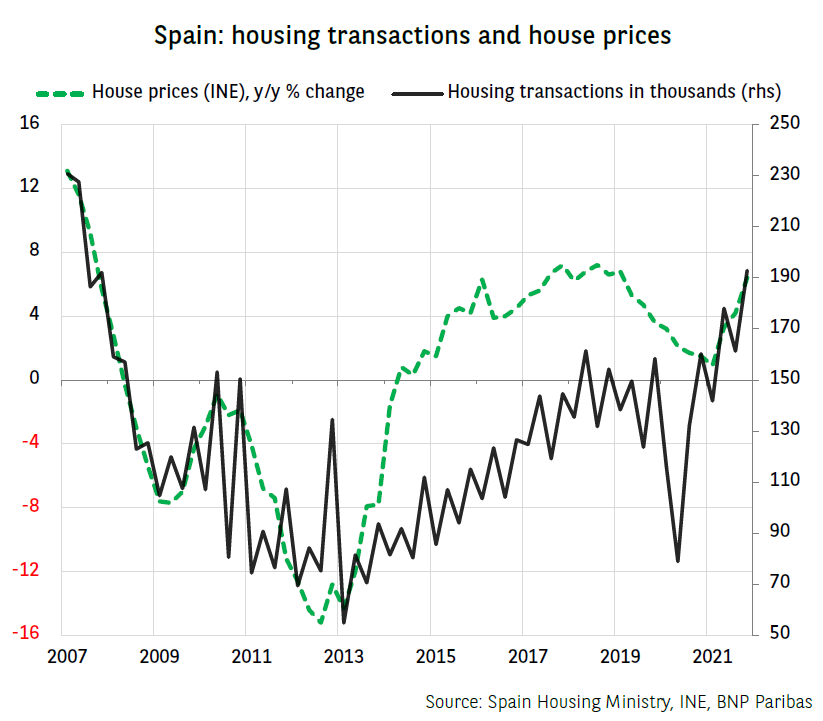
In Spain, the change in house prices and the transaction volume are highly correlated. In an upswing, the latter will be supported by attractive borrowing conditions and confidence in the economic outlook, thereby causing a rise in house prices, which in turn can fuel expectations of further increases and hence raise the transaction volume.

Real estate activity in Spain rebounded sharply in 2021 following a drop in 2020 due to the health crisis. The number of housing transactions exceeded 674,000 last year, the highest level since 2007. Even so, this was nearly 30% below the 2006 peak.

Demand is still buoyed by historically low borrowing costs and a rising number of Spanish households. As a result, house prices rose significantly in 2021 (at annual rate of 3.7%), maintaining the rapid pace of the past six years (average annual growth of 4.6% between 2015 and 2021). House prices are still nearly 10% below the peak of summer 2007 according to the Spanish statistics bureau (INE), but they have been rising at a rapid pace, and much faster than household revenue growth.

The new housing law that took effect last February aims primarily at strengthening the framework for rent and tenant rights, which is a good thing. Yet the law does not directly address the core problem of house price inflation, which is making it difficult for part of the country’s population from getting on the property ladder, notably young people.
Chart

Download The Full Eco Flash

Author

BNP Paribas Team

BNP Paribas Team

BNP Paribas

BNP Paribas Economic Research Department is a worldwide function, part of Corporate and Investment Banking, at the service of both the Bank and its customers.


More from BNP Paribas Team
Share:

Editor's Picks

EUR/USD hits two-day highs near 1.1820

EUR/USD picks up pace and reaches two-day tops around 1.1820 at the end of the week. The pair’s move higher comes on the back of renewed weakness in the US Dollar amid growing talk that the Fed could deliver an interest rate cut as early as March. On the docket, the flash US Consumer Sentiment improves to 57.3 in February.

GBP/USD reclaims 1.3600 and above

GBP/USD reverses two straight days of losses, surpassing the key 1.3600 yardstick on Friday. Cable’s rebound comes as the Greenback slips away from two-week highs in response to some profit-taking mood and speculation of Fed rate cuts. In addition, hawkish comments from the BoE’s Pill are also collaborating with the quid’s improvement.

Gold climbs further, focus is back to 45,000

Gold regains upside traction and surpasses the $4,900 mark per troy ounce at the end of the week, shifting its attention to the critical $5,000 region. The move reflects a shift in risk sentiment, driving flows back towards traditional safe haven assets and supporting the yellow metal.

Crypto Today: Bitcoin, Ethereum, XRP rebound amid risk-off, $2.6 billion liquidation wave

Bitcoin edges up above $65,000 at the time of writing on Friday, as dust from the recent macro-triggered sell-off settles. The leading altcoin, Ethereum, hovers above $1,900, but resistance at $2,000 caps the upside. Meanwhile, Ripple has recorded the largest intraday jump among the three assets, up over 10% to $1.35.

Three scenarios for Japanese Yen ahead of snap election

The latest polls point to a dominant win for the ruling bloc at the upcoming Japanese snap election. The larger Sanae Takaichi’s mandate, the more investors fear faster implementation of tax cuts and spending plans. 

XRP rally extends as modest ETF inflows support recovery

Ripple is accelerating its recovery, trading above $1.36 at the time of writing on Friday, as investors adjust their positions following a turbulent week in the broader crypto market. The remittance token is up over 21% from its intraday low of $1.12.