|

Slower labor cost growth continues to help the inflation fight

Summary

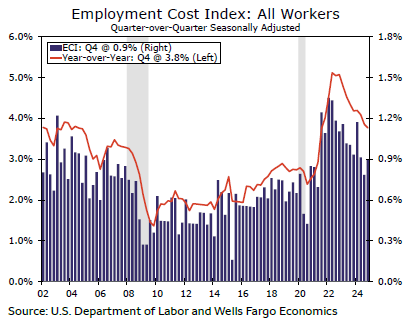
The fourth quarter Employment Cost Index (ECI) gave another indication that the labor market is no longer a major threat to the Fed achieving its 2% inflation goal. The ECI advanced 0.9% in the fourth quarter, boosted in part by further solid increases in private union and public sector pay. Yet the ECI slowed to 3.8% year-over-year, which is near the realm consistent with the Fed's 2% inflation target once accounting for the stronger pace of productivity this cycle.

Compensation costs continue to ease

The fourth quarter reading on the employment cost index (ECI) offered further evidence that the cooler jobs market is reducing upward pressure on inflation. Employment costs rose 0.9% in the fourth quarter, in line with expectations. Over the past year, compensation costs have risen 3.8% (chart). While that remains notably stronger than the past cycle's peak of 3.0%, it has neared the realm consistent with the Fed's 2% inflation target once accounting for the stronger pace of productivity this cycle (productivity growth allows businesses to raise compensation faster than selling prices).
fxsoriginal

The continued moderation in the ECI, the Fed's preferred barometer of compensation cost growth, looks a little friendlier for the Fed's inflation fight than the most recent readings of average hourly earnings (AHE) from the monthly Employment Situation report. Annual growth in hourly earnings averaged 4.0% in the fourth quarter, up two tenths from the prior quarter. Unlike the more volatile AHE figures, however, the ECI controls for compositional shifts in the employment base along industry and occupational lines. It also includes state and local government workers as well as benefits (about 30% of compensation), making it a more encompassing measure of labor costs.

Download The Full Economic Indicator

Author

More from Wells Fargo Research Team
Share:

Editor's Picks

EUR/USD flirts with daily highs, retargets 1.1900

EUR/USD regains upside traction, returning to the 1.1880 zone and refocusing its attention to the key 1.1900 barrier. The pair’s slight gains comes against the backdrop of a humble decline in the US Dollar as investors continue to assess the latest US CPI readings and the potential Fed’s rate path.

GBP/USD remains well bid around 1.3650

GBP/USD maintains its upside momentum in place, hovering around daily highs near 1.3650 and setting aside part of the recent three-day drop. Cable’s improved sentiment comes on the back of the Greenback’s  irresolute price action, while recent hawkish comments from the BoE’s Pill also collaborate with the uptick.

Gold clings to gains just above $5,000/oz

Gold is reclaiming part of the ground lost on Wednesday’s marked decline, as bargain-hunters keep piling up and lifting prices past the key $5,000 per troy ounce. The precious metal’s move higher is also underpinned by the slight pullback in the US Dollar and declining US Treasury yields across the curve.

Crypto Today: Bitcoin, Ethereum, XRP in choppy price action, weighed down by falling institutional interest 

Bitcoin's upside remains largely constrained amid weak technicals and declining institutional interest. Ethereum trades sideways above $1,900 support with the upside capped below $2,000 amid ETF outflows.

Week ahead – Data blitz, Fed Minutes and RBNZ decision in the spotlight

US GDP and PCE inflation are main highlights, plus the Fed minutes. UK and Japan have busy calendars too with focus on CPI. Flash PMIs for February will also be doing the rounds. RBNZ meets, is unlikely to follow RBA’s hawkish path.

Ripple Price Forecast: XRP potential bottom could be in sight

Ripple edges up above the intraday low of $1.35 at the time of writing on Friday amid mixed price actions across the crypto market. The remittance token failed to hold support at $1.40 the previous day, reflecting risk-off sentiment amid a decline in retail and institutional sentiment.