|

RBA leaves cash rate steady, leaving options open
The Reserve Bank of Australia (RBA) left policy rates unchanged but revised down its 2025 growth forecasts. We don’t expect any easing until 1Q25.

The RBA also cut the 2025 GDP growth forecast to 2.3% from 2.5% earlier

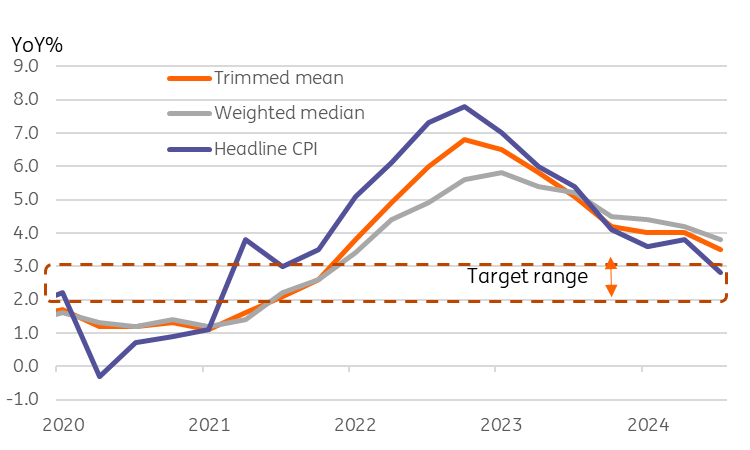
The RBA left the cash rate unchanged at 4.35% in line with our expectations. We think this is consistent with the strong labour market conditions despite headline inflation easing to 2.8% in 3Q2024 and finally falling into the RBA’s target band of 2-3%. As per RBA estimates, headline CPI is unlikely to fall sustainably to the midpoint of this range before 2026.  

Further, the tone of the monetary policy statement was more balanced with the RBA seeing inflation risks to the upside but with cuts made to the GDP growth forecast for 2025. The RBA also pointed to the surge in government spending growth, especially on aged care and national disability insurance schemes, as one of the key reasons behind higher inflation and stronger job growth.

Going forward, we expect both headline and trimmed mean CPI inflation to ease in 4Q24, however, the latter is likely to remain above the target band. Economic activity including retail sales remains weak despite the income tax cuts earlier this year. Weaker house prices are likely to add to subdued consumer sentiment. On balance, given considerable uncertainty around the global outlook including the outcome of US elections, we expect the RBA to stay on hold at the next policy meeting in December as well, although with a dovish tilt.

Core inflation remains above target
Chart

Source: ING, CEIC

Read the original analysis: RBA leaves cash rate steady, leaving options open

Author

ING Global Economics Team

ING Global Economics Team

ING Economic and Financial Analysis

From Trump to trade, FX to Brexit, ING’s global economists have it covered. Go to ING.com/THINK to stay a step ahead.


More from ING Global Economics Team
Share:

Editor's Picks

EUR/USD weakens to near 1.1900 as traders eye US data

EUR/USD eases to near 1.1900 in Tuesday's European trading hours, snapping the two-day winning streak. Markets turn cautious, lifting the haven demand for the US Dollar ahead of the release of key US economic data, including Retail Sales and ADP Employment Change 4-week average.

GBP/USD stays in the red below 1.3700 on renewed USD demand

GBP/USD trades on a weaker note below 1.3700 in the European session on Tuesday. The pair faces challenges due to renewed US Dollar demand, UK political risks and rising expectations of a March Bank of England rate cut. The immediate focus is now on the US Retail Sales data. 

Gold sticks to modest losses above $5,000 ahead of US data

Gold sticks to modest intraday losses through the first half of the European session, though it holds comfortably above the $5,000 psychological mark and the daily swing low. The outcome of Japan's snap election on Sunday removes political uncertainty, which along with signs of easing tensions in the Middle East, remains supportive of the upbeat market mood. This turns out to be a key factor exerting downward pressure on the safe-haven precious metal.

Bitcoin Cash trades lower, risks dead-cat bounce amid bearish signals

Bitcoin Cash trades in the red below $522 at the time of writing on Tuesday, after multiple rejections at key resistance. BCH’s derivatives and on-chain indicators point to growing bearish sentiment and raise the risk of a dead-cat bounce toward lower support levels.

Follow the money, what USD/JPY in Tokyo is really telling you

Over the past two Tokyo sessions, this has not been a rate story. Not even close. Interest rate differentials have been spectators, not drivers. What has moved USD/JPY in local hours has been flow and flow alone.

Bitcoin Cash trades lower, risks dead-cat bounce amid bearish signals

Bitcoin Cash (BCH) trades in the red below $522 at the time of writing on Tuesday, after multiple rejections at key resistance. BCH’s derivatives and on-chain indicators point to growing bearish sentiment and raise the risk of a dead-cat bounce toward lower support levels.