Romania: Pre-election public spending bonanza

Consumption boom supports growth, but abroad More room to remove policy restrictiveness Additional supply weighs on sovereign debt performance EUR/RON should remain broadly stable in 2024, asymmetric risks.
The government pursued an agenda of raising public sector incomes in a heavy election year. Public sector wages increased by nearly 20%, while public pensions were hiked at almost double that pace. Consequently, the budget deficit topped 4.0% of GDP after seven months and the government updated its financing plans, corresponding to a budget deficit of 6.9% of GDP vs. 5.0% in the initial plans. With structural issues unaddressed, the boom in domestic consumption was almost entirely offset by a negative contribution from net exports to economic growth. State infrastructure investments are well underway and should start to pay dividends in the future.
European and local elections were held mid-year and opinion polls suggest a continuity of the grand coalition after the general elections due on December 1. The new government is expected to adopt measures to rein in fiscal slippage. The size of the fiscal adjustment depends on the starting point for the budget deficit for 2024. The speed of the fiscal consolidation is subject to negotiations with the European Commission. The structure of the fiscal corrective measures is likely to be mainly from the revenues side, given the rigid structure of the government spending. Fiscal adjustment on the revenues is less growth-negative than on the expenditures.
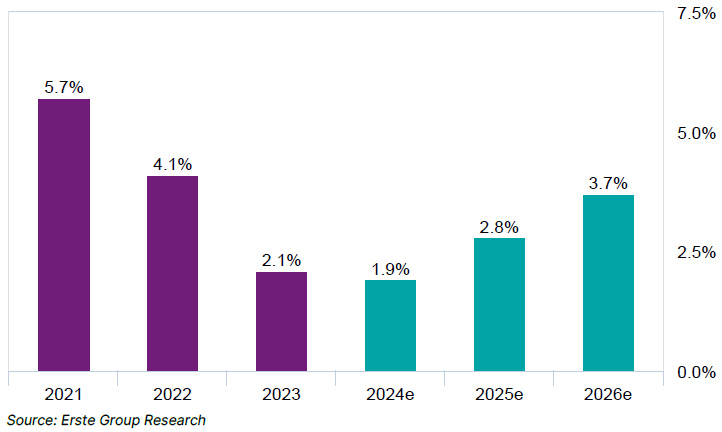
GDP (real,y/y)
Author
Erste Bank Research Team
Erste Bank
At Erste Group we greatly value transparency. Our Investor Relations team strives to provide comprehensive information with frequent updates to ensure that the details on these pages are always current.

















