Powell: Inflation could be 'more volatile'
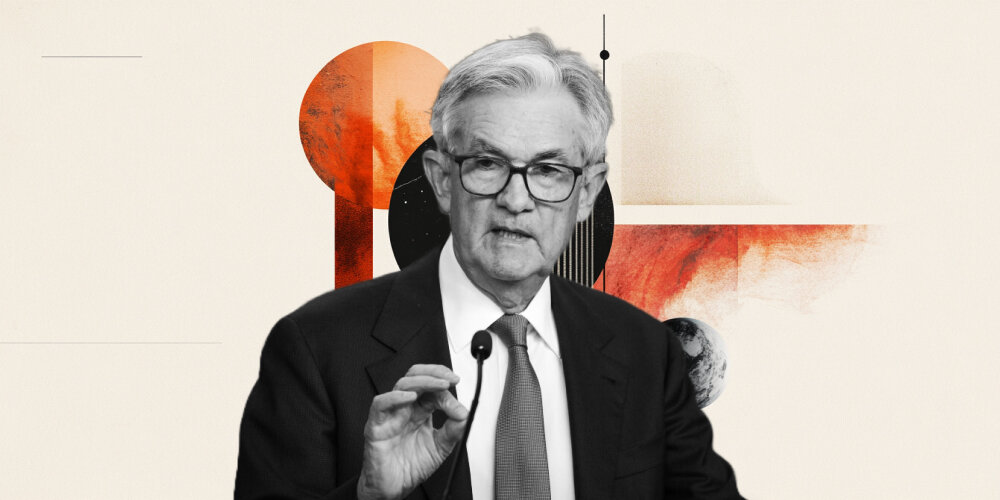

Fed Chair Powell and Vice Chair Jefferson discussed a range of issues, including tariffs, inflation, and monetary policy.
One week after the Federal Open Market Committee (FOMC) met on interest rates, two key members of the committee hit the speaking circuit to discuss the economy, inflation, and monetary policy.
On Thursday, Federal Reserve Board Chairman Jerome Powell delivered remarks at the Thomas Laubach Research Conference in Washington, D.C. on the Fed’s framework for monetary policy.
“The structure of the economy evolves over time, and monetary policymakers’ strategies, tools, and communications need to evolve with it,” Powell said. “The challenges presented by the Great Depression differ from those of the Great Inflation (late 1960s to early 1980s) and the Great Moderation (mid 1980s to 2007), which in turn differ from the ones we face today. A framework should be robust to a broad range of conditions but also needs to be updated periodically as the economy and our understanding of it evolve.”
On the current market, Powell cited the “welcome and historically unusual result” of inflation dropping from 7.2% to the current 2.2% without a sharp increase in unemployment.
But, as the environment has changed significantly since 2020, the FOMC must evolve and respond accordingly. Longer-term interest rates are significantly higher now, driven largely by higher real rates – and higher real rates may reflect the possibility that “inflation could be more volatile” than it was in the 2010s.
“We may be entering a period of more frequent, and potentially more persistent, supply shocks—a difficult challenge for the economy and for central banks,” Powell added.
Powell concluded by saying periods of more frequent and more disparate shocks require more effective communication by the Fed to convey the uncertainty about the economy and the outlook.
“We will examine ways to improve along that dimension as we move forward,” he said.
Responding to risks
On Wednesday afternoon, Federal Reserve Vice Chair Philip Jefferson addressed the Annual Conference of Second District Directors and Advisors at the New York Fed where he discussed the increased risks the Fed is monitoring. One of them is a slowing economy, as the GDP decreased 0.3% in Q1.
“Tariff announcements and heightened uncertainty about government policies in general are the dominant economic developments of more recent weeks and have caused me to look carefully at my forecasts,” Jefferson said, . “It is not my role to express views on policies coming from the Administration or Congress, but I do study the implications of those policies on economic activity and inflation.”
Jefferson also cited the potential risk of a decline in business sentiment related to trade policy.
“The Beige Book reported that some retailers are expecting to raise prices in response to tariffs, which could then limit spending, especially by the most price-sensitive consumers. Manufacturers saw risks of supply chain disruptions related to trade policy changes. Moreover, uncertainty is quite high,” Jefferson said.
Thus, Jefferson adjusted down his expectations for economic growth this year, but still expects expansion, not a recession.
“Of course, trade policy is still evolving, so its ultimate economic implications are not known, and I will be following developments carefully,” he added.
Tariffs likely to interrupt disinflation
On inflation, Jefferson cited further progress toward the Fed’s 2% inflation target. But he added that there is a lot of uncertainty around the future path of inflation.
“If the increases in tariffs announced so far are sustained, they are likely to interrupt progress on disinflation and generate at least a temporary rise in inflation,” Jefferson said. “Whether tariffs create persistent upward pressure on inflation will depend on how trade policy is implemented, the pass-through to consumer prices, the reaction of supply chains, and the performance of the economy.”
Jefferson added that it is uncertain whether inflationary pressures would be temporary or persistent.
“Our monetary policy actions are guided by our dual mandate to promote maximum employment and stable prices for the American people,” Jefferson said. “With the increased risks to both sides of our mandate, I believe that the current stance of monetary policy is well positioned to respond in a timely way to potential economic developments.”
Author
Jacob Wolinsky
ValueWalk
Jacob Wolinsky is the founder of ValueWalk, a popular investment site. Prior to founding ValueWalk, Jacob worked as an equity analyst for value research firm and as a freelance writer. He lives in Passaic New Jersey with his wife and four children.