|

NZD/CAD Could Be Gearing Up For 300-Pip Slide

fxsoriginal

Near the end of April we flagged that NZD/CAD could be on the verge of a major breakdown. Recent price action remains constructive of that view.

Unsurprisingly, commodity currencies have felt the heat throughout the trade war. However, other factors have been at play to weigh on AUD, CAD and NZD with varying degrees such as global growth concerns, weak domestic data and, therefore, expectations for central bank easing. However, once again recent developments have seen the pecking order change among the three, where CAD is now the strongest of the three and NZD is the weakest.

  • Aussie selling was given a reprieve on reports that Australia had narrowly avoided Trump’s tariffs on metals, giving AUD a tailwind just before RBA cut rates to a record low.
  • The US-Mexico deal announced over the weekend has provided support for CAD, as traders see a deal with a US neighbour as ‘neighbourhood friendly’. Of course, this can change in a flash but for now, CAD remains the strongest of the three commodity currencies.
  • In the current environment, NZD/CAD appears to be the better short over AUD/CAD
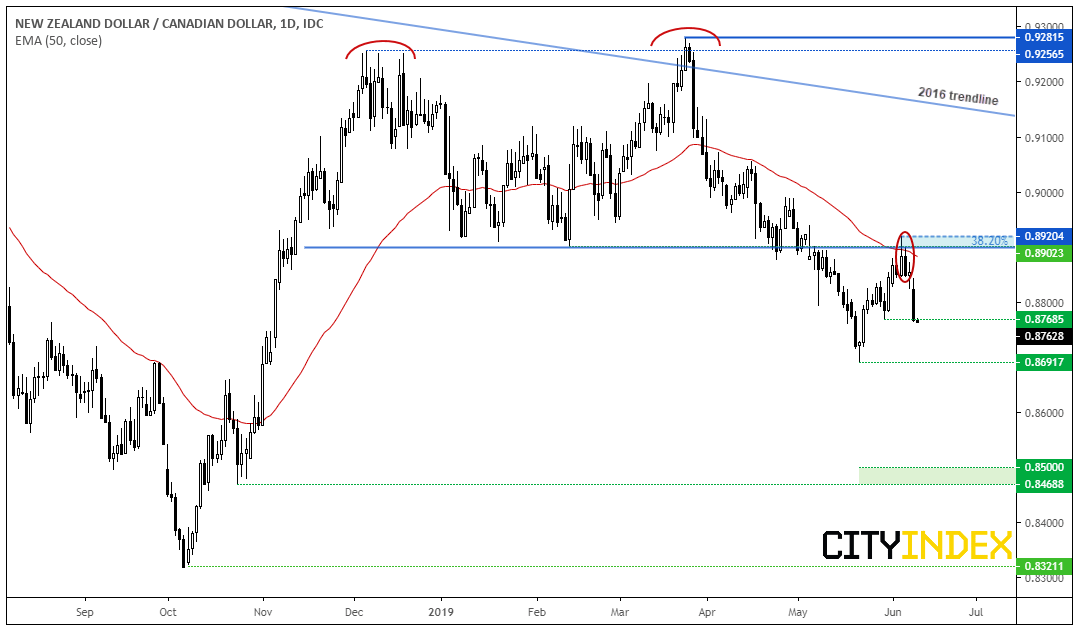
Following its failed upside break of the 2016 trendline, momentum has remained predominantly bearish and its breakdown has confirmed a multi-month double top pattern. If successful, the pattern projects an approximate target around 0.8500.

  • Prices have retraced towards (and respected) the original breakout level and produced a 2-bar reversal at the 38.2% Fibonacci level.
  • Bearish momentum has now realigned with the dominant trend, following its most bearish session in 11-week yesterday.  
  • From here, we’d expect bears to fade into rallies and target the 0.8692 lows ahead of another break lower.

Author

Matt Simpson, CFTe, MSTA

Matt Simpson is a certified technical analyst who combines charts and fundamentals to generate trading themes.


More from Matt Simpson, CFTe, MSTA
Share:

Editor's Picks

EUR/USD stays defensive below 1.1900 as USD recovers

EUR/USD trades in negative territory for the third consecutive day, below 1.1900 in the European session on Thursday. A modest rebound in the US Dollar is weighing on the pair, despite an upbeat market mood. Traders keep an eye on the US weekly Initial Jobless Claims data for further trading impetus. 

GBP/USD holds above 1.3600 after UK data dump

\GBP/USD moves little while holding above 1.3600 in the European session on Thursday, following the release of the UK Q4 preliminary GDP, which showed a 0.1% growth against a 0.2% increase expected. The UK industrial sector activity deteriorated in Decembert, keeping the downward pressure intact on the Pound Sterling. 

Gold sticks to modest intraday losses as reduced March Fed rate cut bets underpin USD

Gold languishes near the lower end of its daily range heading into the European session on Thursday. The precious metal, however, lacks follow-through selling amid mixed cues and currently trades above the $5,050 level, well within striking distance of a nearly two-week low touched the previous day.

Cardano eyes short-term rebound as derivatives sentiment improves

Cardano (ADA) is trading at $0.257 at the time of writing on Thursday, after slipping more than 4% so far this week. Derivatives sentiment improves as ADA’s funding rates turn positive alongside rising long bets among traders.

The market trades the path not the past

The payroll number did not just beat. It reset the tone. 130,000 vs. 65,000 expected, with a 35,000 whisper. 79 of 80 economists leaning the wrong way. Unemployment and underemployment are edging lower. For all the statistical fog around birth-death adjustments and seasonal quirks, the core message was unmistakable. The labour market is not cracking.

Sonic Labs’ vertical integration fuels recovery in S token

Sonic, previously Fantom (FTM), is extending its recovery trade at $0.048 at the time of writing, after rebounding by over 12% the previous day. The recovery thesis’ strengths lie in the optimism surrounding Sonic Labs’ Wednesday announcement to shift to a vertically integrated model, aimed at boosting S token utility.