|

Nonfarm Payrolls Preview: New year, old data

  • US economy expected to have added 164K new jobs in December.
  • Political headlines will probably continue to overshadow fundamental figures.
  • US Dollar retaining its bullish dominance ahead of the release of the key report.

The 2020 macroeconomic calendar will kick-start with December employment figures, the first relevant piece of data to be out this year. However, the market can’t be any less concerned about fundamentals.

Relief news related to the trade war between the US and China, as both countries are set to sign phase one of the trade deal next week, were overshadowed by the escalating conflict in the Middle-East. US President Trump ordered the killing of an Iranian Commander, while Tehran responded by launching missiles on US military facilities on Iraq. The conflict deescalated afterwards, although investors remain on there toes and financial assets are extremely sensitive to risk-related headlines, which can easily overshadow macro data.

 Anyway, and back to employment figures, the US economy is expected to have added 164K new jobs in December, after gaining 226K positions in November. The unemployment rate is seen unchanged at 3.5%, as well as the participation rate is foreseen at 63.2%. Average Hourly Earnings are seen up by 0.3% MoM and by 3.1% YoY, pretty much unchanged when compared to the previous month.

Leading indicators providing positive signals

 For a change, leading indicators ahead of the Nonfarm Payroll´s release are providing encouraging signs. The country added 266K jobs in the previous month, while the number of layoffs in December fell to 32.8K from 44.6K previously. Furthermore, the University of Michigan Consumer Confidence Index bounced at the end of the year to 99.3.

The ISM PMI reports offered discouraging signals, as the employment sub-component of the  Non-Manufacturing index was slightly lower when compared to the previous month, down to 55.2 from 55.5. The employment sub-component of the Manufacturing PMI fell into contraction territory to 45.1.

US jobs report pre-release checklist – Dec 6th, 2019

Previous Non-Farm PayrollsPositiveNovember's 266k job growth was the biggest in the last 10 months, triggering a meaningful +2.57 deviation.
Challenger Job CutsPositiveThe number of corporate layoffs went down in December to 32.843K from 44.6K in November.
Initial Jobless Claims PositiveThe 4-week moving average for the number of first-time employment claimants went down from 233.5K to 224K, a positive development in the last month.
Continuing Jobless Claims NegativeThe number of individuals currently receiving unemployment benefits has risen in three of the last five weeks, with four consecutive worse-than-expected releases.
ISM Non-Manufacturing PMI NeutralEmployment sub-component in the ISM Non-Manufacturing PMI retraced a bit in December, from 55.5 to 55.2, still way into expansion territory.
ISM Manufacturing PMI NegativeEmployment sub-component in the ISM Manufacturing PMI disappointed for the fourth month in a row, printing a modest 45.1, way into contraction territory.
University of Michigan Consumer Confidence Index PositiveUMich consumer survey rose to 99.3 in December, very close to its multi-year highs.
Conference Board Consumer Confidence Index NeutralCB consumer survey showed a small retracement from 126.8 to 126.5 in December, keeping its 4-month range between 125 and 127 levels.
ADP Employment Report PositiveThe leading indicator most correlated to the NFP printed an encouraging 202k job gain for December, a 7-month high.
JOLTS Job Openings PositiveJob openings rose to 7.267 million in October, just the second month showing a positive trend within the last seven.

Dollar’s possible reaction to different scenarios

As long as there are no risk-related headers, and given that the dollar has the market’s favour. An upbeat report will likely trigger gains across the board. Also, an upbeat report will likely underpin equities, which means that the USD/JPY pair may be the best performer. A negative outcome, on the other hand, could push the pair back lower, particularly if it remains below 109.70.

The Australian dollar is among the weakest currencies, which means that it will tend to follow the same behaviour as the USD/JPY, despite rising equities tend to support the greenback.

The GBP/USD pair, on the other hand, is Brexit-dependent, and will probably have a less relevant reaction to the report.

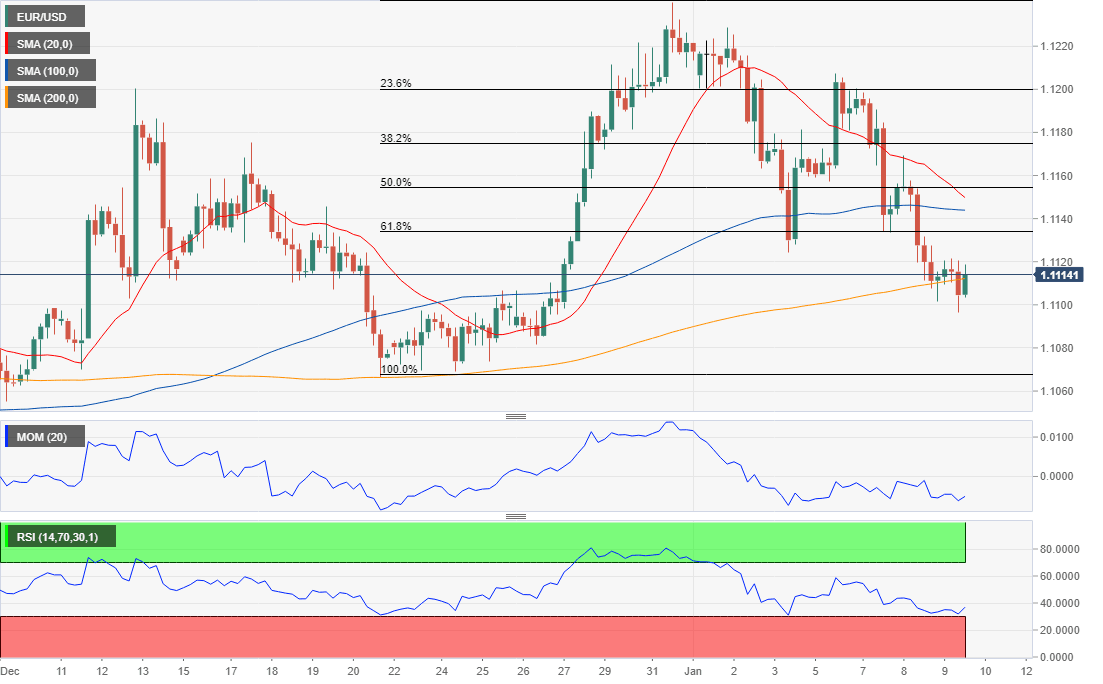
The EUR/USD pair is quite a case. It has been trading within well-limited intraday ranges for months, and it seems unlikely that the NFP report could break the stalemate situation. For sure, reading above expected would push the pair lower, with 1.1065 being the most relevant support and bearish target. The employment report needs to be extremely disappointing to push the pair back toward the 1.1200 price zone.
Author

Valeria Bednarik

Valeria Bednarik was born and lives in Buenos Aires, Argentina. Her passion for math and numbers pushed her into studying economics in her younger years.


More from Valeria Bednarik
Share:

Editor's Picks

EUR/USD hits two-day highs near 1.1820

EUR/USD picks up pace and reaches two-day tops around 1.1820 at the end of the week. The pair’s move higher comes on the back of renewed weakness in the US Dollar amid growing talk that the Fed could deliver an interest rate cut as early as March. On the docket, the flash US Consumer Sentiment improves to 57.3 in February.

GBP/USD reclaims 1.3600 and above

GBP/USD reverses two straight days of losses, surpassing the key 1.3600 yardstick on Friday. Cable’s rebound comes as the Greenback slips away from two-week highs in response to some profit-taking mood and speculation of Fed rate cuts. In addition, hawkish comments from the BoE’s Pill are also collaborating with the quid’s improvement.

Gold climbs further, focus is back to 45,000

Gold regains upside traction and surpasses the $4,900 mark per troy ounce at the end of the week, shifting its attention to the critical $5,000 region. The move reflects a shift in risk sentiment, driving flows back towards traditional safe haven assets and supporting the yellow metal.

Crypto Today: Bitcoin, Ethereum, XRP rebound amid risk-off, $2.6 billion liquidation wave

Bitcoin edges up above $65,000 at the time of writing on Friday, as dust from the recent macro-triggered sell-off settles. The leading altcoin, Ethereum, hovers above $1,900, but resistance at $2,000 caps the upside. Meanwhile, Ripple has recorded the largest intraday jump among the three assets, up over 10% to $1.35.

Three scenarios for Japanese Yen ahead of snap election

The latest polls point to a dominant win for the ruling bloc at the upcoming Japanese snap election. The larger Sanae Takaichi’s mandate, the more investors fear faster implementation of tax cuts and spending plans. 

XRP rally extends as modest ETF inflows support recovery

Ripple is accelerating its recovery, trading above $1.36 at the time of writing on Friday, as investors adjust their positions following a turbulent week in the broader crypto market. The remittance token is up over 21% from its intraday low of $1.12.