Non-Farm Payrolls: EUR/USD volatility set to rise – fasten your seat belts
- The worst manufacturing PMI in 10 years raises concerns about the US economy.
- Two disappointing Non-Farm Payrolls reports also push tensions higher.
- EUR/USD volatility may rise after several years of relatively muted responses.


The "king of forex indicators" – Non-Farm Payrolls – is always interesting – and the upcoming publication for September 2019 maybe even more fascinating – especially for EUR/USD traders. The reason is growing concern about the US economy after several years of smooth-sailing – particularly in the labor market.
Worrying developments
Is the US economy facing a recession? That is the question that many investors are asking after ISM's Purchasing Managers' Index (PMI) for the manufacturing sector contracted for the second consecutive month. Moreover, the score of 47.8 is the worst since June 2009 and well below expectations of topping 50 – the threshold separating expansion for contracting.
Another source of concern stems from several hiccups in the labor market in recent months. Non-Farm Payrolls used to rise at a pace of around 200,000 per month. However, the economy gained only 33K positions in February. That seemed like a one-off after jobs reports in March and in April returned to normal. But then came May with only 72K. One again, the employment market went back to normal in June and July's figure was already somewhat weaker – 159K according to the revised data.
And after that, August's NFP already disappointed with 130K – despite increased government hiring toward the 2020 census. Contrary to February and May's sudden drops – followed by leaps – we are now seeing persistent declines.
Expectations for the upcoming September report are already modest – around 140K. They may have further dropped after the ISM Manufacturing PMI mentioned earlier.
EUR/USD volatility around the Non-Farm Payrolls
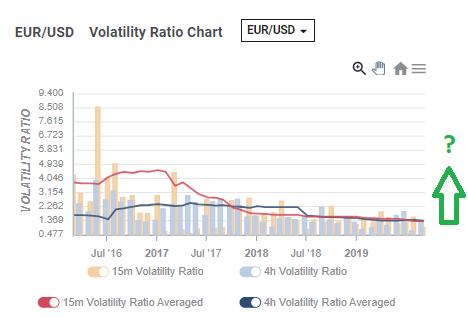
In any case, uncertainty is higher, and it may lead to higher volatility. For EUR/USD traders, the past few years have seen more modest price action. The chart below shows how volatility in the first 15 minutes after the release has dropped from the peak in 2016-2017 and is gradually sloping lower.
Average volatility in the four-hours following the publication has also been on a downtrend, suffering a drop in mid-2018 and edging lower ever since.
Given the higher uncertainty, this spell of frustrating price action may come to an end on October 4.
Author
Yohay Elam
FXStreet
Yohay is in Forex since 2008 when he founded Forex Crunch, a blog crafted in his free time that turned into a fully-fledged currency website later sold to Finixio.