|

Mis-leading index? LEI breaks through pandemic-era low

Summary

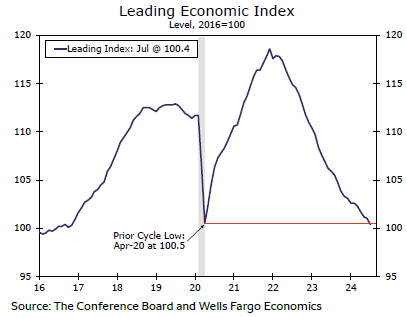
The outlook for a soft landing is still in play, and the Leading Economic Index continues to signal otherwise. The LEI declined 0.6% in July, bringing the streak to 29 consecutive months without a gain. At 100.4, the index has now fallen below the prior cycle's low reached in April 2020.

Long way down

The Leading Economic Index (LEI) declined 0.6% in July, bringing the streak to 29 consecutive months that the index has gone without an increase. The decline brings the index level to 100.4, declining below the prior cycle low previously reached in April 2020 (chart). The index level is now at its lowest point since 2016.

The Coincident Index came in flat on the month at 112.5. The index, a gauge of how the economy is currently performing, has been consistently increasing on trend since it began recovering from the 2020 recession. The recent positive trend for the Coincident Index in tandem with the persistently pessimistic trend in the LEI has led the Coincident-to-Leading Index ratio to increase exponentially. Ratio values greater than one signal that the outlook for the economy is comparatively worse than current economic performance, and vice versa. The ratio sits at 1.12 in July, signaling that the outlook for the economy is significantly more negative than the present situation (chart). This is the highest the ratio has been since 2009 in the trough of the Great Financial Crisis. The ratio usually peaks at the end of a cycle prior to a rebound in economic growth, a signal that the economy could be poised for decent growth in the quarters ahead.
fxsoriginal

Download The Full Economic Indicator

Author

More from Wells Fargo Research Team
Share:

Editor's Picks

EUR/USD weakens to near 1.1900 as traders eye US data

EUR/USD eases to near 1.1900 in Tuesday's European trading hours, snapping the two-day winning streak. Markets turn cautious, lifting the haven demand for the US Dollar ahead of the release of key US economic data, including Retail Sales and ADP Employment Change 4-week average.

GBP/USD stays in the red below 1.3700 on renewed USD demand

GBP/USD trades on a weaker note below 1.3700 in the European session on Tuesday. The pair faces challenges due to renewed US Dollar demand, UK political risks and rising expectations of a March Bank of England rate cut. The immediate focus is now on the US Retail Sales data. 

Gold sticks to modest losses above $5,000 ahead of US data

Gold sticks to modest intraday losses through the first half of the European session, though it holds comfortably above the $5,000 psychological mark and the daily swing low. The outcome of Japan's snap election on Sunday removes political uncertainty, which along with signs of easing tensions in the Middle East, remains supportive of the upbeat market mood. This turns out to be a key factor exerting downward pressure on the safe-haven precious metal.

Bitcoin Cash trades lower, risks dead-cat bounce amid bearish signals

Bitcoin Cash trades in the red below $522 at the time of writing on Tuesday, after multiple rejections at key resistance. BCH’s derivatives and on-chain indicators point to growing bearish sentiment and raise the risk of a dead-cat bounce toward lower support levels.

Follow the money, what USD/JPY in Tokyo is really telling you

Over the past two Tokyo sessions, this has not been a rate story. Not even close. Interest rate differentials have been spectators, not drivers. What has moved USD/JPY in local hours has been flow and flow alone.

Bitcoin Cash trades lower, risks dead-cat bounce amid bearish signals

Bitcoin Cash (BCH) trades in the red below $522 at the time of writing on Tuesday, after multiple rejections at key resistance. BCH’s derivatives and on-chain indicators point to growing bearish sentiment and raise the risk of a dead-cat bounce toward lower support levels.