|

Might we see a minimal job loss recession? Why not?
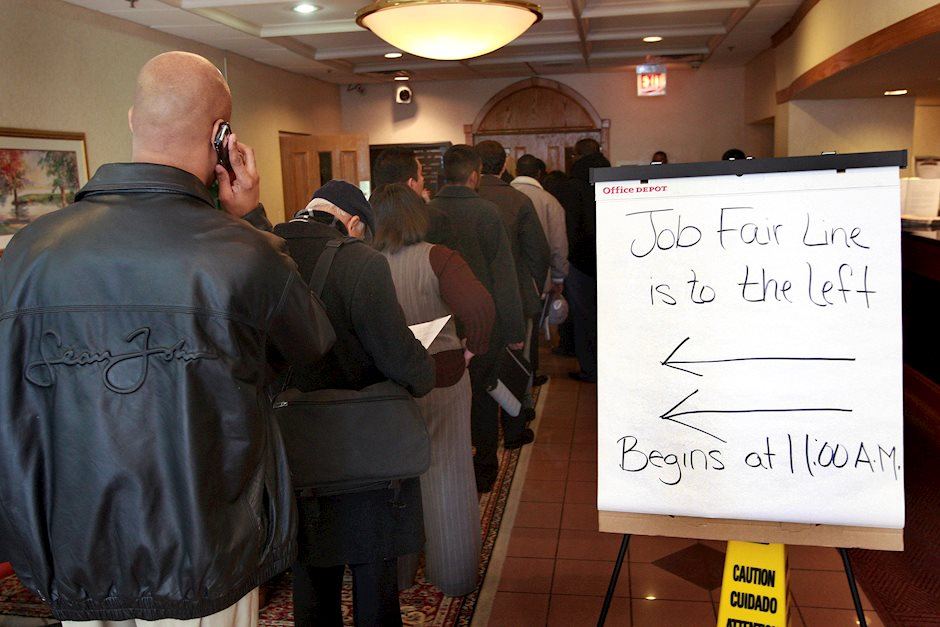
Job openings are the key reason many people believe a recession is not in the cards. OK, what if?
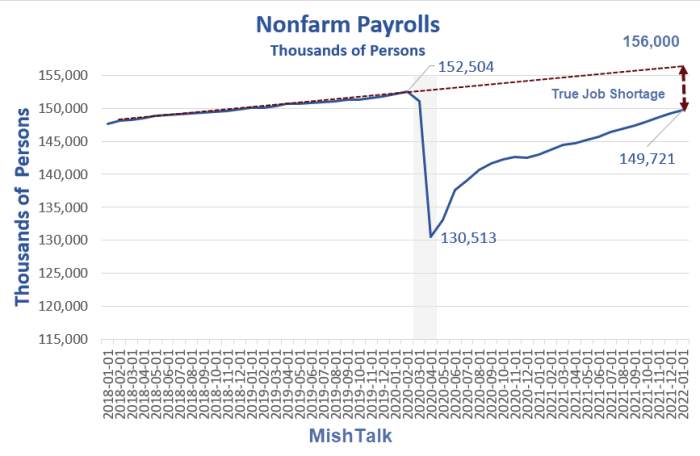
Nonfarm Payrolls data from BLS, chart by Mish

To recover jobs to the level they were at pre-Covid, the economy needs 152,504,000 minus 149,721,000 jobs (2,783,000). 

But to recover to the trend the economy needs 6,279,000 jobs.

Job Openings
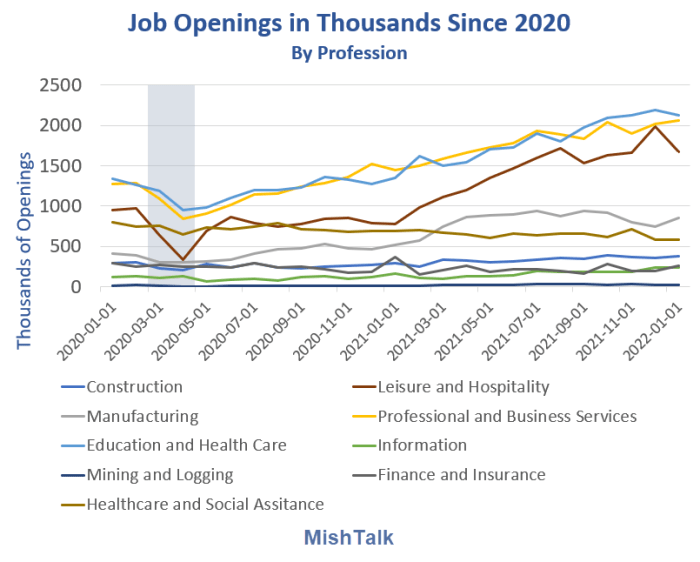
Job openings data from BLS, chart by Mish

What if instead of firing millions of leisure and hospitality workers, the openings vanish? 

Will we need construction workers if housing slows? 

What about manufacturing jobs if the automotive sector takes a dive?

Comparison to Double Dip Recession
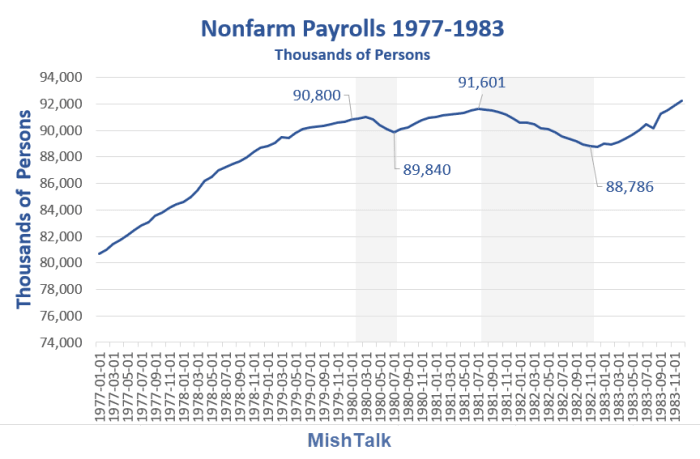
Nonfarm Payrolls data from BLS, chart by Mish

If we look back at the 1980-1981 double dip recession, the number of jobs lost was minimal. 

The 1980 recession gained jobs for the first two months of the recession then compared to pre-recession lost less than a million jobs.

The larger 81 recession lost less than 2 million jobs. 

In both cases, the number of jobs rose before the recession ended in stark contrast to the housing bubble bust.

Nonfarm Payrolls 2006-2014
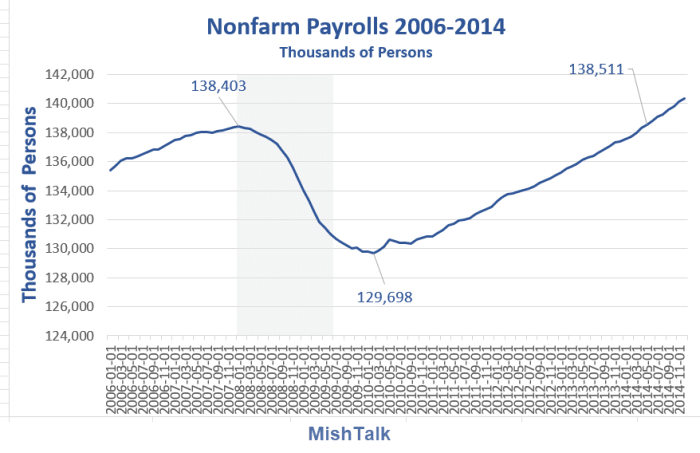
Nonfarm Payrolls data from BLS, chart by Mish

Comparison

  • The housing bubble "Great Recession" suffered immense job josses with a very slow job recovery.
  • The double dip recessions in the 1980s had small job losses and speedy recoveries.

I expect the next recession to look much more like the 1980s inflationary recessions than the housing bubble "Great Recession".

I also envision very steep stock market declines. As a result of the stock market wealth impact, people start looking for work even some of those who retired early. 

So while the employment loss may be relatively small, the change in unemployment rate is likely to be more significant.

What Can the Fed Do About the Price of Food, Medicine, Gasoline, or Rent?

The answer is nothing or next to nothing. Rates hikes will not impact inelastic items.

For discussion, please see What Can the Fed Do About the Price of Food, Medicine, Gasoline, or Rent?

Bubbles Will Pop

If you think the Fed can fix decades of easy money and reckless Congressional spending while not remotely understanding inflation, you are only nuts.

Please note Most People Have No Idea How Much Stocks are Likely to Crash

Author

Mike “Mish” Shedlock's

Mike “Mish” Shedlock's

Sitka Pacific Capital Management,Llc

More from Mike “Mish” Shedlock's
Share:

Editor's Picks

EUR/USD weakens as US jobs data trims Fed rate cut bets

The EUR/USD pair trades in negative territory for the third consecutive day near 1.1860 during the early European session on Thursday. Traders will keep an eye on the US weekly Initial Jobless Claims data. On Friday, the attention will shift to the US Consumer Price Index inflation report. 

GBP/USD bullish outlook prevails above 1.3600, UK GDP data looms

The GBP/USD pair gains ground near 1.3635, snapping the two-day losing streak during the early European session on Thursday. The preliminary reading of UK Gross Domestic Product for the fourth quarter will be closely watched later on Thursday. The UK economy is estimated to grow 0.2% QoQ in Q4, versus 0.1% in Q1. 

Gold remains on the defensive below two-week top; lacks bearish conviction amid mixed cues

Gold sticks to modest intraday losses through the Asian session on Thursday, though it lacks follow-through selling and remains close to a nearly two-week high, touched the previous day. The commodity currently trades above the $5,070 level, down just over 0.20% for the day, amid mixed cues.

UK GDP set to post weak growth as markets rise bets on March rate cut

Markets will be watching closely on Thursday, when the United Kingdom’s Office for National Statistics will release the advance estimate of Q4 Gross Domestic Product. If the data land in line with consensus, the UK economy would have continued to grow at an annualised pace of 1.2%, compared with 1.3% recorded the previous year. 

The market trades the path not the past

The payroll number did not just beat. It reset the tone. 130,000 vs. 65,000 expected, with a 35,000 whisper. 79 of 80 economists leaning the wrong way. Unemployment and underemployment are edging lower. For all the statistical fog around birth-death adjustments and seasonal quirks, the core message was unmistakable. The labour market is not cracking.

Sonic Labs’ vertical integration fuels recovery in S token

Sonic, previously Fantom (FTM), is extending its recovery trade at $0.048 at the time of writing, after rebounding by over 12% the previous day. The recovery thesis’ strengths lie in the optimism surrounding Sonic Labs’ Wednesday announcement to shift to a vertically integrated model, aimed at boosting S token utility.