Jump in July Durable Goods orders clouds sluggish underlying demand


Summary
New orders of durable goods surged 9.9% in July, coming on the heels of a 6.9% contraction the prior month. The month-to-month volatility has been driven primarily by aircraft. Excluding transportation goods, orders slipped 0.2% in July. Today's data confirm the ongoing trend that manufacturers are largely standing idle until looser policy comes to fruition and supports broad-based capital expenditures.
Flying high?
New orders of durable goods surged 9.9% in July, coming on the heels of a 6.9% contraction the prior month. The month-to-month volatility has been driven primarily by aircraft. Separately released data from Boeing showed aircraft orders picking up in July after some weakness in May and June, which corroborates the recent swings in headline durable good orders. Excluding transportation goods, orders slipped 0.2% in July.
Softness was broad-based. Orders of motor vehicles & parts (-2.6%) posted the largest monthly decline, followed by communication equipment (-1.1%) and primary metals (-0.9%). The decrease in new orders of autos and parts reflects the ongoing normalization in the sector that has been faced with numerous supply challenges since the pandemic. On the flip side, computers and related products continue to be a bright spot in the otherwise dreary landscape—new orders of computers rose 3.2% in July and are up nearly 13% over the year.
Over the past year, new orders of durable goods (excluding transportation) are up a meager 0.65%, which is the softest annual growth rate since January (chart). The stalling is illustrative of restrictive monetary policy and political uncertainty. These dynamics have underpinned a deferment mindset among businesses who are reluctant to take on major projects today.
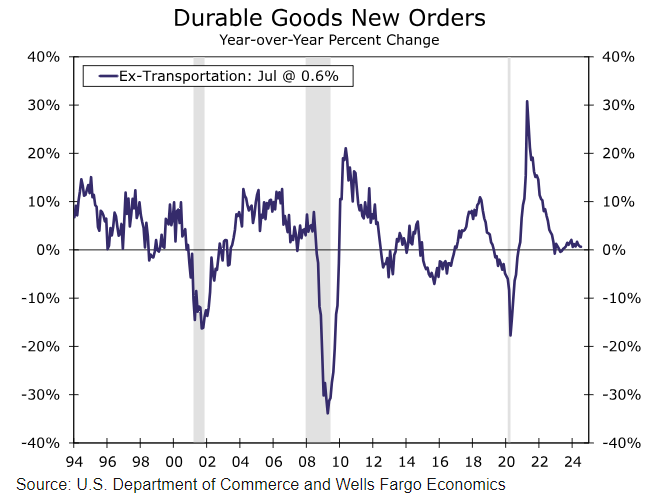
Source: U.S. Department of Commerce and Wells Fargo Economics
The composition of orders points to a sluggish environment for capital expenditures. Yet, it is shipments, not new orders, that are used for the calculation of business fixed investment in the U.S. GDP accounts. Nondefense capital goods shipments rose 4.7% in July, coming on top of an upwardly revised 6.1% pop in June. While that suggests business equipment spending is tracking for a decent outturn in the third quarter, most of the strength is tied to aircraft. Excluding aircraft and defense goods, core capital goods shipments fell 0.4% in July after a flat reading to end Q2, pointing to a recent loss of momentum.
We suspect a rebound in capital expenditures is coming as the Federal Reserve begins reducing its target range for the federal funds rate, but it will take some time for the accommodation of lower interest rates to filter through to the real economy. Today's data confirm the ongoing trend that manufacturers are largely standing idle until looser policy comes to fruition and supports broad-based order demand.
Author
Wells Fargo Research Team
Wells Fargo