JPY: Trump trade could bring more weakness

Key points
-
Recent intervention by Japanese authorities provided temporary support for the yen, but without coordinated efforts and fundamental shifts, its effects are waning.
-
Market has priced in September Fed rate cut, and near-term focus has shifted to US politics instead which are USD-positive.
-
The Bank of Japan may delay its tightening due to recent yen strength, and even if normalization occurs, any adjustments are expected to be minimal and dovish, maintaining the wide yield gap with the US.
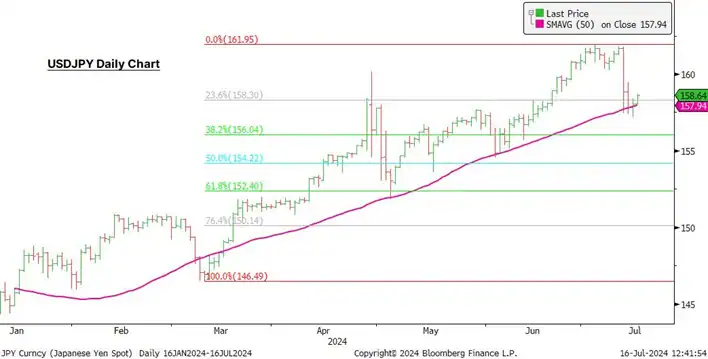
As noted in our Weekly FX Chartbook yesterday, USDJPY could be poised for another run higher. Below are some of the key reasons that support the case for further yen weakness:
Market intervention impact fading: While recent intervention by Japanese authorities provided temporary support for the yen, its effects are waning. Without coordinated efforts and fundamental shifts, interventions are unlikely to sustain a stronger yen.
Fed policy outlook: Fed Chair Powell has so far avoided signalling a September rate cut and remains in a data-dependent mode. Other Fed speakers this week may follow his lead given they still have a lot more data to chew on before a potential rate cut in September. This outlook means that another slide in US yields like the one that was seen last week may be avoided for now, contributing to the upward momentum in USDJPY.
US Dollar strength from Trump trade: The increasing probability of a Trump 2.0 presidency has been supporting the US dollar. Market participants anticipate that a second term for Trump could lead to aggressive fiscal policies and trade measures, driving demand for the greenback.
Political uncertainty and safe haven demand: The geopolitical and political landscape, including uncertainties surrounding US politics, often leads to safe-haven demand for the US dollar, further boosting USDJPY.
Higher US yields: US yields remain elevated, especially at the long end of the curve, due to market expectations of sustained economic strength and potential inflationary pressures from tariff measures if Trump is elected as the president again in November. This means US yields continue to stay higher, limiting room for yen strength.
BoJ's underwhelming rate hikes: There is recent chatter that the Bank of Japan may delay its tightening because of the intervention-driven yen strength seen last week. The BOJ has a tendency to surprise dovish and could continue to postpone its rate hikes or quantitative tightening measures. Even if some normalization comes through at the July meeting, any adjustments to rates is expected to be minimal and accompanied with a dovish narrative. This slow pace of BOJ’s tightening will do little to narrow the yield gap with the US, keeping the yen under pressure.
In summary, a combination of strong US economic fundamentals, a cautious BOJ, and geopolitical dynamics is likely to drive the USDJPY pair higher in the near term. Traders should closely monitor upcoming economic data and policy statements from both the Fed and BOJ for further insights into the direction of USDJPY.
Key data and levels to watch
Data: US Retail Sales (Tue), Japan’s CPI (Fri)
Key support for USD/JPY: 157.20, 156
Key resistance for USD/JPY: 159.20, 160
Key support for EUR/JPY: 171.50, 170.60
Key resistance for EUR/JPY: 173.60, 175.45
Source: Bloomberg. Disclaimer: Past performance does not indicate future performance.
Read the original analysis: JPY: Trump trade could bring more weakness
Author
Saxo Research Team
Saxo Bank
Saxo is an award-winning investment firm trusted by 1,200,000+ clients worldwide. Saxo provides the leading online trading platform connecting investors and traders to global financial markets.

















