|

Japan: Deflation intensifies in the services sector

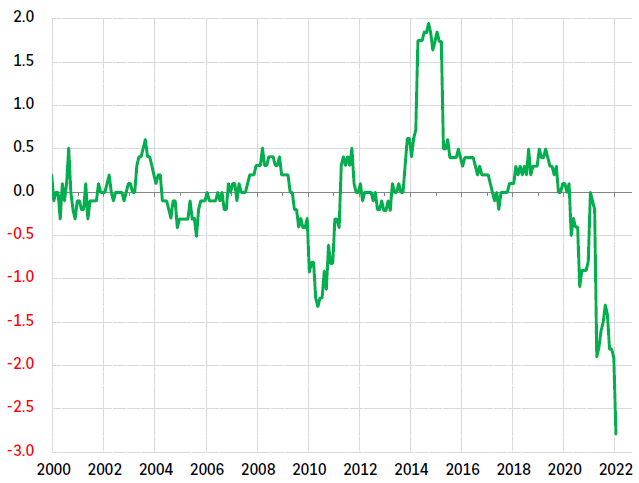
In Japan, possibly more than anywhere else, it is important to distinguish the dynamics between headline and core inflation. Headline inflation – at 0.5% in January – is bound to rise further, led by higher energy prices. By contrast, core inflation is still deeply in deflationary territory, and this trend is amplifying. Excluding perishable food products and energy, the consumer price index (CPI) declined by 1.2% year-on-year in January, the biggest decline since March 2011. The services sector even has reported the strongest deflation since 1970 (-2,8%), mainly due to the sharp drop in mobile phone charges, down more than 50% since March 2021. Medical services were also down (-0.8% y/y), as was durable household goods (-3,0% y/y), and leisure goods (-1.1% y/y).

Even so, the Japanese economy has not been spared an upturn in long-term rates: 10-year JGB yields are now close to the upper range of 0.25% set by the Bank of Japan (BoJ). On February 10th, the central bank has strengthened its policy levers by announcing unlimited purchases of 10-year bonds, if necessary, at a fixed rate of 0.25%1. Unlike the other central banks of the developed countries, which are beginning to normalise monetary policy to counter much higher inflationary pressures, the decline in service prices gives the BoJ more leeway to pursue its accommodating monetary policy.

Japan: Consumer price index in the services sector (y/y % change)
Chart

Source: Statistics Bureau of Japan, BNP Paribas

Download The Full Eco Flash

Author

BNP Paribas Team

BNP Paribas Team

BNP Paribas

BNP Paribas Economic Research Department is a worldwide function, part of Corporate and Investment Banking, at the service of both the Bank and its customers.


More from BNP Paribas Team
Share:

Editor's Picks

EUR/USD: US Dollar to remain pressured until uncertainty fog dissipates

Unimpressive European Central Bank left monetary policy unchanged for the fifth consecutive meeting. The United States first-tier employment and inflation data is scheduled for the second week of February. EUR/USD battles to remain afloat above 1.1800, sellers moving to the sidelines.

GBP/USD reclaims 1.3600 and above

GBP/USD reverses two straight days of losses, surpassing the key 1.3600 yardstick on Friday. Cable’s rebound comes as the Greenback slips away from two-week highs in response to some profit-taking mood and speculation of Fed rate cuts. In addition, hawkish comments from the BoE’s Pill are also collaborating with the quid’s improvement.

Gold: Volatility persists in commodity space

After losing more than 8% to end the previous week, Gold remained under heavy selling pressure on Monday and dropped toward $4,400. Although XAU/USD staged a decisive rebound afterward, it failed to stabilize above $5,000. The US economic calendar will feature Nonfarm Payrolls and Consumer Price Index data for January, which could influence the market pricing of the Federal Reserve’s policy outlook and impact Gold’s performance.

Crypto Today: Bitcoin, Ethereum, XRP rebound amid risk-off, $2.6 billion liquidation wave

US NFP and CPI data awaited after Warsh’s nomination as Fed chief. Yen traders lock gaze on Sunday’s snap election. UK and Eurozone Q4 GDP data also on the agenda. China CPI and PPI could reveal more weakness in domestic demand.

Three scenarios for Japanese Yen ahead of snap election

The latest polls point to a dominant win for the ruling bloc at the upcoming Japanese snap election. The larger Sanae Takaichi’s mandate, the more investors fear faster implementation of tax cuts and spending plans. 

XRP rally extends as modest ETF inflows support recovery

Ripple is accelerating its recovery, trading above $1.36 at the time of writing on Friday, as investors adjust their positions following a turbulent week in the broader crypto market. The remittance token is up over 21% from its intraday low of $1.12.