Is France headed for political stalemate and how bad is this for the Euro? [Video]
-
Far-right National Rally party maintains lead ahead of June 30 first round of votes.
-
But can it secure an absolute majority as left-wing alliance makes progress?
-
A hung parliament might be the worst outcome for the Euro.
![Is France headed for political stalemate and how bad is this for the Euro? [Video]](https://editorial.fxstreet.com/images/Macroeconomics/Countries/Europe/Eurozone_countries/France/red-push-pin-on-map-of-france-53086188_XtraLarge.jpg)

France in political turmoil
President Macron’s decision to call a snap legislative vote hot on the heels of the European elections came as a complete shock not only in France but also across Europe, not to mention for financial markets. What is widely perceived as an attempt by Macron to reassert his authority in the French parliament after his party lost its majority at the previous election in 2022, the move appears to have backfired.
Macron was probably hoping that the mere threat of Marine Le Pen’s National Rally or Rassemblement National (RN) party coming into power after it won the most French seats in the European Parliament would have been a wake-up call for other parties, as well as the French public, to unite against the far right. But that didn’t happen.
With only a few days to go until the first round of voting on June 30, the Ensemble coalition that is led by Macron’s Renaissance party is a distant third in the opinion polls, overtaken by the newly formed alliance of left-wing parties called the New Popular Front (Nouveau Front Populaire - NFP). Meanwhile, RN has widened its lead, with most polls putting it ahead with at least 35% of the vote.
Doubts about a far-right majority
However, that may not necessarily translate to enough seats for RN to obtain an absolute majority in the 577-member National Assembly where 289 seats are required to control the legislative agenda in France’s lower house. This then raises a host of possibilities as to who could form a government.
Talks between RN and an even more hardline far-right party, Reconquete, which belongs to Le Pen’s rival, Eric Zemmour, broke down soon after the announcement of the snap elections. Since then, RN’s 28-year-old leader, Jordan Bardella, has signalled he is not interested in sharing power with other parties and has set the goal of winning an absolute majority.
Going mainstream
This can be seen as being both a positive and negative move. RN is clearly trying to appeal to mainstream voters to secure the majority it needs and in doing so, it has had to tone down some of its more controversial ideas. This is good news for the markets as it reduces the risk of a Liz Truss-style debt crisis and a confrontational relationship with the European Union.
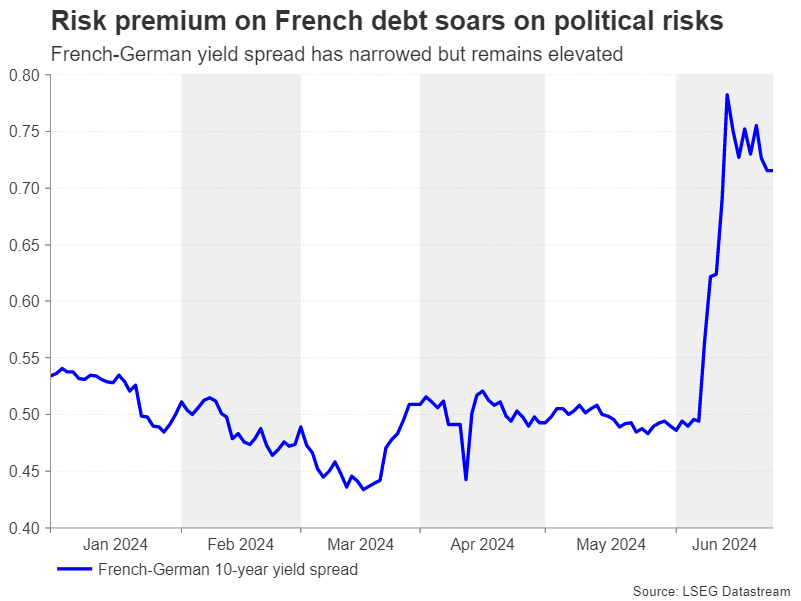
RN’s likely candidate for the post of finance minister has said the party would abide by the EU’s fiscal rules, while Bardella appears to have rowed back on a pledge to undo Macron’s pension reforms, which raised the retirement age to 64. The party’s softened stance on many of its radical policies helped to calm investors’ fears, with the yield spread between French and German 10-year bonds declining somewhat from the post-European election spike.
The euro has also been steadier but remains within its short-term downward trajectory amid the uncertainty about the outcome of the elections. If an RN majority was more certain, the euro might be under less pressure right now as Le Pen and Bardella seem to be taking the party in a similar direction as Italy’s Giorgia Meloni has done with her far-right Brothers of Italy party when she won the country’s election.
Is the left a bigger threat?
If RN wins the most seats but falls short of a majority, it’s still possible it would try to form some sort of a coalition with other parties, potentially with the right-wing Les Republicains, despite ruling it out for now.
The bigger fear is if the left-wing NFP comes a close second and manages to strike a deal with other smaller parties. Its policies include increasing public sector pay by 10%, lowering the retirement age to 62 and boosting healthcare and education. Although it plans to finance these by hiking taxes, it’s questionable if the amount raised would cover the planned 150 billion euros in spending.
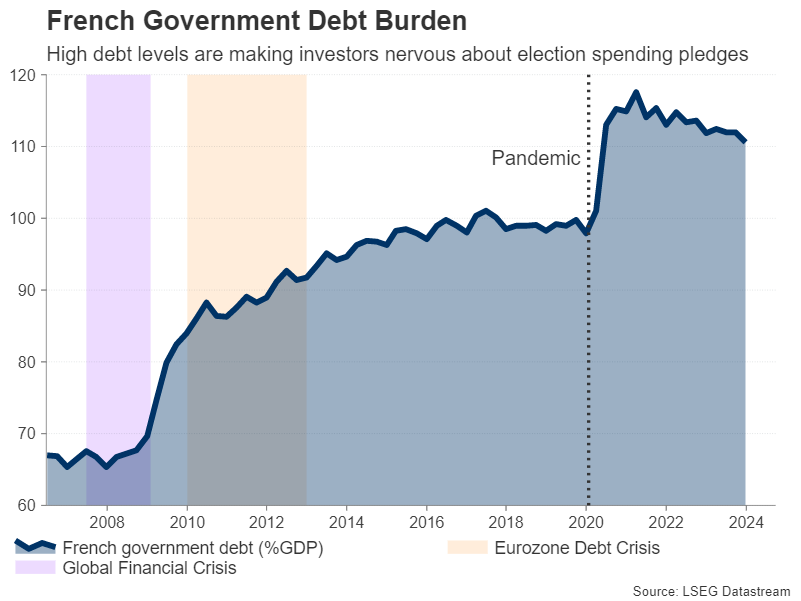
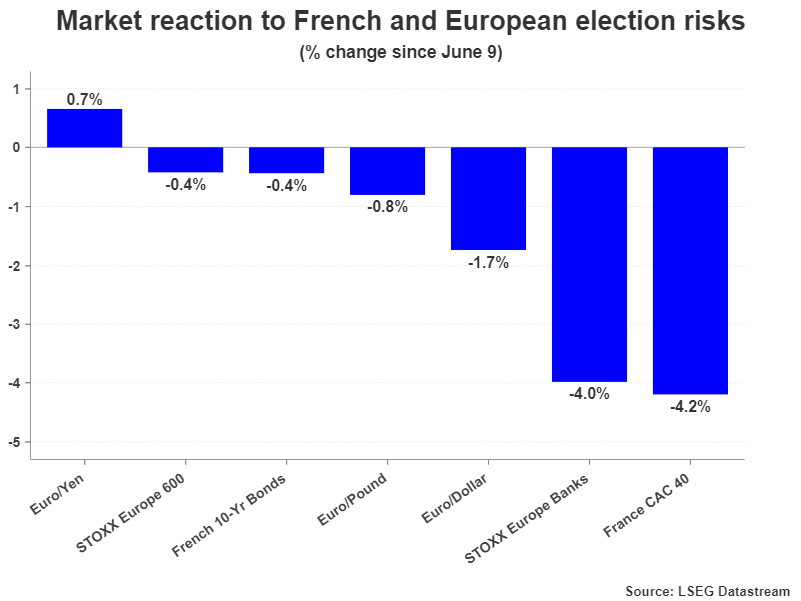
France already has a very high debt level of more than 100% of GDP and ran a budget deficit of 5.5% in 2023, in excess of the EU’s 3% limit. Any new government that triggers alarm bells about higher spending would likely spark another panic in the markets, sending French yields sharply higher and stocks lower. France’s leading stock index, the CAC 40, shed more than 7% as the political turmoil unfolded before rebounding somewhat.
Can Macron’s party hold onto power?
A less disastrous scenario for the markets is if Macron’s Ensemble coalition were to agree to a pact with the NFP simply to keep out the far right and since this would be its only option of being in government given Macron’s plummeting approval ratings. An alliance between the left and centrists parties would probably produce a more moderate government. But even if such a coalition can be agreed, it might not last long or struggle to pass legislation.
In the event of a hung parliament, the President can play a role in pushing parties to reach a deal. The President can also exercise his influence by picking the next prime minister, especially when there’s no clear winner and so the post does not necessarily go to someone from the largest party. However, with so many fractures across France’s political spectrum, it’s hard to see parties putting their differences aside for the sake of avoiding political instability.
Political paralysis
Under the French constitution, new parliamentary elections cannot take place for another year after the last one. So, if no parties are able to form a government, there would likely be political paralysis for at least a whole year or until Macron’s term expires in 2027. If push comes to shove, Macron may decide to stand down before then, even though he has said he would not do so.
For currencies and financial markets in general, there is nothing more dreaded than uncertainty, so the prospect of a prolonged period of uncertainty in the Eurozone’s second largest economy does not bode well for the euro. Making matters worse are concerns about the rise of far right parties in other European countries such as Germany where the ruling coalition is hanging by a thread.
Euro bears eye Dollar parity
Against the US dollar, the single currency has already taken quite a tumble, slipping from the $1.0900 level to lows of around $1.0670. With the final results of the election not due until after the second round on July 7, the euro could continue drifting downwards, possibly towards the April low of $1.0599.
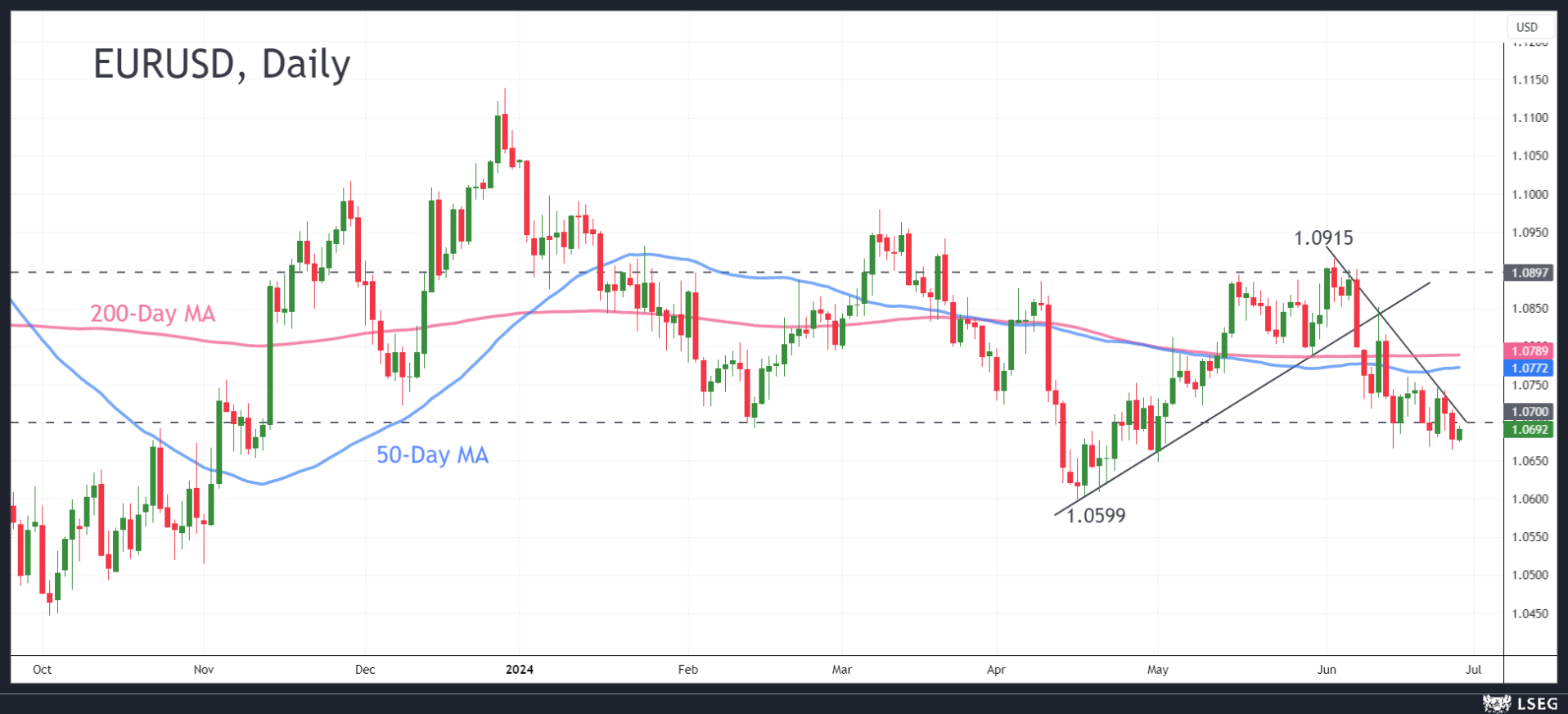
The heightened political risks that have rekindled fears of a fresh debt crisis are already weighing on business sentiment, endangering the Eurozone’s feeble economic recovery. Any sustained deterioration in business confidence could add to the euro’s woes, as the European Central Bank might be more inclined to cut interest rates aggressively.
Whilst steeper rate cuts would be positive for risk assets, it would be bearish for the euro. In the worst case scenario where an extreme right or extreme left party takes power with an agenda of unfunded spending, or even a messy situation where the ruling coalition is unable to ‘cohabit’ with President Macron, the euro could face the prospect of parity again with the dollar.
Author
Mr Boyadjian graduated from the London School of Economics in 1999 with a BSc in Business Mathematics and Statistics. Following graduation, he joined PricewaterhouseCoopers in the Business Recoveries team, where he was responsibl