|

International trade: From shortage to surplus?

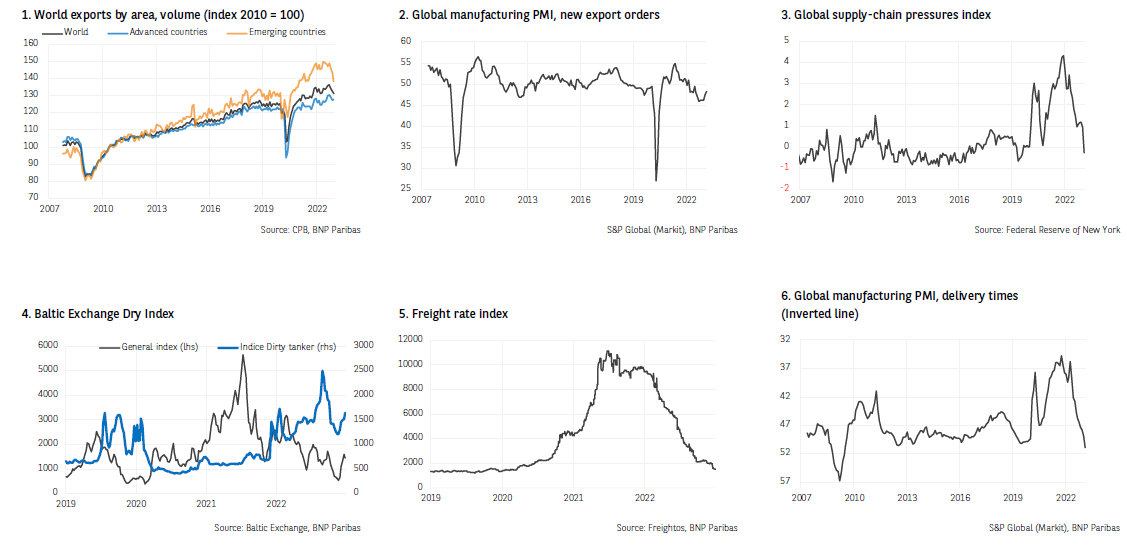
International trade data show quite clearly that the slowing of activity has been accentuated over recent months. Global export volumes (Chart 1), have continued to fall, according to the latest figures (December 2022). Health restrictions in China, which were only relaxed in mid-December, weighed on this dynamic. Nevertheless, global exports saw a 2.6% increase over the whole of 2022, relative to 2021.

The semiconductor sector, considered a good barometer of global activity, has seen falls in production levels and exports, which were amplified at the beginning of the year. This can be seen in particular in South Korea’s export figures, which are viewed as leading indicators: over the first 20 days of February exports, smoothed over three months, fell to their lowest level since October 2017. Although the risk of semiconductor shortages seems to have eased overall, supply in certain sectors, particularly the automotive industry, remains limited.

The slowdown in demand has eased further global production chains, in which bottlenecks had already largely cleared in the second half of 2022. The aggregate index of pressure on global supply chains (Chart 3) fell significantly in February as did the PMI delivery times component (Chart 6). Indeed, in February delivery times were the shortest since May 2009. Maritime freight (Chart 5) saw another fall of nearly 20% over the first half of March. Prices for container ship (Harpex index) were stable following a fall of 80% from its peak twelve months ago. However, the Baltic Dry Index of shipping costs (Chart 4) bounced back at the beginning of the year, due primarily to higher shipping costs for crude oil.
Chart

Download The Full Eco Flash

Author

BNP Paribas Team

BNP Paribas Team

BNP Paribas

BNP Paribas Economic Research Department is a worldwide function, part of Corporate and Investment Banking, at the service of both the Bank and its customers.


More from BNP Paribas Team
Share:

Editor's Picks

EUR/USD: US Dollar to remain pressured until uncertainty fog dissipates

Unimpressive European Central Bank left monetary policy unchanged for the fifth consecutive meeting. The United States first-tier employment and inflation data is scheduled for the second week of February. EUR/USD battles to remain afloat above 1.1800, sellers moving to the sidelines.

GBP/USD reclaims 1.3600 and above

GBP/USD reverses two straight days of losses, surpassing the key 1.3600 yardstick on Friday. Cable’s rebound comes as the Greenback slips away from two-week highs in response to some profit-taking mood and speculation of Fed rate cuts. In addition, hawkish comments from the BoE’s Pill are also collaborating with the quid’s improvement.

Gold: Volatility persists in commodity space

After losing more than 8% to end the previous week, Gold remained under heavy selling pressure on Monday and dropped toward $4,400. Although XAU/USD staged a decisive rebound afterward, it failed to stabilize above $5,000. The US economic calendar will feature Nonfarm Payrolls and Consumer Price Index data for January, which could influence the market pricing of the Federal Reserve’s policy outlook and impact Gold’s performance.

Week ahead: US NFP and CPI data to shake Fed cut bets, Japan election looms

US NFP and CPI data awaited after Warsh’s nomination as Fed chief. Yen traders lock gaze on Sunday’s snap election. UK and Eurozone Q4 GDP data also on the agenda. China CPI and PPI could reveal more weakness in domestic demand.

Three scenarios for Japanese Yen ahead of snap election

The latest polls point to a dominant win for the ruling bloc at the upcoming Japanese snap election. The larger Sanae Takaichi’s mandate, the more investors fear faster implementation of tax cuts and spending plans. 

XRP rally extends as modest ETF inflows support recovery

Ripple is accelerating its recovery, trading above $1.36 at the time of writing on Friday, as investors adjust their positions following a turbulent week in the broader crypto market. The remittance token is up over 21% from its intraday low of $1.12.