How to trade the Fed rate decision

The Federal Reserve (Fed) is the United States (US) central bank. A central bank usually provides financial and banking services for its country's government and commercial banking system.
It also issues the local currency and implements monetary policy. Each decision has a vast impact on the value of the local currency, and hence, Forex (FX) traders pay extreme attention to each announcement.
The Fed meets roughly every six weeks, or eight times a year, for two consecutive days, announcing its decision afterwards. The decision is made by a limited number of Fed officials, known as the Federal Open Market Committee (FOMC).
The Fed’s upcoming announcement is expected to be the most relevant of the year, given that the central bank is finally meant to change its monetary policy.
Does the Fed's decision provide opportunities for traders?
Indeed, the Fed’s decisions usually trigger volatility across financial markets.
Generally speaking, changes in the interest rate affect all companies and households. Simply put, higher rates lift money costs, resulting in restricted consumption. The Fed hikes rates when it wants to cool down consumption and, hence, inflation.
The opposite scenario is also valid. Lower rates tend to boost consumption and, therefore, economic growth.
At the same time, hiking rates usually result in a stronger currency, in this case, the US Dollar (USD), while trimming them usually weakens the currency.
There is, however, one caveat: Market players usually anticipate the decision and price it, selling or buying the USD in anticipation of the announcement. With that in mind, policymakers’ actions that align with expectations tend to generate a limited reaction.
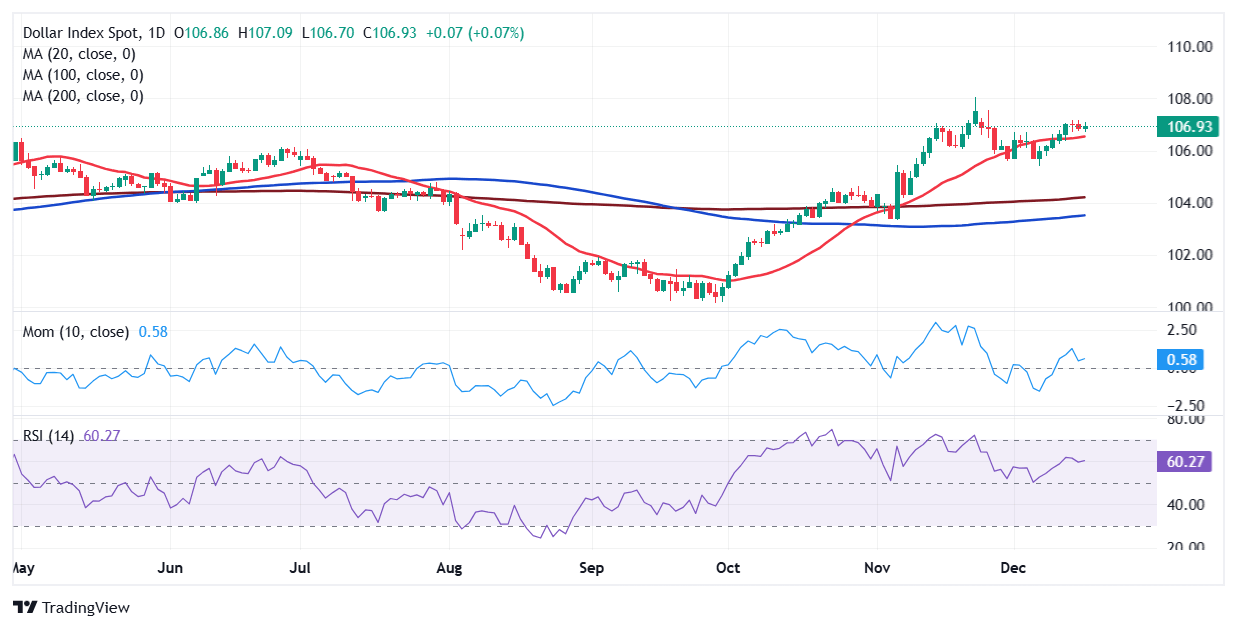
The DXY US Dollar Index, which gauges the value of the US Dollar against a basket of major currencies, has surged the days ahead of the Fed meeting even as investors broadly expect the central bank to cut interest rates.
Volatility within this kind of event is usually linked to the deviation between the market’s expectation and the actual decision.
What is expected the Fed will do in the upcoming December meeting?
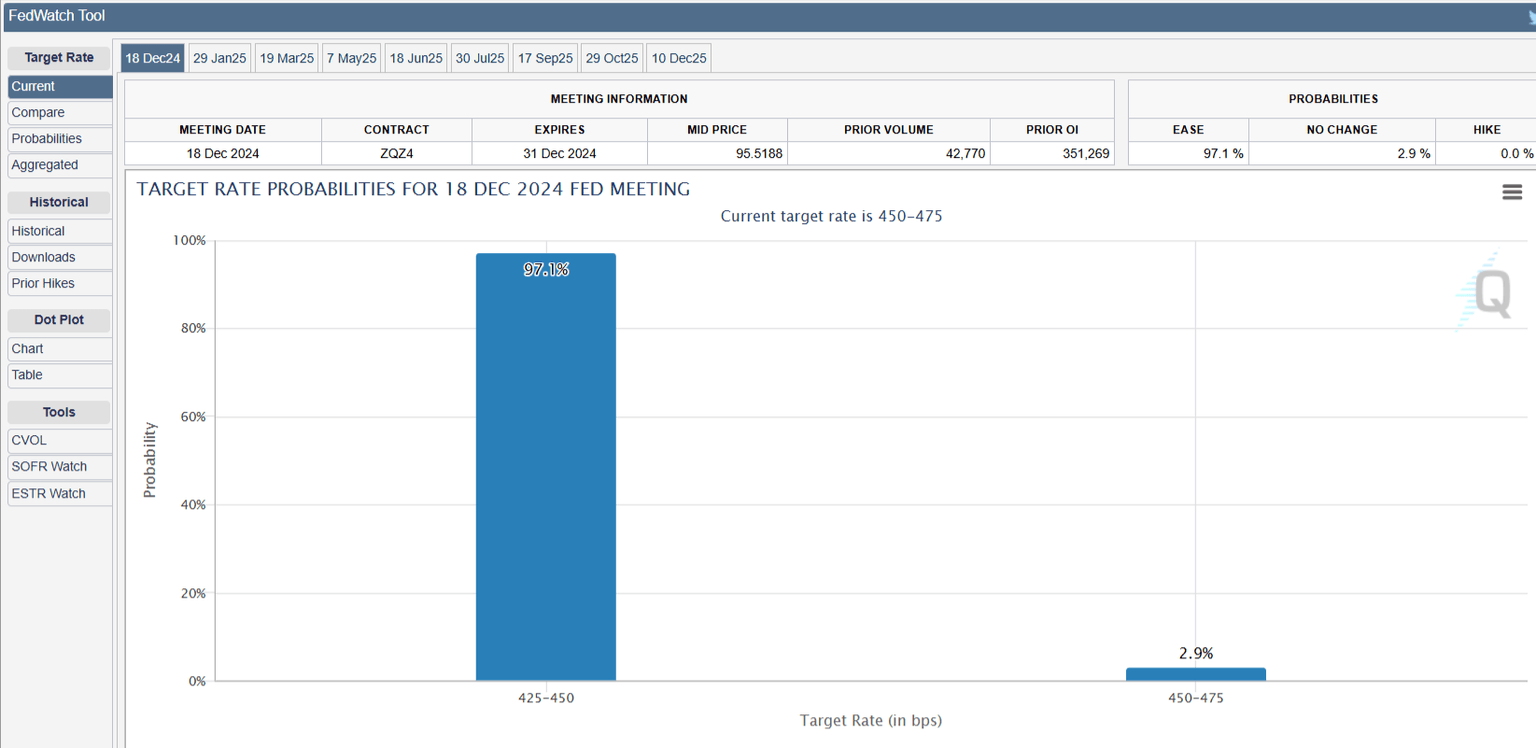
Before the announcement, investors have priced in a 25 basis points (bps) cut. As of Tuesday, the odds for such a decision stand at 97.1%, according to the CME FedWatch Tool, having changed little after the US election outcome.
This time, the Fed will release the Summary of Economic Projections (SEP), a report that provides insights into the economic outlook and expectations of the FOMC members. It is released four times a year, with the latest published in September.
The document includes officials' perspectives on key economic figures, such as Real GDP Growth, the Unemployment Rate and inflation. Additionally, the SEP projects the federal funds rate, which is the interest rate at which banks lend to each other.
The SEP does not grant future action or levels of economic improvement, it just outlines policymakers’ perspectives on them.
What are the different scenarios and how to trade December’s Fed decision?
As said, the USD reaction will depend on the Fed’s ability to surprise investors.
Generally speaking, the interest rate announcement will trigger the initial reaction. If policymakers keep rates on hold, that would be an unexpected outcome and be read as hawkish, resulting in the US Dollar soaring across the FX board.
Officials, however, are unlikely to proceed this way, as they usually refrain from triggering volatile markets’ reactions.
A 25 bps trim, as expected, will have no significant impact on the USD. Instead, investors will look at the SEP or dot-plot, searching for clues on what they could expect in 2025.
Are policymakers willing to keep trimming rates? At a faster or at a slower pace? Do they see inflation shrinking further into the Fed’s goal or, on the contrary, ticking higher? The answer to such questions will set the USD direction once market players digest the news.
Speculative interest will then wait for Chairman Jerome Powell's speech. Powell’s press conference usually hints at what the Fed may or may not do in the next meeting, and investors will take further clues from it.
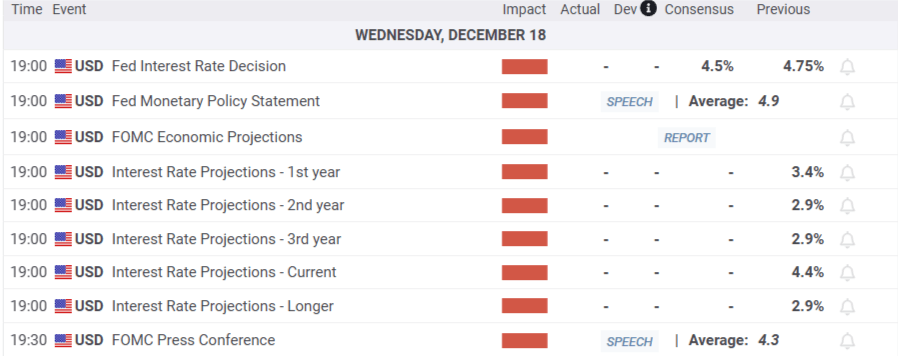
Main events related to the December’s Federal Reserve decision. Source: FXStreet
Given the USD momentum ahead of the announcement, dovish words from Chair Powell could trigger a bearish correction. Still, it could be short-lived, as speculative interest will likely resume buying at better levels.
Hawkish words will maintain the USD on the bullish side, yet the lack of surprise could moderate gains.
Generally speaking, and unless the message is super clear from all sides, the market would take some 15 minutes to find its way. The initial reaction could be wiped out, and the USD could change course pretty fast afterwards.
Once the dust settles, and if there is a clear path for the Greenback, the most likely scenario is that such a directional move will resume once Asian traders reach their desks.
Premium
You have reached your limit of 3 free articles for this month.
Start your subscription and get access to all our original articles.
Author
Valeria Bednarik
FXStreet
Valeria Bednarik was born and lives in Buenos Aires, Argentina. Her passion for math and numbers pushed her into studying economics in her younger years.

















