|

Housing shortage, a major challenge for the Labour Party

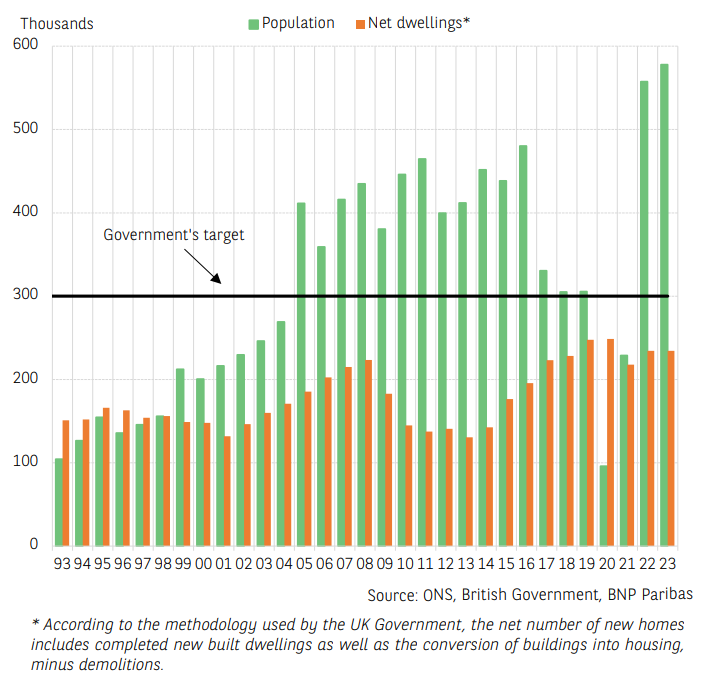
The newly elected Labour Party has set a target of 1,500,000 extra homes in five years, or 300,000 a year, in an attempt to reduce the shortage in England. This is not a new figure; it was already the one put forward in the Conservative Party manifesto when Boris Johnson was elected in 2019.

Dwelling and population growth in England
Chart

By creating on average 250,000 homes a year between 2019 and 2023,[1] the target was far from having been achieved by the Tories, who admittedly came up against a succession of shocks (health crisis, soaring costs of materials and interest rates, labour shortages exacerbated by Brexit). Among the measures targeted by the Labour Party, the most important is arguably that aimed at reforming the rules around housing planning in the country (National Planning Policy Framework), which, as well as reintroducing quotas, aims to simplify and speed up the process of obtaining planning permission.

"Get Britain building again" would mean a change of gear never seen before. With the exception of the Covid-19 crisis in 2020, when population growth fell sharply as a result of restrictions on mobility to the UK, the creation of new housing in England has failed for almost 25 years to keep pace with population growth. While construction activity will benefit from the forthcoming fall in interest rates and the normalisation of production costs, the lack of available workers will limit these effects.

Download The Full Eco Flash

Author

BNP Paribas Team

BNP Paribas Team

BNP Paribas

BNP Paribas Economic Research Department is a worldwide function, part of Corporate and Investment Banking, at the service of both the Bank and its customers.


More from BNP Paribas Team
Share:

Editor's Picks

EUR/USD plummets to 1.1840 on US NFP

EUR/USD’s selling momentum now picks up pace and rapidly hits the 1.1840 region on Wednesday. Indeed, the pair’s decline comes amid rising buying pressure on the US Dollar in the wake of firmer-than-expected results from US NFP in January.

GBP/USD approaches 1.3600 on USD-buying

GBP/USD adds to Tuesday’s pullback and trades closer to the 1.3600 support on Wednesday. That said, Cable’s extra downside traction comes against the backdrop of renewed strength in the Greenback as investors assess the latest US NFP data.

Gold trims gains post-NFP, targets $5,000

Gold rapidly reverses initial gains and retreats to the vicinity of the $5,000 region per troy ounce amid further gains in the Greenback and rising US Treasury yields, all following the latest US NFP readings.

Ripple Price Forecast: XRP sell-side pressure intensifies despite surge in addresses transacting on-chain 

Ripple (XRP) is edging lower around $1.36 at the time of writing on Wednesday, weighed down by low retail interest and macroeconomic uncertainty, which is accelerating risk-off sentiment.

S&P 500 at 7,000 is a valuation test, not a liquidity problem

The rebound from last week’s drawdown never quite shook the sense that it was being supported by borrowed conviction. The S&P 500 once again tested near the 7,000 level (6,986 as the high watermark) and failed, despite a macro backdrop that would normally be interpreted as supportive of risk.

Bitcoin price slips below $67,000 ahead of US Nonfarm Payrolls data

Bitcoin price extends losses, and trades below the lower consolidating boundary at $67,300 at the time of writing. A firm close below this level could trigger a deeper correction for BTC. Despite the weakness in price action, institutional demand shows signs of support, recording mild inflows in ETFs so far this week.