Has households' purchasing power returned to its pre-inflation level?


While in most major advanced economies the year-on-year growth in nominal wages has been back above inflation for a few months now, we can ask ourselves where households’ purchasing power stands compared to its pre-inflationary crisis level. This purchasing power can be measured in two ways: in the broad sense and more accurately, when it is calculated on the basis of the real gross disposable income (GDI) of households; and in a narrower sense, but perhaps more meaningful for households, when it is assessed on the basis of real wages[1].
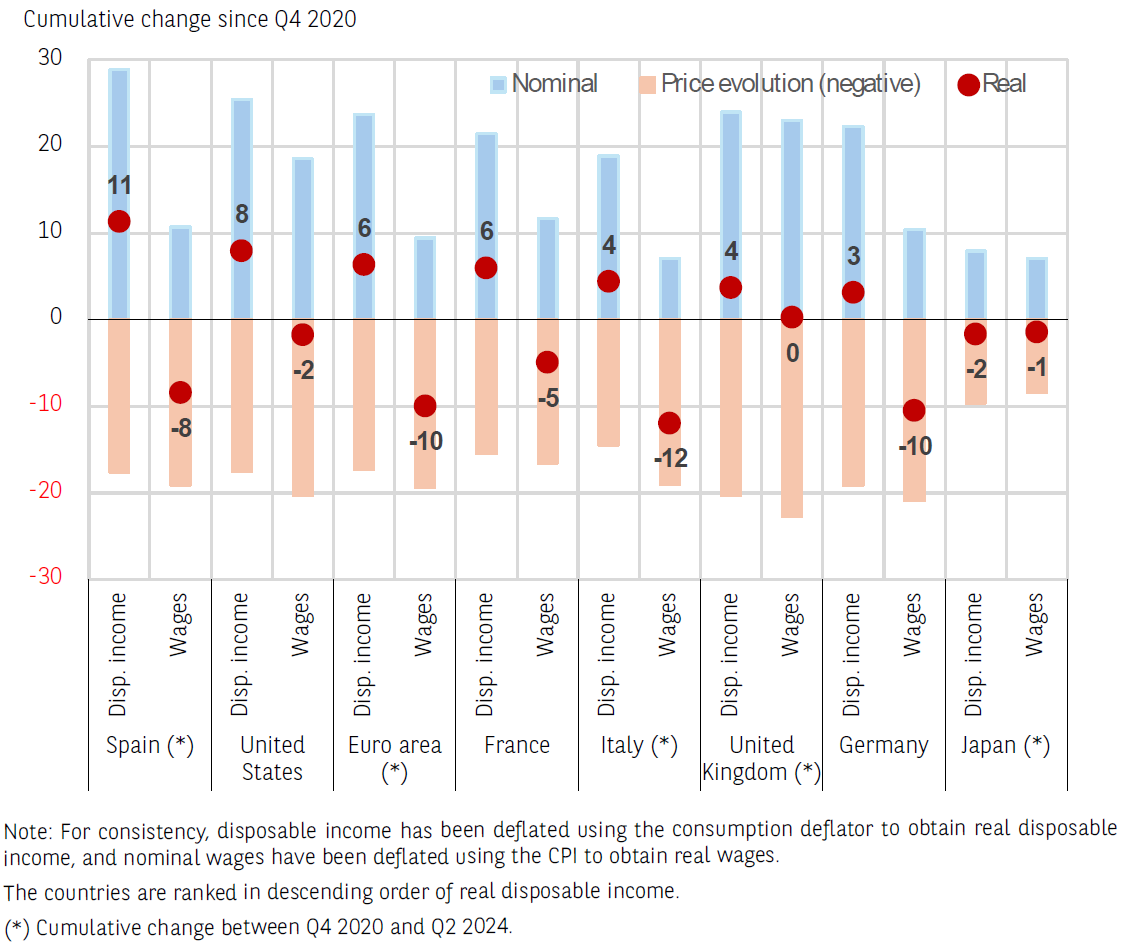
Since Q4 2020 (the reference date chosen because it marks the trough of inflation before the first signs of its surge in early 2021), gains in GDI purchasing power, of varying magnitude, have been recorded in all the countries analysed, with the exception of Japan. In contrast, the cumulative increase in nominal wages remains below that of the consumer price index (CPI) in all countries. It should be noted that the difference in cumulative evolution between the consumption deflator and the CPI is, in fact, not very large, and is always the same sign (except in Japan).
Author
BNP Paribas Team
BNP Paribas
BNP Paribas Economic Research Department is a worldwide function, part of Corporate and Investment Banking, at the service of both the Bank and its customers.

















