|

Greenflation: How inflationary is the energy transition?
Green production will initially cost more

The green transition will largely involve a change in production methods. The physical capital used to produce today is largely responsible for the high greenhouse gas (GHG) emissions. In order to produce “green”, this capital will need to be replaced by structures, equipment, materials and techniques that emit fewer GHGs. These major changes are likely to be inflationary, although opposite effects cannot be ruled out. We distinguish between several channels.

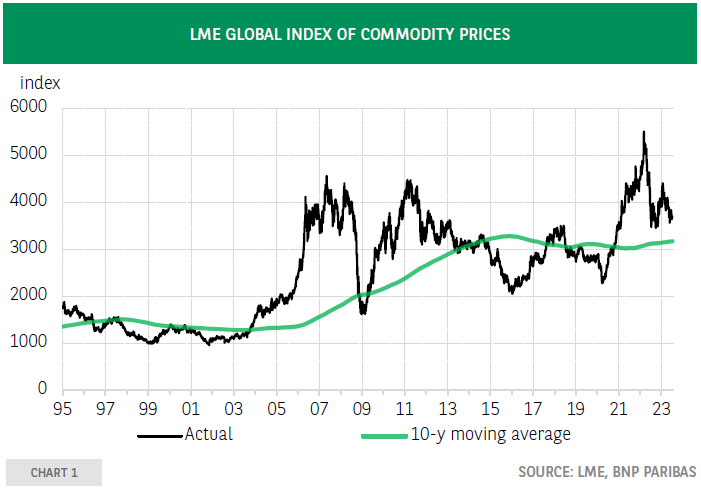
First, some of the minerals needed to develop a “net zero” industry are available in limited quantities and some are difficult to extract even though they are in high demand. According to the International Energy Agency, total demand for minerals to produce low-carbon technologies is expected to increase fourfold by 20401 assuming that the objectives of the Paris Agreements are met (see Chart 1). Regarding lithium, for example, for which demand is expected to quadruple between 2025 and 20352, scientists are still divided as to whether the reserves available will be sufficient to meet the growing demand for electric batteries. A first major difficulty comes from the high concentration of ore supply in the hands of a very small number of producers.
Chart

Download The Full Eco Flash

Author

BNP Paribas Team

BNP Paribas Team

BNP Paribas

BNP Paribas Economic Research Department is a worldwide function, part of Corporate and Investment Banking, at the service of both the Bank and its customers.


More from BNP Paribas Team
Share:

Editor's Picks

EUR/USD holds firm above 1.1900 as US NFP looms

EUR/USD holds its upbeat momentum above 1.1900 in the European trading hours on Wednesday, helped by a broadly weaker US Dollar. Markets could turn cautious later in the day as the delayed US employment report for January will takes center stage. 

GBP/USD recovers losses despite rising UK political risks, BoE rate cut bets

Pound Sterling advances against the US Dollar after registering modest losses in the previous session, trading around 1.3650 during the Asian hours on Wednesday. The pair could extend losses as the Pound Sterling faces pressure from rising political risks in the UK and growing expectations of near-term Bank of England rate cuts.

Gold sticks to gains near $5,050 as focus shifts to US NFP

Gold holds moderate gains near the $5,050 level in the European session on Wednesday, reversing a part of the previous day's modest losses amid dovish US Federal Reserve-inspired US Dollar weakness. This, in turn, is seen as a key factor acting as a tailwind for the non-yielding yellow metal ahead of the critical US NFP release. 

Bitcoin, Ethereum and Ripple show no sign of recovery

Bitcoin, Ethereum, and Ripple show signs of cautious stabilization on Wednesday after failing to close above their key resistance levels earlier this week. BTC trades below $69,000, while ETH and XRP also encountered rejection near major resistance levels. With no immediate bullish catalyst, the top three cryptocurrencies continue to show no clear signs of a sustained recovery.

Dollar drops and stocks rally: The week of reckoning for US economic data

Following a sizeable move lower in US technology Stocks last week, we have witnessed a meaningful recovery unfold. The USD Index is in a concerning position; the monthly price continues to hold the south channel support.

BNB prolonged correction signals deeper bearish momentum
BNB (BNB), formerly known as Binance Coin, is trading below $618 on Wednesday, marking the sixth consecutive day of correction since the weekend. The bearish price action is further supported by rising short bets alongside negative funding rates in the derivatives market.