Gold Weekly Forecast: Uptrend remains intact with a chance of correction
- Gold set a new all-time high for the fourth consecutive week.
- Investors will remain focused on Trump tariff talks in the absence of high-tier data releases.
- XAU/USD remains within an uptrend, but overbought conditions could pave the way for a correction.


Gold (XAU/USD) regained bullish momentum and touched a new record high above $2,950 on Thursday before entering a consolidation phase. Nevertheless, the precious metal posted gains for the eighth consecutive week. Geopolitical and political headlines are likely to continue to drive Gold’s valuation in the near term.
Gold shows no signs of slowing
Gold fell near 1.5% on Friday, February 14, as investors booked their profits. Thin trading conditions at the beginning of the new week limited XAU/USD’s volatility, with financial markets in the US remaining closed on Monday in observance of the Presidents’ Day holiday.
After announcing sweeping 25% tariffs on all steel and aluminum imports in the previous week, US President Donald Trump said on Tuesday that he plans to impose tariffs of around 25% on foreign cars and added that semiconductor chip and pharmaceutical imports are next in line to face higher duty charges. Gold gathered bullish momentum and gained about 1.3% on the day.
In the absence of fundamental drivers, Gold entered a consolidation phase and failed to make a decisive move in either direction on Wednesday. Later in the day, the Federal Reserve’s (Fed) Minutes of the January policy meeting showed that some policymakers noted that potential changes in trade and immigration policy could hinder the disinflation process.
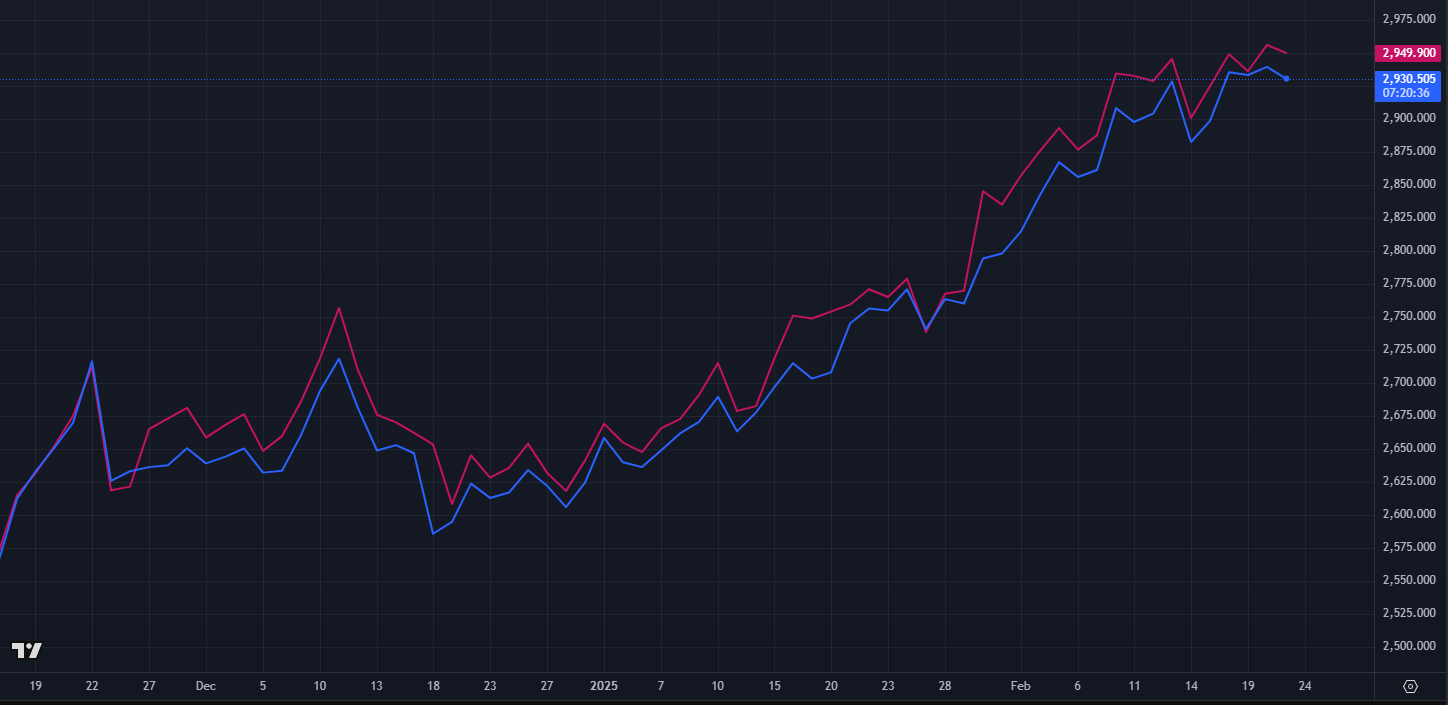
Meanwhile, news of some of the world’s biggest financial institutions capitalizing on the price differences between the Gold futures market in New York and the cash market in London garnered investors’ attention throughout the week. JPMorgan and HSBC are reportedly the biggest names transporting Gold from London to New York in commercial flights to cover losses on short positions, as futures prices in New York rise at a faster pace than in London due to looming threats of Trump’s aggressive tariff policy triggering a trade war with Europe. The chart below highlights the difference between spot Gold prices (blue line) and the COMEX Futures prices (red line).
In a report published on Tuesday, Goldman Sachs said it had revised its end-2025 projection for Gold price to $3,100 from $2,890. "We estimate that structurally higher central bank demand will add 9% to the gold price by year-end, which, combined with a gradual boost to ETF (exchange traded funds) holdings as the funds rate declines, should outweigh the drag from normalizing positioning, assuming uncertainty diminishes," Goldman Sachs explained.
“However, if policy uncertainty–including tariff fears–stays high, higher speculative positioning for longer could push gold prices as high as $3,300/oz by year-end.”
On Friday, the data from the US showed that the S&P Global Composite PMI declined to 50.4 in February's flash estimate from 52.7 in January. The benchmark 10-year US Treasury bond yield dropped below 4.5% after this data and helped XAU/USD hold its ground heading into the weekend.
Gold investors to stay focused on political and geopolitical headlines
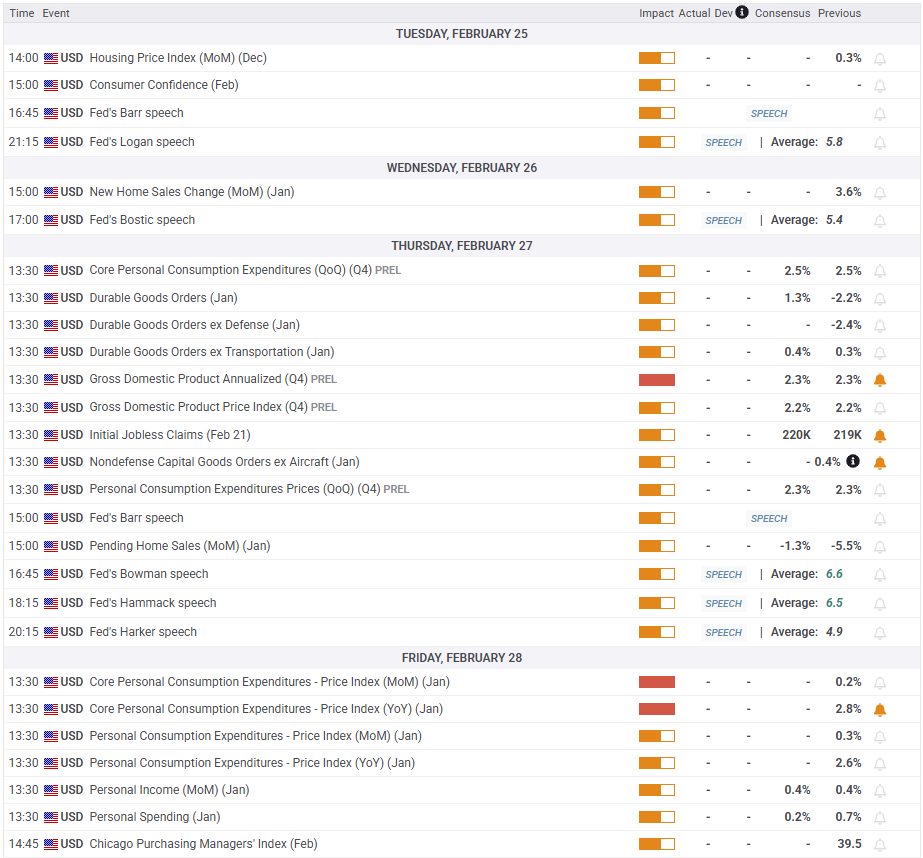
The US economic docket will offer a few data releases that could have a short-lasting effect on Gold’s valuation. On Thursday, the US Bureau of Economic Analysis will publish its second estimate of the annualized fourth-quarter 2024 Gross Domestic Product (GDP) growth data. Any upward revision to the initial estimate of 2.3% could support the US Dollar (USD) and weigh on XAU/USD with the immediate reaction.
On Friday, the Personal Consumption Expenditures (PCE) Price Index data for January will be featured in the US economic calendar. A smaller-than-expected increase in the monthly core PCE Price Index could hurt the USD and support Gold price heading into the weekend.
In the meantime, investors will continue to pay close attention to the difference in futures and spot Gold prices. In case the same trend continues, with financial institutions looking to buy Gold in cash markets, Gold prices could remain supported in the near term. However, if the Trump administration adopts a more optimistic tone about developing constructive trade relations with Europe, Gold could come under bearish pressure.
Further developments surrounding the Russia-Ukraine conflict could also influence Gold’s performance. In a social media post, Trump called Ukrainian President Volodymyr Zelenskiy a “dictator without elections” and urged him to move fast or risk losing his country. Reporting on the issue, “European officials have been left shocked and flat-footed by the Trump administration's Ukraine moves in recent days,” Reuters said. A further escalation of geopolitical tensions with the EU and the US clashing over the resolution of the conflict could trigger another leg higher in Gold prices.
Gold technical analysis
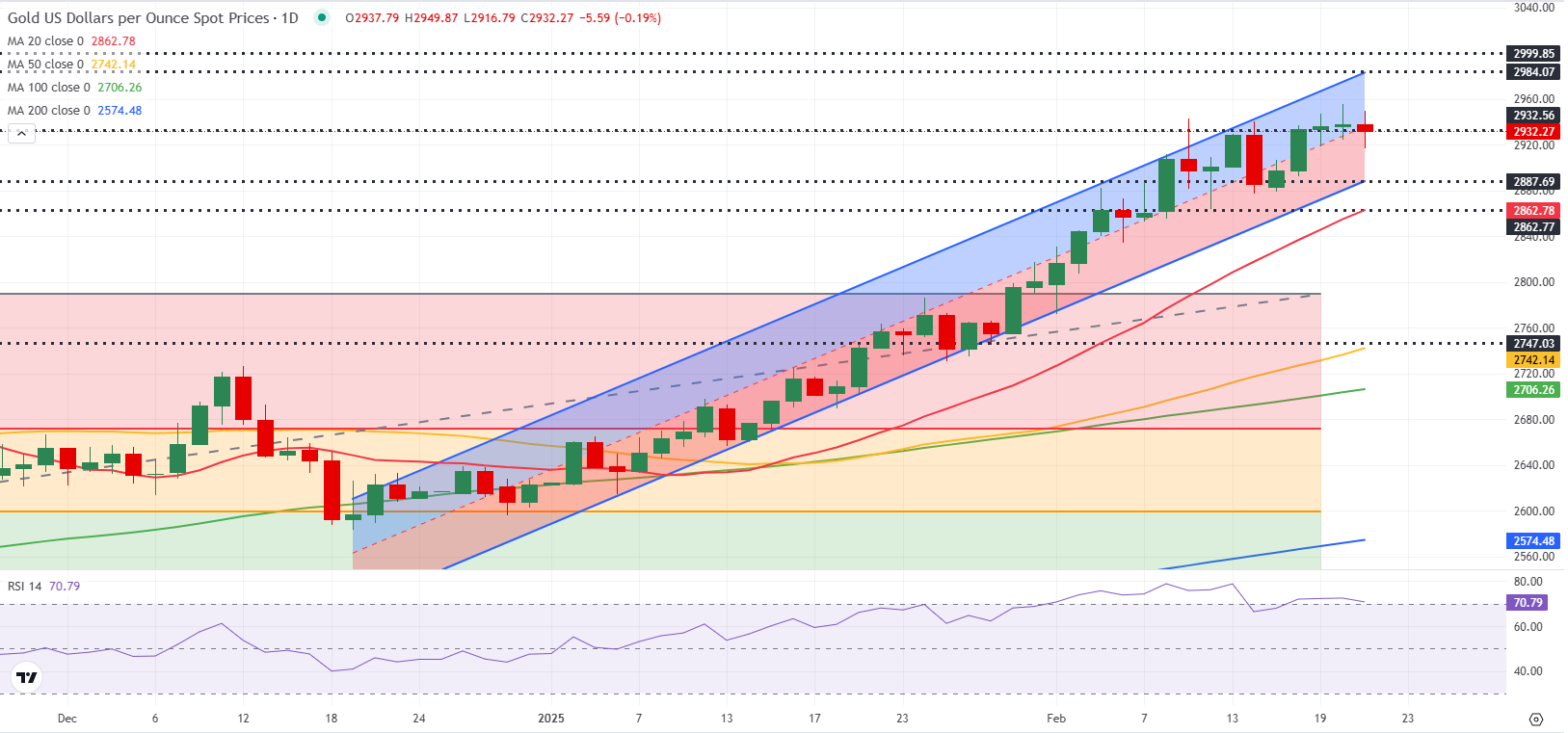
Gold remains within a two-month-old ascending regression channel, while the Relative Strength Index (RSI) indicator on the daily chart stays near 70, suggesting that the bullish bias remains intact with the possibility of a technical correction in the short term.
In case Gold confirms $2,930 (mid-point of the ascending channel) as support, the upper limit of the ascending channel could be seen as the next resistance at $2,985 before $3,000 (psychological level). On the downside, $2,900 (round level) aligns as interim support before $2,885 (lower limit of the ascending channel). A daily close below the latter could discourage buyers and open the door for an extended correction toward the 20-day Simple Moving Average, currently located near $2,860.
Gold FAQs
Gold has played a key role in human’s history as it has been widely used as a store of value and medium of exchange. Currently, apart from its shine and usage for jewelry, the precious metal is widely seen as a safe-haven asset, meaning that it is considered a good investment during turbulent times. Gold is also widely seen as a hedge against inflation and against depreciating currencies as it doesn’t rely on any specific issuer or government.
Central banks are the biggest Gold holders. In their aim to support their currencies in turbulent times, central banks tend to diversify their reserves and buy Gold to improve the perceived strength of the economy and the currency. High Gold reserves can be a source of trust for a country’s solvency. Central banks added 1,136 tonnes of Gold worth around $70 billion to their reserves in 2022, according to data from the World Gold Council. This is the highest yearly purchase since records began. Central banks from emerging economies such as China, India and Turkey are quickly increasing their Gold reserves.
Gold has an inverse correlation with the US Dollar and US Treasuries, which are both major reserve and safe-haven assets. When the Dollar depreciates, Gold tends to rise, enabling investors and central banks to diversify their assets in turbulent times. Gold is also inversely correlated with risk assets. A rally in the stock market tends to weaken Gold price, while sell-offs in riskier markets tend to favor the precious metal.
The price can move due to a wide range of factors. Geopolitical instability or fears of a deep recession can quickly make Gold price escalate due to its safe-haven status. As a yield-less asset, Gold tends to rise with lower interest rates, while higher cost of money usually weighs down on the yellow metal. Still, most moves depend on how the US Dollar (USD) behaves as the asset is priced in dollars (XAU/USD). A strong Dollar tends to keep the price of Gold controlled, whereas a weaker Dollar is likely to push Gold prices up.
Premium
You have reached your limit of 3 free articles for this month.
Start your subscription and get access to all our original articles.
Author
Eren Sengezer
FXStreet
As an economist at heart, Eren Sengezer specializes in the assessment of the short-term and long-term impacts of macroeconomic data, central bank policies and political developments on financial assets.