Gold Price Weekly Forecast: XAU/USD faces two-way risks in Fed week
- Gold price failed to gather directional momentum this week.
- Technical outlook reveals key levels that XAU/USD needs to clear for next breakout.
- May inflation data from the US and Fed's policy meeting will be watched closely.


Gold price continued to fluctuate in its three-week-old range as investors refrained from taking large positions ahead of next week’s highly-anticipated macroeconomic events. The US Consumer Price Index (CPI) data for May on Tuesday and the Federal Reserve’s (Fed) policy announcements on Wednesday could help XAU/USD find the next direction.
What happened this week?
Gold price fell below $1,950 at the beginning of the week as investors continued to digest the impressive May jobs report from the US, which showed that Nonfarm Payrolls rose 339,000 to surpass the market expectation of 190,000 by a wide margin. In the second half of the day, however, the US Dollar (USD) came under selling pressure after the ISM Services PMI survey revealed a loss of momentum in service sector activity. Furthermore, the publication showed the Prices Paid Index edged lower to 56.2 from 59.6, while the Employment Index dropped to 49.2 from 50.8, pointing to a softer input inflation and a decline in the sector’s payrolls. The downbeat data prompted XAU/USD to regain traction and Gold closed the day in positive territory.
In the absence of high-tier data releases, Gold price traded in a very tight range on Tuesday before turning south on Wednesday. In an unexpected decision, the Bank of Canada (BoC) raised its policy rate by 25 basis points to 4.75%, triggering a rally in global bond yields. As the benchmark 10-year US Treasury bond yield rose nearly 4% mid-week, inversely-correlated XAU/USD once again slumped below $1,950.
Following a quiet European session on Thursday, Gold price gathered bullish momentum and advanced toward $1,970. Initial Jobless Claims in the US jumped to 261,000 in the week ended June 3 from 233,000 a week earlier, highlighting looser labor market conditions and attracting dovish Fed bets. Signs of increasing unemployment levels mean less labor shortages, a key factor behind recent wage increases that have fueled inflation particularly in the services sector. The trading action turned subdued ahead of the weekend and XAU/USD moved up and down in a narrow channel at around $1,960 on Friday.
Next week
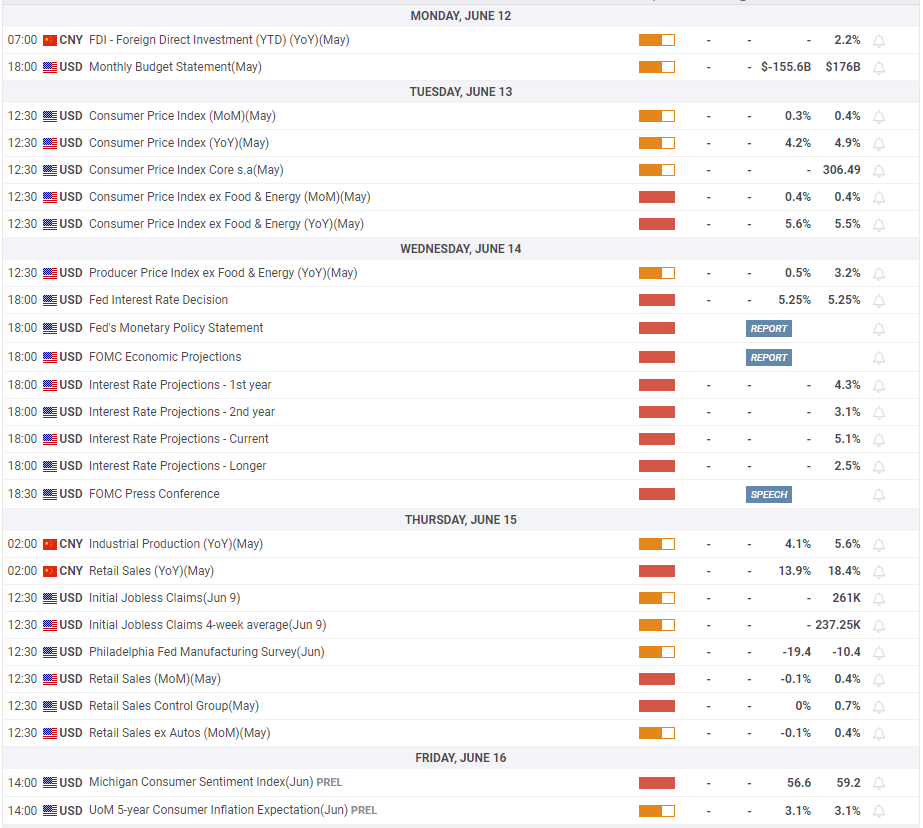
The Consumer Price Index (CPI) in the US is forecast to rise 4.2% on an annual basis in May, down from the 4.9% increase recorded in April. The Core CPI, which excludes volatile food and energy prices, is seen rising 5.6% in the same period on the back of a 0.4% monthly increase.
Markets are likely to react to the monthly Core CPI figure since it is not distorted by base effects stemming from energy prices. More importantly, the Fed is most concerned about inflation in core services excluding housing, and this measure hasn’t softened significantly yet. The current market positioning suggests that it will take a significant increase in Core CPI for investors to change their minds about the Fed leaving its policy rate unchanged on Wednesday. Since January 2022, monthly Core CPI rose 0.6% three times, the last one coming in September 2022. Another 0.6% or even higher jump could open the door to one more 25 bps Fed hike, triggering a rally in the USD and weighing heavily on XAU/USD. On the other hand, a smaller-than-forecast rise should confirm a pause in the Fed’s tightening cycle and help Gold price stretch higher.
It’s difficult to assess the potential impact of the Fed’s rate decision on Gold price before seeing how May inflation data will influence the market pricing. At this point, the CME Group FedWatch Tool shows that markets are pricing in a more than 75% probability of the Fed holding the policy rate steady at 5-5.25% range.
In case inflation data confirms no change in interest rates, a 25 bps hike would be seen as a hawkish surprise and provide a boost to the USD and US bond yields, leading to a sharp decline in XAU/USD. On the other hand, Gold price is likely to surge if the Fed doesn’t touch interest rates despite strong CPI figures for May.
In the Fed’s March Summary of Projections (SEP), the so-called dot plot, the median view of the policy rate at end-2023 stood at 5.1%. If the Fed leaves the policy rate steady but revises the terminal projection rate higher, that would suggest that policymakers are not done with rate increases, making it difficult for Gold price to gain traction. An unchanged terminal rate forecast should have the opposite effect and help XAU/USD push higher.
Market participants will also pay close attention to FOMC Chairman Jerome Powell’s comments on the policy outlook. Following the May meeting, Powell reiterated that it would not be appropriate to cut the policy rate this year and explained that it was difficult to predict how much credit tightening will replace the need for any further rate hikes. If Powell continues to push back against rate-cut expectations, the USD could stay resilient and limit XAU/USD’s potential gains. Similarly, any remarks that suggest credit tightening is not as severe as initially anticipated should have a positive impact on the USD’s valuation. On the flip side, Gold price is likely to turn north in case Powell opens the door to the possibility of a rate cut in late 2023 or early 2024.
Still, heightened volatility in financial markets during the Fed event will make it even harder to figure out XAU/USD’s next direction. Hence, it might be wise to wait for the dust to settle before taking a position.
Gold technical outlook
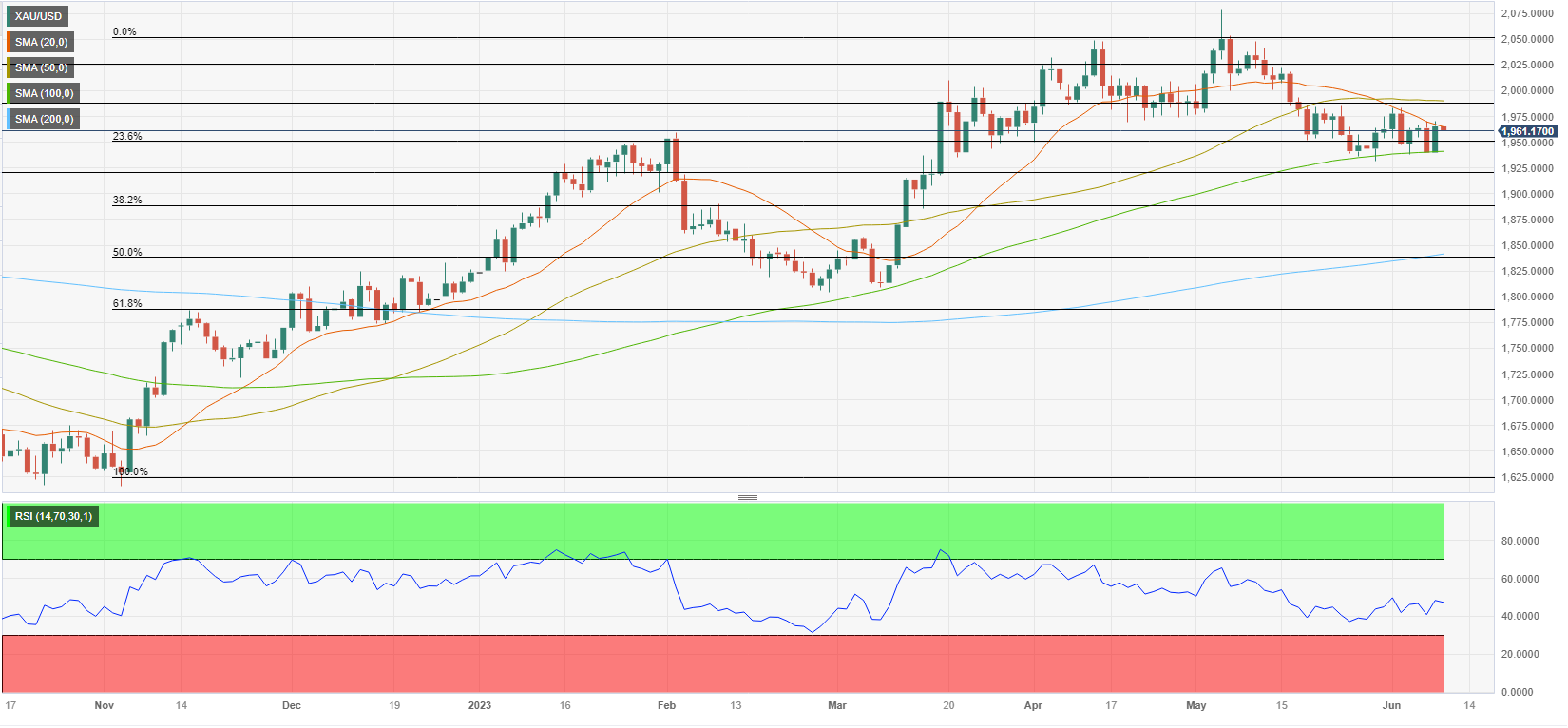
Gold price has been moving in between the 50-day and the 100-say Simple Moving Averages (SMA) since mid-May, reflecting the yellow metal's indecisiveness. Additionally, the Relative Strength Index (RSI) indicator on the daily chart fluctuates near 50, highlighting the neutral stance.
On the upside, $1,990 (50-day SMA) aligns as first hurdle. With a daily close above that level, XAU/USD could face resistance at $2,000 (psychological level, static level) before targeting $2,025 (static level).
$1,950/$1,945 (Fibonacci 23.6% retracement of the latest uptrend, 100-day SMA) forms important support. If Gold price falls below that area and starts using it as resistance, sellers could show interest and open the door for an extended decline toward $1,925 (static level) and $1,900 (Fibonacci 38.2% retracement, psychological level).
Gold forecast poll
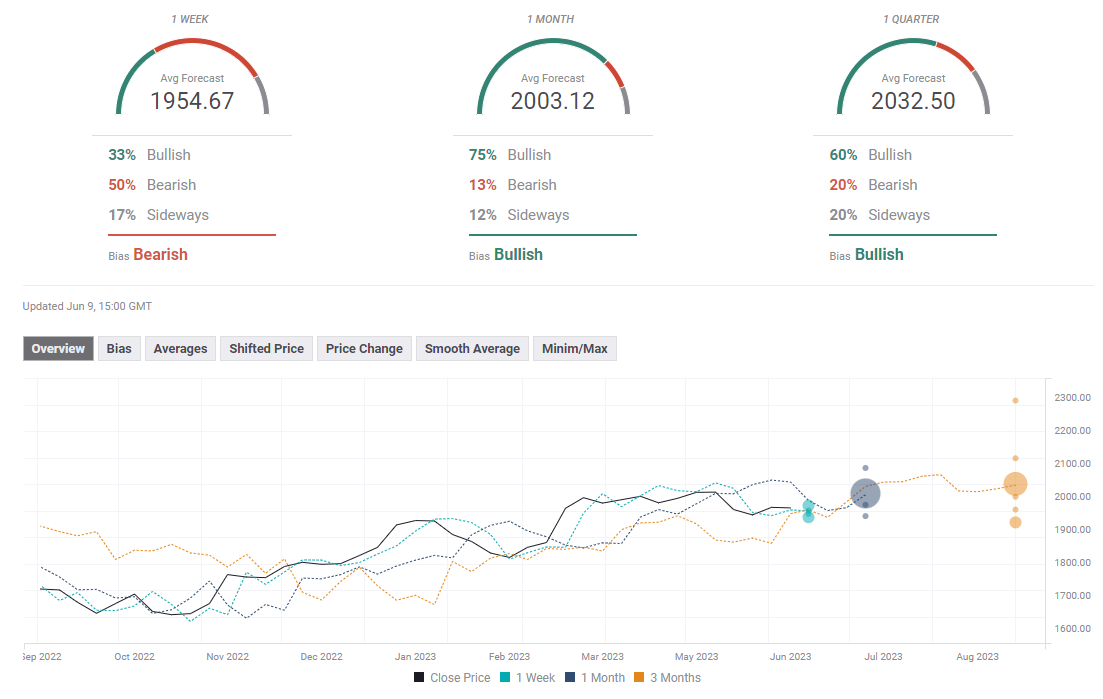
FXStreet Forecast Poll highlights a bullish bias in the one-month view with a large portion of experts expecting XAU/USD to rise at least to $2,000 in that time frame.
Premium
You have reached your limit of 3 free articles for this month.
Start your subscription and get access to all our original articles.
Author
Eren Sengezer
FXStreet
As an economist at heart, Eren Sengezer specializes in the assessment of the short-term and long-term impacts of macroeconomic data, central bank policies and political developments on financial assets.