Gold Price Forecast: XAU/USD traders appear non-committal ahead of US jobs data
- Gold price keeps its range near $2,640, as US employment data will trickle in on Tuesday.
- The US Dollar holds recovery following Trump’s tariffs plan-led steep sell-off.
- Technically, Gold price awaits a range breakout as the daily RSI trades neutral.


Gold price is battling the short-term critical barrier at around $2,635 early Tuesday, consolidating the two-day corrective decline from three-week highs of $2,665. Gold traders refrain from placing fresh directional bets ahead of the top-tier US ISM Services PMI and JOLTS Job Openings data.
Gold price eyes US data for fresh trading impetus
Despite Monday’s two-way price movement, Gold price remains confined in a familiar range as traders weigh the latest reports surrounding incoming US President Donald Trump’s tariff plans and the US economic data releases for a clear direction heading into Friday’s US Nonfarm Payrolls data release.
Gold price reversed the Asian bounce and fell as low as $2,615 in the European session on Monday on fading China’s stimulus optimism and sagging physical Gold demand from India. The rising domestic Gold prices due to the depreciation of the Indian Rupee (INR) to record low dampened demand for the bright metal from the world’s no. 2 Gold consumer.
Further, Goldman Sachs pushed back its forecast of Gold reaching $3,000 per ounce, initially expected by the end of 2025. This also exerted downward pressure on Gold price.
However, Gold price found fresh buyers in American trading after the US Dollar (USD) fell steeply across the board following a report from the Washington Post (WaPo) that Trump's aides were exploring plans that would apply tariffs only on sectors seen as critical to US national or economic security.
Trump quickly denied the report in a post on his Truth Social platform, which allowed the Greenback to recover some ground, prompting Gold price to settle in the red.
Later this Tuesday, speculations around Trump’s tariff plans, the US jobs data and the broader market sentiment will play a pivotal role in the Gold price action. Meanwhile, a speech by Richmond Federal Reserve (Fed) President Thomas Barkin on the economic forecast will be closely scrutnized for gauging the Fed next policy move.
Gold price technical analysis: Daily chart
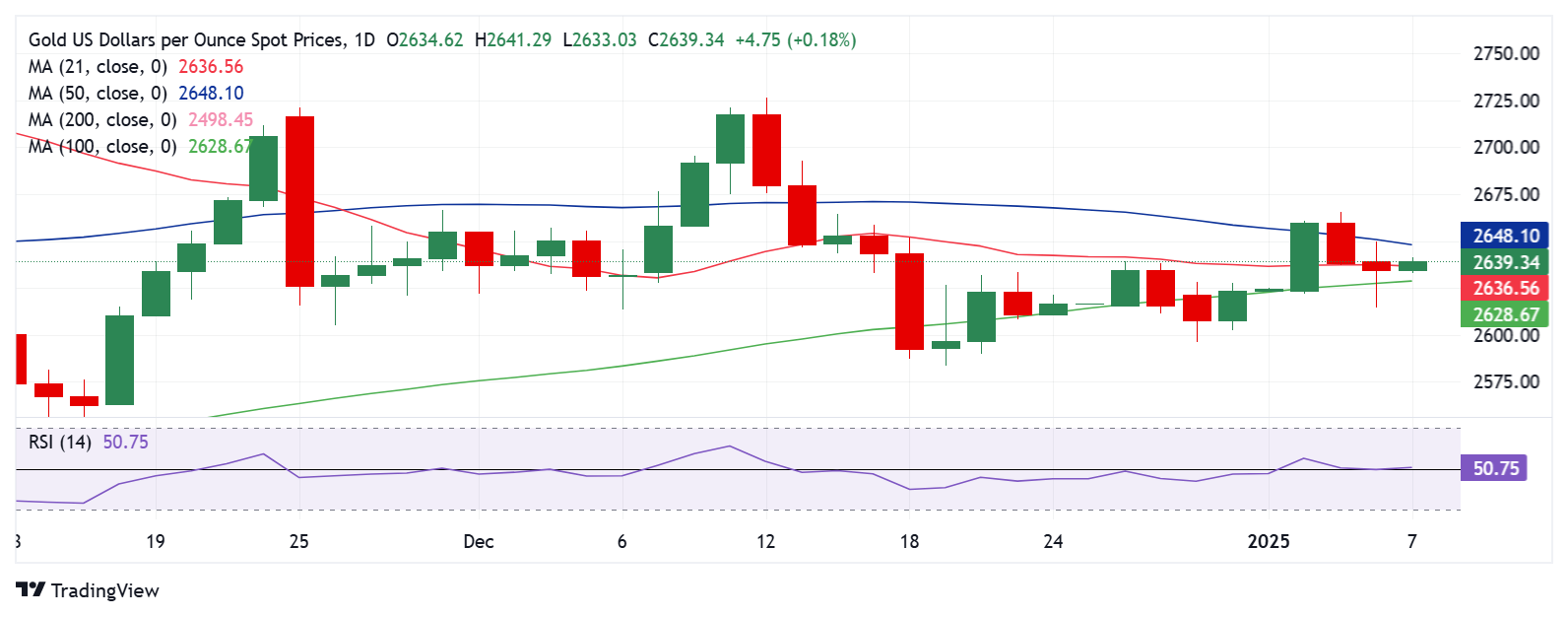
The daily chart shows that the 14-day Relative Strength Index (RSI) trades listlessly at the 50 level, leaving Gold price gyrating in a narrow range.
In doing so, Gold price clings to the 21-day Simple Moving Average (SMA) at $2,636 after failing to sustain above it on a daily closing basis on Monday.
The immediate support is now seen at the 100-day SMA at $2,627, below which the door will open for a retest of the previous week’s low of $2,596.
Ahead of that, the previous day’s low of $2,615 will offer some support to Gold buyers.
If Gold buyers regain control above the 50-day SMA barrier at $2,648, the next relevant topside barrier is seen at the three-week high of $2,665.
Further up, the $2,700 level will challenge bearish committments.
Economic Indicator
JOLTS Job Openings
JOLTS Job Openings is a survey done by the US Bureau of Labor Statistics to help measure job vacancies. It collects data from employers including retailers, manufacturers and different offices each month.
Read more.Next release: Tue Jan 07, 2025 15:00
Frequency: Monthly
Consensus: 7.7M
Previous: 7.744M
Source: US Bureau of Labor Statistics
Premium
You have reached your limit of 3 free articles for this month.
Start your subscription and get access to all our original articles.
Author
Dhwani Mehta
FXStreet
Residing in Mumbai (India), Dhwani is a Senior Analyst and Manager of the Asian session at FXStreet. She has over 10 years of experience in analyzing and covering the global financial markets, with specialization in Forex and commodities markets.