Gold Price Forecast: XAU/USD remains a ‘buy-the-dip’ trade on tariff war fears
- Gold price regains $2,900 as looming Trump’s reciprocal tariffs risk a trade war.
- The US Dollar stays subdued despite hot US CPI inflation data and hawkish Fed Chair Powell.
- Gold price sees dip-buying amid a 4H bullish technical setup ahead of US PPI data.


Gold price is trying to hold above the $2,900-mark early Thursday, having witnessed intense volatility a day ago. The focus once again remains on the US fundamentals and US President Donald Trump’s tariff plans for a fresh boost to Gold prices.
Gold price capitalizes on Trump’s tariffs-led nervousness
White House noted late Wednesday that the earlier announced reciprocal tariffs by President Trump could come by on Thursday, keeping the haven demand for the traditional safety net – Gold price – intact.
However, Gold traders remain wary of creating additional bullish positions in the bright metal amid increased expectations that the Federal Reserve (Fed) could pause its easing trajectory until the third quarter of this year. The hotter-than-expected January US Consumer Price Index (CPI) data published on Wednesday reinforced the hawkish bets surrounding the Fed's interest rates outlook.
The annual headline CPI increased 3% in January, up from 2.9% the previous month. The core inflation unexpectedly rose to 3.3% over the year in January versus December’s 3.2% growth. Speaking with US lawmakers Wednesday, Fed Chair Jerome Powell said the latest data show we’re close but not there on inflation, implying that the Fed is in no rush to cut rates further.
The Fed’s hawkishness triggered a sharp rally in the US Treasury bond yields on Wednesday, fuelling a steep decline in Gold price to near the $2,865 region. Gold buyers quickly jumped in on bargain hunting, lifting the yellow metal to settle back above $2,900. Gold is widely considered a hedge against inflation, which remains at the top of the market’s concerns.
Attention now turns toward the US Producer Price Index (PPI) data due later in Thursday’s American session for further cues on the Fed’s policy stance, which could influence the non-interest-bearing Gold price.
However, any downside in Gold price will likely remain cushioned as Trump’s reciprocal tariffs could raise tensions surrounding a potential trade war worldwide. The European Union (EU) will prioritize negotiations over retaliatory countermeasures to avoid a damaging trade war, officials signalled earlier on Wednesday.
Gold price technical analysis: Four-hour chart
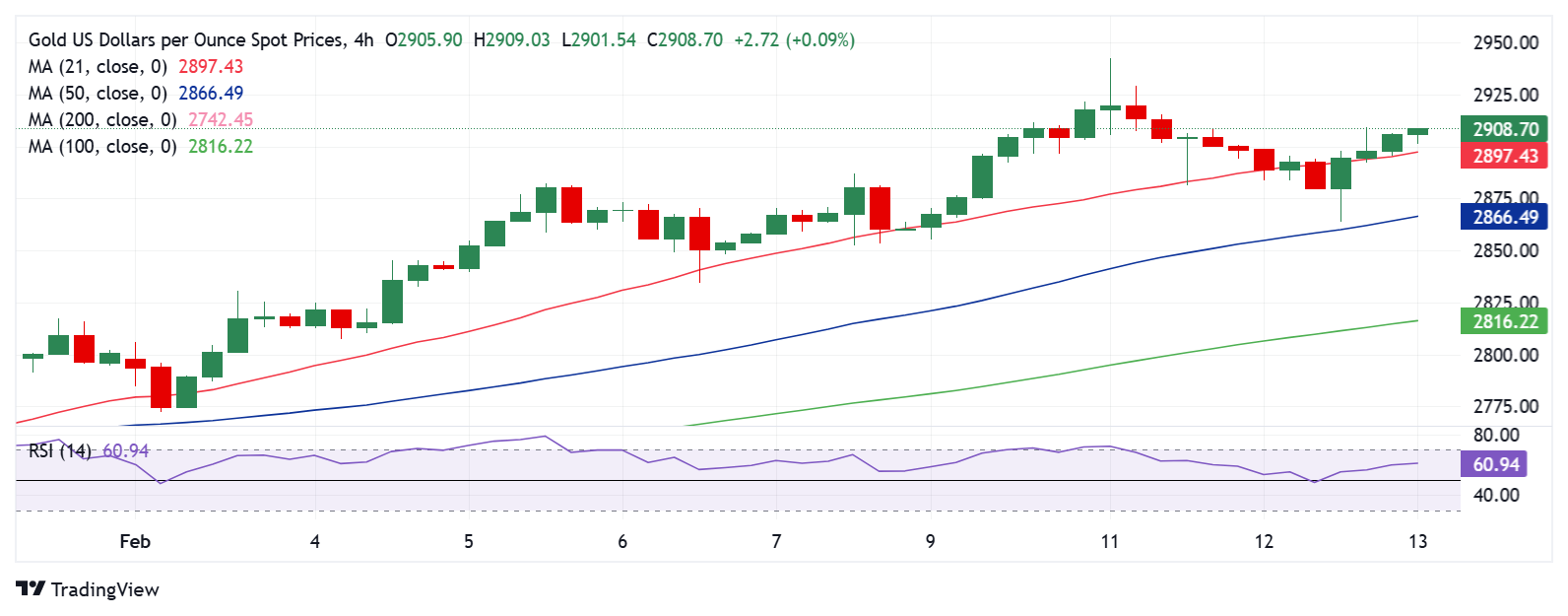
Following a brief dip below the critical 21-four hourly Simple Moving Average (SMA), now at $2,897, Gold price managed to recapture the latter, fuelling a gradual recovery.
The Relative Strength Index (RSI) holds well above the midline, currently near 63.50, backing the upside potential.
The further recovery will need acceptance above the $2,910 round level on a four-hourly candlestick closing basis.
The next topside barrier is aligned at the record high of $2,943.
On the flip side, a four-hourly candlestick closing below the 21-four hourly SMA at $2,897 will reinforce the selling interest, calling for a test of the 50-four hourly SMA at $2,866.
The last line of defense for Gold buyers is the 100-four hourly SMA at $2,816.
Tariffs FAQs
Tariffs are customs duties levied on certain merchandise imports or a category of products. Tariffs are designed to help local producers and manufacturers be more competitive in the market by providing a price advantage over similar goods that can be imported. Tariffs are widely used as tools of protectionism, along with trade barriers and import quotas.
Although tariffs and taxes both generate government revenue to fund public goods and services, they have several distinctions. Tariffs are prepaid at the port of entry, while taxes are paid at the time of purchase. Taxes are imposed on individual taxpayers and businesses, while tariffs are paid by importers.
There are two schools of thought among economists regarding the usage of tariffs. While some argue that tariffs are necessary to protect domestic industries and address trade imbalances, others see them as a harmful tool that could potentially drive prices higher over the long term and lead to a damaging trade war by encouraging tit-for-tat tariffs.
During the run-up to the presidential election in November 2024, Donald Trump made it clear that he intends to use tariffs to support the US economy and American producers. In 2024, Mexico, China and Canada accounted for 42% of total US imports. In this period, Mexico stood out as the top exporter with $466.6 billion, according to the US Census Bureau. Hence, Trump wants to focus on these three nations when imposing tariffs. He also plans to use the revenue generated through tariffs to lower personal income taxes.
Premium
You have reached your limit of 3 free articles for this month.
Start your subscription and get access to all our original articles.
Author
Dhwani Mehta
FXStreet
Residing in Mumbai (India), Dhwani is a Senior Analyst and Manager of the Asian session at FXStreet. She has over 10 years of experience in analyzing and covering the global financial markets, with specialization in Forex and commodities markets.