Gold Price Forecast: XAU/USD needs acceptance above $2,050 to unleash the upside
- Gold price is stuck in a familiar range between $2,030 and $2,040 early Thursday.
- Risk-on rally in global stocks weighs on the US Dollar amid subdued US Treasury bond yields.
- The path of least resistance for Gold price appears to the upside but $2,050 holds the key.

Gold price is finding buyers early Thursday to take on the $2,040 barrier once again, having failed to resist above the same since last Friday. Gold price is capitalizing on the risk-on sentiment-driven US Dollar (USD) weakness while sluggish US Treasury bond yields also remain supportive.
All eyes remain on mid-tier US jobs data and more Fedspeak
The US Dollar is extending its downbeat momentum into Asian trading on Thursday, undermined by muted US Treasury bond yields and a risk rally seen on global markets. Asian stocks track the US equities higher, as the S&P 500 index closed at a record high, courtesy of strong earnings and increased expectations of a ‘soft-landing’ for the US economy.
Markets also stay cheerful on expectations that more policy support measures from China could come through, as the country continues to battle deflation. China’s prices fell at the fastest pace in 15 years, reflected by the 0.8% decline in the Consumer Price Index (CPI). China’s Producer Price Index (PPI) fell 2.5% from a year earlier in January after a 2.7% decrease reported in the previous month.
Gold price is also capitalizing on China’s stimulus optimism, as the dragon nation is the world’s top consumer of the yellow metal. However, traders are expected to take account of the recent less dovish commentary from the US Federal Reserve (Fed) policymakers, limiting the upside attempts in the Gold price.
Boston Fed President Susan Collins said on Wednesday, "for the moment, policy remains well positioned, as we carefully assess the evolving data and outlook,” adding it will be "appropriate to begin easing policy restraint later this year."
Richmond Fed President Thomas Barkin, "I am very supportive of being patient to get to where we need to get. There's still a reasonable amount of uncertainty" on inflation.
Meanwhile, "sitting here today I would say two to three cuts would seem to be appropriate for me right now...that's my gut based on the data we have so far," Minneapolis Fed President Neel Kashkari said in an interview with broadcaster CNBC.
Later in the day, Gold traders will brace for more Fedspeak, with Barkin set to speak again. Also, the US weekly Jobless Claims data will be closely watched after the Initial Jobless Claims increased to a seasonally adjusted 224,000 for the week ended Jan. 27.
The Fed commentary and the US data could help markets repricing the Fed rate cut bets for this year, providing a fresh trading impetus to Gold price.
Gold price technical analysis: Daily chart
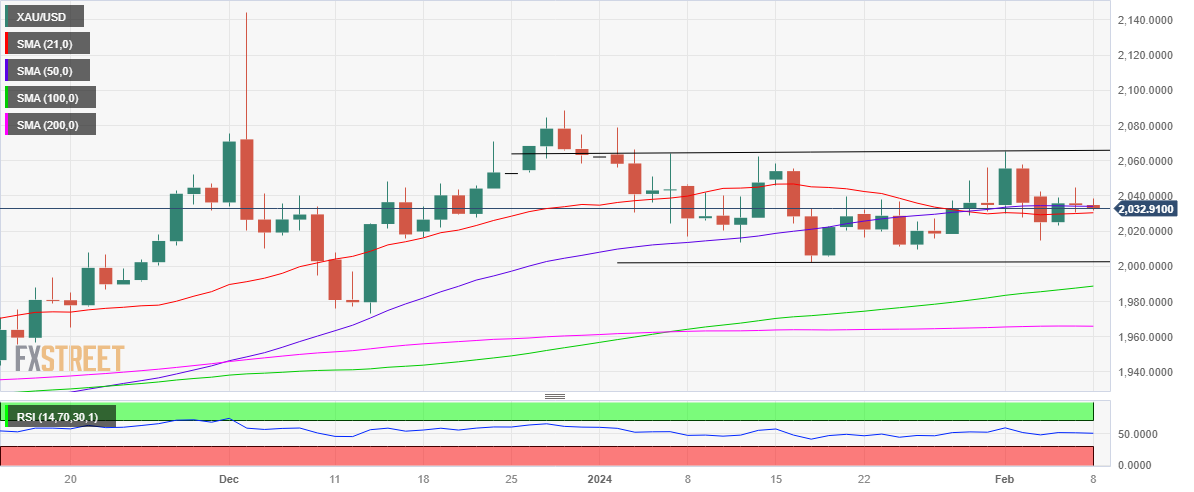
As observed on the daily chart, Gold price continues its battle with the $2,030-$2,035 region. That level is the confluence of the 21-day and 50-day Simple Moving Averages (SMA).
The 14-day Relative Strength Index (RSI) is trading listlessly just at the 50 level, pointing to a further rangebound movement in Gold price.
If Gold price holds the fort above the $2,030-$2,035 demand area, the immediate powerful resistance for Gold price is seen at the $2,050 psychological level. The next critical supply zone for the bright metal is seen at around $2,065.
To the downside, Gold sellers need to seek a decisive close below the abovementioned $2,035-$2,030 area. Further down, a test of the $2,000 threshold if the $2,010 round figure gives way.
Gold FAQs
Why do people invest in Gold?
Gold has played a key role in human’s history as it has been widely used as a store of value and medium of exchange. Currently, apart from its shine and usage for jewelry, the precious metal is widely seen as a safe-haven asset, meaning that it is considered a good investment during turbulent times. Gold is also widely seen as a hedge against inflation and against depreciating currencies as it doesn’t rely on any specific issuer or government.
Who buys the most Gold?
Central banks are the biggest Gold holders. In their aim to support their currencies in turbulent times, central banks tend to diversify their reserves and buy Gold to improve the perceived strength of the economy and the currency. High Gold reserves can be a source of trust for a country’s solvency. Central banks added 1,136 tonnes of Gold worth around $70 billion to their reserves in 2022, according to data from the World Gold Council. This is the highest yearly purchase since records began. Central banks from emerging economies such as China, India and Turkey are quickly increasing their Gold reserves.
How is Gold correlated with other assets?
Gold has an inverse correlation with the US Dollar and US Treasuries, which are both major reserve and safe-haven assets. When the Dollar depreciates, Gold tends to rise, enabling investors and central banks to diversify their assets in turbulent times. Gold is also inversely correlated with risk assets. A rally in the stock market tends to weaken Gold price, while sell-offs in riskier markets tend to favor the precious metal.
What does the price of Gold depend on?
The price can move due to a wide range of factors. Geopolitical instability or fears of a deep recession can quickly make Gold price escalate due to its safe-haven status. As a yield-less asset, Gold tends to rise with lower interest rates, while higher cost of money usually weighs down on the yellow metal. Still, most moves depend on how the US Dollar (USD) behaves as the asset is priced in dollars (XAU/USD). A strong Dollar tends to keep the price of Gold controlled, whereas a weaker Dollar is likely to push Gold prices up.
Premium
You have reached your limit of 3 free articles for this month.
Start your subscription and get access to all our original articles.
Author
Dhwani Mehta
FXStreet
Residing in Mumbai (India), Dhwani is a Senior Analyst and Manager of the Asian session at FXStreet. She has over 10 years of experience in analyzing and covering the global financial markets, with specialization in Forex and commodities markets.

















