Gold Price Forecast: Further XAU/USD upside hinges on US Retail Sales, PPI inflation data
- Gold price consolidates the rebound from a key support on Thursday.
- Dollar finds buyers amid firm Treasury yields, as top-tier US data grab eyeballs.
- Gold price needs a daily close above $2,180 to refresh record highs.


Gold price is treading water above $2,170, awaiting a fresh batch of high-impact economic data from the United States (US) for the next push higher. The US Dollar is attempting a bounce amid a negative shift in risk sentiment while the US Treasury bond yields are consolidating a three-day recovery rally, capping the further upside in Gold price.
Gold price awaits fresh catalysts to resume upside
The US Dollar on Wednesday reversed most of the hot US Consumer Price Index (CPI) data-inspired rally, as odds for a June Federal Reserve (Fed) interest rate cut remained more or less the same at about 70%, convincing markets that a dovish policy pivot is likely on the table by the end of the second quarter.
The renewed US Dollar weakness helped Gold price resume its record-setting rally but sellers lurked once again near $2,180, courtesy of the ongoing upswing in the US Treasury bond yields across the curve.
Later on Thursday, it remains to be seen if the Gold price regains upside traction to retest the all-time high at $2,195, as traders await the top-tier US Retail Sales and Producer Price Index (PPI) data for fresh hints on the timing of the first Fed rate cut this year. The weekly US Initial Jobless Claims data will be also eyed for fresh trading impetus on Gold price.
US Retail Sales are likely to rebound 0.8% over the month in February, against a 0.8% decline reported in January. Meanwhile, the US PPI is seen rising 1.1% YoY in February vs. a 0.9% increase seen previously. Potential signs of sticky inflation and strong consumer demand in the US are unlikely to bode well for Gold price.
Gold price technical analysis: Daily chart
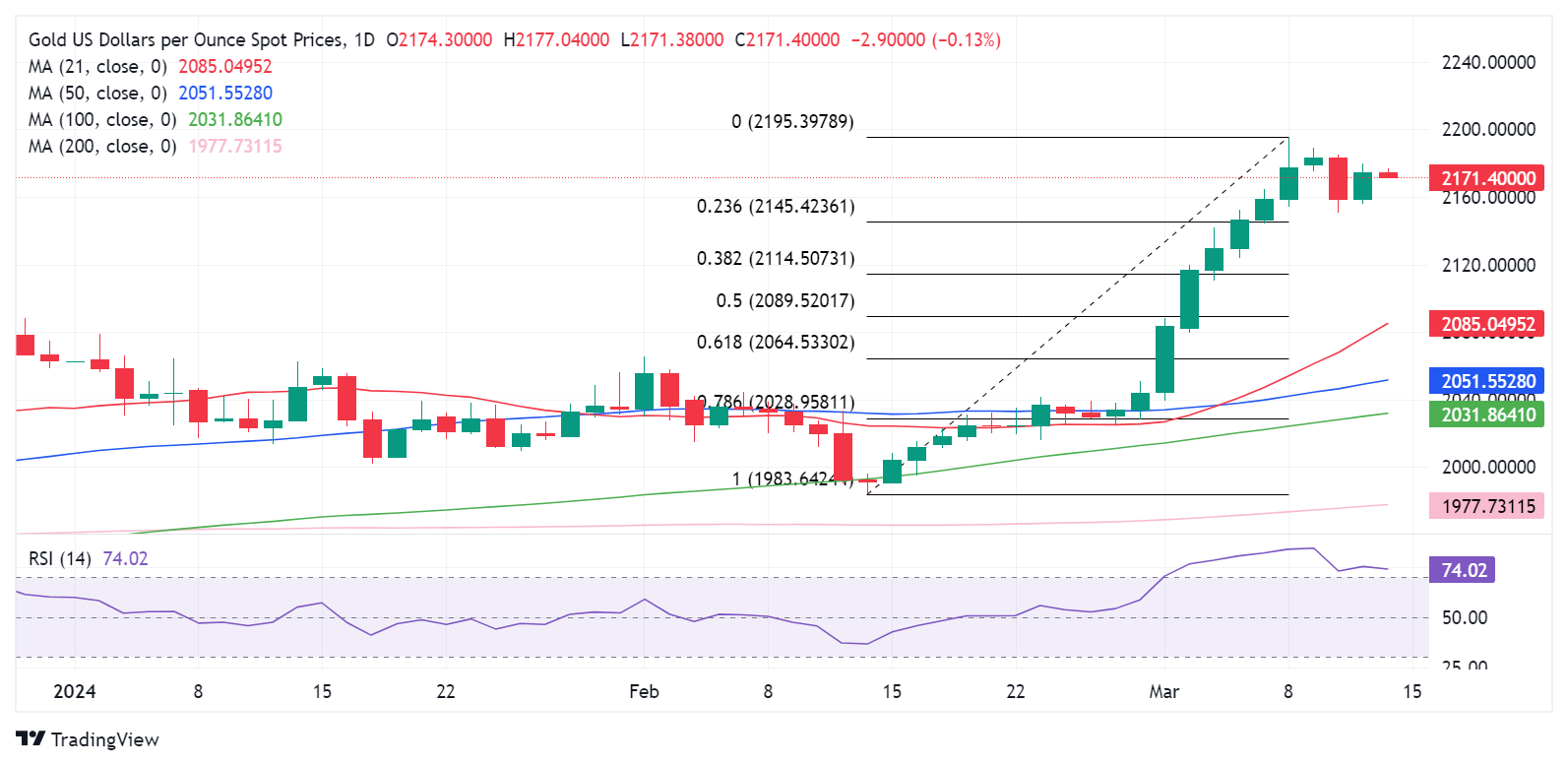
As observed on the daily chart, Gold price rebounded from just above the key $2.145 support, where the March 7 low and the 23.6% Fibonacci Retracement (Fibo) level of the recent rally from the February 14 low of $1,984 to the all-time high of $2,195 coincide.
The upswing occurred, as the 14-day Relative Strength Index (RSI) eased from the extremely overbought region to near 75.00, where it now wavers.
Once again, buyers are looking for an entry above $2,180 to take Gold price toward Tuesday’s high of $2,185, above which the all-time highs of $2,195 will be retested. The next key upside targets are seen at the $2,200 threshold and the $2,250 psychological level.
Conversely, the initial demand area is seen at Wednesday’s low of $2,156. A failure to defend that level will test the abovementioned powerful support at $2,145 yet again.
Further down, the static support at $2,125 will come to the buyers’ rescue. The last line of defense for Gold buyers is aligned at the 38.2% Fibo level of the same ascent at $2,116.
Gold FAQs
Gold has played a key role in human’s history as it has been widely used as a store of value and medium of exchange. Currently, apart from its shine and usage for jewelry, the precious metal is widely seen as a safe-haven asset, meaning that it is considered a good investment during turbulent times. Gold is also widely seen as a hedge against inflation and against depreciating currencies as it doesn’t rely on any specific issuer or government.
Central banks are the biggest Gold holders. In their aim to support their currencies in turbulent times, central banks tend to diversify their reserves and buy Gold to improve the perceived strength of the economy and the currency. High Gold reserves can be a source of trust for a country’s solvency. Central banks added 1,136 tonnes of Gold worth around $70 billion to their reserves in 2022, according to data from the World Gold Council. This is the highest yearly purchase since records began. Central banks from emerging economies such as China, India and Turkey are quickly increasing their Gold reserves.
Gold has an inverse correlation with the US Dollar and US Treasuries, which are both major reserve and safe-haven assets. When the Dollar depreciates, Gold tends to rise, enabling investors and central banks to diversify their assets in turbulent times. Gold is also inversely correlated with risk assets. A rally in the stock market tends to weaken Gold price, while sell-offs in riskier markets tend to favor the precious metal.
The price can move due to a wide range of factors. Geopolitical instability or fears of a deep recession can quickly make Gold price escalate due to its safe-haven status. As a yield-less asset, Gold tends to rise with lower interest rates, while higher cost of money usually weighs down on the yellow metal. Still, most moves depend on how the US Dollar (USD) behaves as the asset is priced in dollars (XAU/USD). A strong Dollar tends to keep the price of Gold controlled, whereas a weaker Dollar is likely to push Gold prices up.
Premium
You have reached your limit of 3 free articles for this month.
Start your subscription and get access to all our original articles.
Author
Dhwani Mehta
FXStreet
Residing in Mumbai (India), Dhwani is a Senior Analyst and Manager of the Asian session at FXStreet. She has over 10 years of experience in analyzing and covering the global financial markets, with specialization in Forex and commodities markets.

















