German snap elections eyed: Friedrich Merz poised to be the new chancellor


Germans will head to the election polls this Sunday to select a new Bundestag, Germany’s National Parliament. Following the collapse of the ruling coalition in November 2024 – the ‘Traffic Light coalition’ – and a snap vote called for in December after dissolving the Bundestag, Germany will vote on Sunday, 23 February – seven months earlier than the regular, planned election date.
This comes at a time when the German economy – the largest in the eurozone – faces stiff headwinds on several fronts. Germany’s economic activity recently reported consecutive annual contractions in 2023 and 2024, a first since early 2000. At the same time, Germany’s benchmark index – the DAX 40 – recently pencilled in back-to-back all-time highs amid six consecutive weeks in the green. I think it is fair to say that equity bulls are in the driving seat for the time being, and given chart studies, further outperformance could be on the table.
Who are the main parties running, and what are the polls saying?
The primary Parties running in this election include the following:
- The centre-right Christian Democrats (CDU/CSU) Party, chaired by Friedrich Merz (CDU) and Markus Söder (CSU)
- The Social Democratic Party (SPD), chaired by Saskia Esken and Lars Klingbeil
- The Green Party, chaired by Franziska Brantner and Felix Banaszak
- The Free Democratic Party (FDP), chaired by Christian Lindner
- The Left Party, chaired by Ines Schwerdtner and Jan van Aken
- The far-right AfD (Alternative Fur Deutschland), chaired by Tino Chrupalla and Alice Weidel
While exit polls deliver a good indication of the election results on Sunday, it could take several days before the final result is clear, depending on postal votes and how smaller Parties fare.
According to YouGov’s final MRP poll (multi-level regression and post-stratification), the CDU/CSU Party retains a significant gain. As illustrated below, the poll also shows that the CDU/CSU is on track to claim 220 out of the 630 seats of the Bundestag, with a 30% vote share.
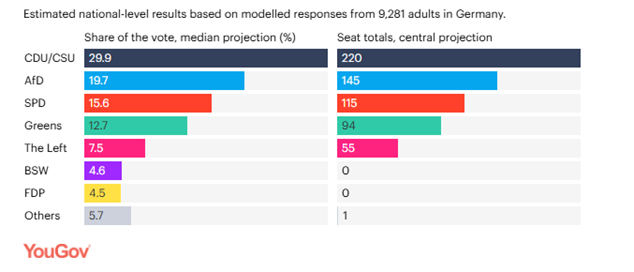
The far-right AfD Party has also gained considerably in the polls, expected to finish second with 20% of the share vote and 145 seats. This is followed by the SPD Party, which is projected to come in third place, with 16% of the share vote and 115 seats.
If current polls are correct, the CDU/CSU Party will likely win the election and Friedrich Merz will become the next Chancellor. However, as I am sure you are aware, it is doubtful that one Party will secure enough seats to form a government; hence, a coalition must be formed, which could drag on for months. Of note, for a coalition to be established in Germany, over 50% of the seats in the Bundestag need to be held.
In terms of what coalition governments are likely to be, I think one thing is reasonably evident at this point: no Party is willing to work with the AfD to form a majority. Consequently, Merz and the CDU/CSU Party could form a majority government by teaming up with the SPD to create a ‘Grand Coalition’. A possible three-way Coalition may also be in the offing, where the two said Parties join forces with the Greens. Nevertheless, this may be problematic as CSU’s leader reportedly does not want to partner with the Greens.
Markets ahead of the election
As I briefly noted above, the DAX 40 has trended to the upside, which has largely been one-sided. I think the recent optimism has been bolstered by robust earnings, progress on peace talks between Russia and the US regarding the Russia-Ukraine conflict, and, of course, political anticipation of the CDU/CSU Party forming a coalition to loosen the ‘debt brake’.
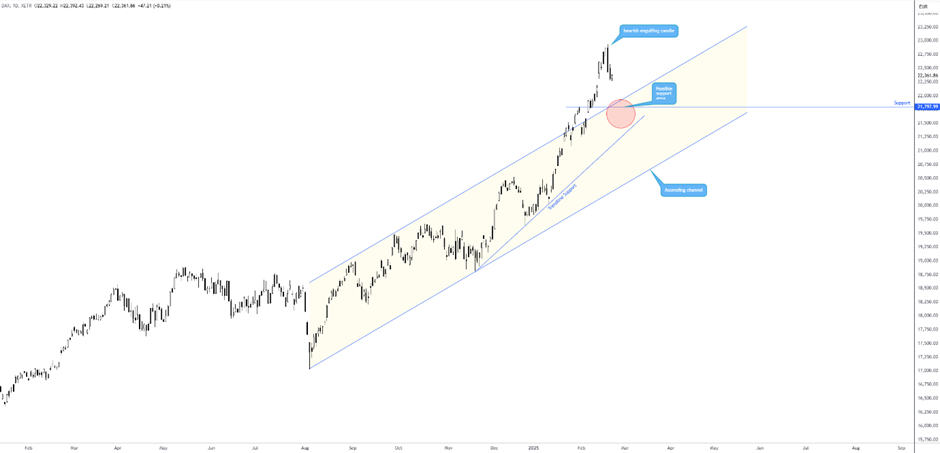
For anyone new to technical analysis, the daily chart of the DAX 40 below is about as close as you will get to a textbook uptrend: a series of higher highs and higher lows. Technically speaking, dip buyers will closely watch the latest correction from Wednesday’s record high of 22,935 (a bearish engulfing formation, I might add), particularly between 21,368 and around 22,000 – a support zone. This area comprises a trendline support, taken from the low of 18,812, channel support, extended from the low of 17,024, and local horizontal support from 21,797.
Regarding where I stand with the EUR/USD (euro versus the US dollar), my outlook for the pair remains unchanged. I will keep this short as I have been banging the drum about a potential bearish scenario in this market for quite some time now.
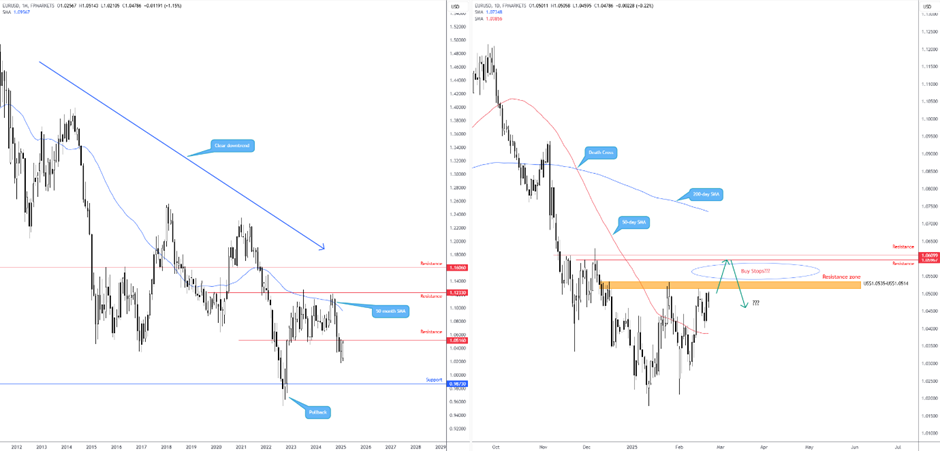
From the monthly chart, resistance is at US$1.0516, with scope for further underperformance towards support as far south as US$0.9873 (below parity). Couple this with a possible whipsaw forming above a resistance zone on the daily timeframe between US$1.0535 and US$1.0514 into resistance at US$1.0610-US$1.0597, I feel strong sellers could emerge from such a setup and force the EUR/USD southbound.
Author
Aaron Hill
FP Markets
After completing his Bachelor’s degree in English and Creative Writing in the UK, and subsequently spending a handful of years teaching English as a foreign language teacher around Asia, Aaron was introduced to financial trading,

















