German PMI Preview: From bad to worse? EUR/USD is ready for another fall
- Prospects for Germany's economy have likely remained grim in August.
- The ECB is watching the survey data ahead of its next decision.
- FXStreet's Surprise Index is pointing to a disappointing outcome that may weigh on EUR/USD.


A car cannot accelerate without a strong engine, and a train is unable to advance if its front car is derailing. Germany – the "locomotive" of the euro-zone – contracted in the second quarter. Markit's forward-looking Purchasing Managers' Indexes (PMIs) will likely show unflattering conditions in August. And this may raise fears of an outright recession in the continent's largest economy.
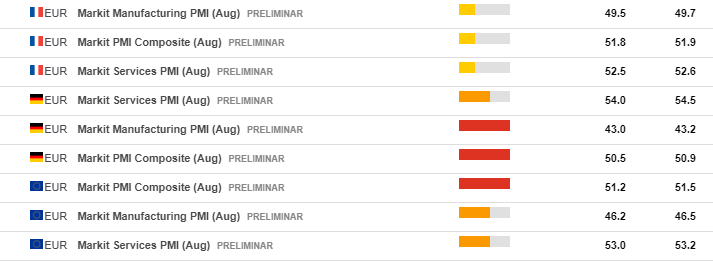
The preliminary version of the survey for August is expected to be similar to that in July. The initial focus will be on France's manufacturing PMI – which has slipped below the 50-point threshold, separating expansion from contraction. A still-growing services sector is expected to maintain the calm.
Why German manufacturing is critical for the euro's value
The focus quickly shifts to the German figures – and especially the manufacturing PMI. Contrary to many other developed economies, Germany leans heavily toward production and exports. The nation's high trade balance surplus is the lion's share of the euro zone's positive balance – and one of the reasons the euro has held up. The common currency has not collapsed despite signs of a slowdown and the European Central Bank's willingness to introduce more monetary stimulus.
In other words, speculation is pushing the common currency lower, but exporters keep its bid.
Yet when the German industrial export machine stutters – the euro struggles – and so do other European economies. Cross-border supply chains create a dependency on the largest economy.
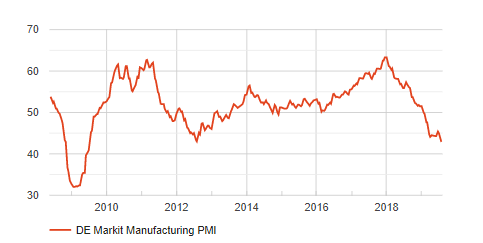
Markit's manufacturing PMI has been below 50 since the beginning of the year, hitting 43.2 points in the final read for July. Economists now expect a score of 43 points – even lower.
Expectations and scenarios
1) Above expectations: As a gloomy number is already forecast, EUR/USD may have room to rise if the outcome exceeds these downbeat projections. Such a market reaction is always possible when estimates are low and cannot be ruled out at this juncture.
Nevertheless, the upside surprise will need to be substantial – closer to 50 than to 43 – to trigger hope for a revival and for the euro to turn its fate.
2) Within expectations: If estimates are correct, the reaction may depend on the services PMI. It scored a healthy 54.5 points in July, and a minor drop to 54 is expected. That would keep the composite figure above 50. If the services figure beats, there is room for a minor uptick.
If prospects for that sector fall – and especially if the composite PMI is dragged below 50 – EUR/USD may edge lower.
3) Below expectations: A disappointment cannot be ruled out even if projections are modest. In this case, EUR/USD has room to fall, as markets may price in an even more aggressive easing from ECB President Mario Draghi and his colleagues.
But what are the chances of setting a new low – the worst since 2009?
We turn to FXStreet's Surprise Index and find that this option has significant chances.
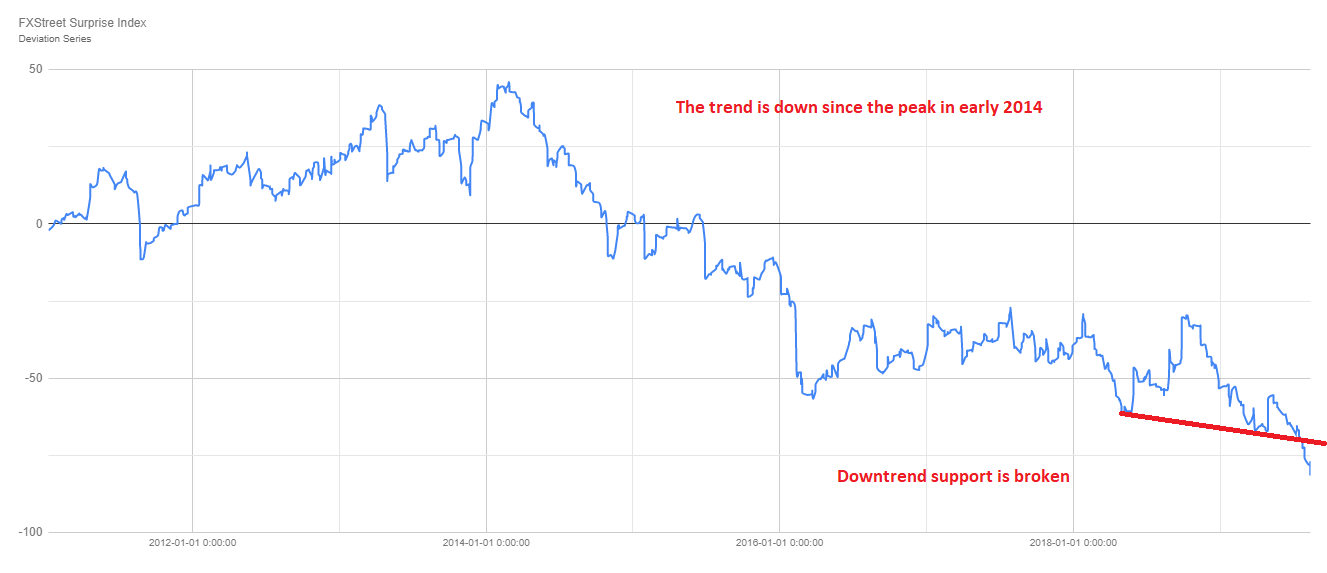
FXStreet Surprise Index quantifies, in terms of standard deviations of data surprises (actual releases vs. survey median), the extent to which economic indicators exceed or fall short of consensus estimates.
Examining top-tier and medium-tier figures since 2011, we can see a clear downtrend since the index peaked in early 2014. Moreover, a downtrend support line that accompanied the indicator since mid-2018 has been sharply broken to the downside recently. A downside surprise is more likely than an upside one.
Taking a closer look at data from early 2018 onwards reveals a similar picture. The surprise index peaked at the beginning of 2019. It has since broken below an uptrend support line that accompanied it since around February. However, it is still holding above another line that dates back to the spring of 2018.
The glimmer of hope arising from the longer-term support line implies that a downside surprise may be relatively moderate.
Nevertheless, FXStreets's Surprise Index is generally pointing to a downside surprise – and that may bring the euro down.
Conclusion
Markit's preliminary PMIs and especially the German manufacturing one may have a significant impact on the euro. Low expectations may result in an easy path for a beat, but FXStreet's Surprise Index points to another disappointment.
Author
Yohay Elam
FXStreet
Yohay is in Forex since 2008 when he founded Forex Crunch, a blog crafted in his free time that turned into a fully-fledged currency website later sold to Finixio.