German Election Monitor: Next euro area election unlikely to rock the boat
-
SPD candidate Martin Schulz is struggling to differentiate himself from Angela Merkel, while AfD has lost in the polls due to infighting.
-
CDU-led grand coalition or centrist coalitions between CDU, FDP and Greens are still the most likely outcomes, given the proximity in policies and current polling.
-
As coalition talks usually last for four-six weeks, a renewed push with France for closer EU integration is unlikely to begin before end-October.

Angela Merkel's CDU remains the favourite to win election
With the final vote less than a month away, an aggressive German election campaign continues to be absent. This is due partly to a close similarity in party programmes (page 3), with both the Conservatives (CDU/CSU) and Social Democrats (SPD) calling for a policy mix of more infrastructure spending and tax cuts, while deeper structural challenges that loom ahead, such as possible eurozone reforms or integration of refugees, are visibly absent from the headlines.
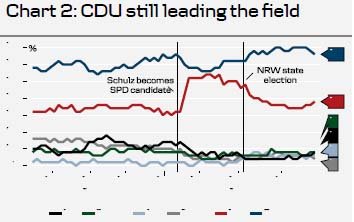
According to the polls, Merkel is still on track to secure her fourth term in office, as her conservative CDU party remains ahead with around 40%(see Chart 2). Following a brief poll surge (dubbed the ‘Schulz effect') after the SPD selected him as leader in January, Martin Schulz's popularity has abated. The SPD also lost to the CDU in an important federal election in the traditional SPD stronghold of North Rhine-Westphalia (NRW) in May and Schulz has struggled to create renewed momentum for the party, which still polls 14 percentage points below the CDU.
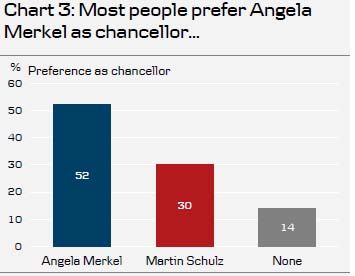
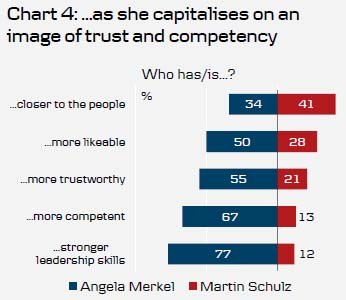
Schulz has tried to attack Merkel on a range of issues, including refugee policy, defence spending and Turkey. However, with her soft-spoken campaign style that avoids any provocations to rivals, Merkel has weathered these attacks without any dent to her popularity, as she benefits from her incumbent position and an image of stability and reliability, which resonates well with the risk-averse German public. Merkel's campaign capitalises on the strong economic background: GDP growth is on track for 2% in 2017, unemployment is at a record low of 5.6%, fuelling consumer confidence and private consumption and in H1 17, the government achieved a budget surplus of EUR18.3bn, while public debt remains low at 67% of GDP. External factors have also played in Merkel's favour, such as the election of Trump in the US and an abatement of the 2015-16 refugee crisis. Overall, 52% of respondents in a recent poll by Infratest Dimap would prefer Angela Merkel as chancellor (compared to 30% for Martin Schulz) and she outranks her rival in most categories such as leadership skills, trustworthiness and likeability (Charts 3 and 4).
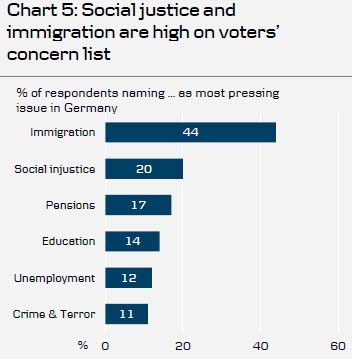
However, it is too early to rule out a comeback from the SPD, should it finally succeed in differentiating itself from Merkel's platform. Schulz has indicated that he plans to focus on his campaign ‘leitmotif' social justice in the weeks ahead, pledging already to spend EUR12bn to improve education if he becomes Chancellor. This could turn out to be a promising strategy for the SPD, given that social justice remains the second most important topic for voters after immigration (Chart 5).
Author
Danske Research Team
Danske Bank A/S
Research is part of Danske Bank Markets and operate as Danske Bank's research department. The department monitors financial markets and economic trends of relevance to Danske Bank Markets and its clients.