GBPUSD Forecast 2017: Expect yet another murky year for Cable

The GBP/USD pair has shown notable resilience to the post-US presidential election US Dollar upsurge and traded well above the early October flash crash fall to sub-1.20. Some of the positive developments supporting the major have been:
Comments from the Brexit Secretary David Davis, that UK might consider paying into the EU budget in order to secure the best possible and favorable access to the single market, helped ease 'hard Brexit' concerns and supported the pair's recovery from multi-decade lows. The views on EU budget contribution were further endorsed by the prime minister’s spokeswoman and the chancellor, Philip Hammond.
Adding to this, a slew of better-than-expected UK economic data, following the historic EU referendum, has been another key factor supporting the British Pound. The incoming economic data has ensured that UK economy ends 2016 with a respectable growth.
Uncertainties prevail
The recovery, however, has been limited amid extended uncertainty over the Brexit negotiation process by which Britain will end its membership with the European Union. With Prime Minister Theresa May expected to trigger Article 50 by the end of March, downside risks for the pair remain elevated in Q1 2017.
Moreover, political risks stemming from key elections due in the Netherlands, France and Germany in 2017 would add to the complexity and leave the British Pound vulnerable to significant bouts of volatility until the first half of 2017.
Possible weakening in the real economy
Another headwind for the sterling is likely to come in the form of deceleration in the real GDP growth in 2017, which might lead to additional monetary easing by the Bank of England (BoE). UK inflation has already accelerated to the highest level in more than two years (1.2% y/y in November). Economists forecast that a sharp depreciation of the domestic currency, following the UK-EU-referendum, might continue to fuel higher consumer prices and could even surpass BoE's 2.0% target in the near-future. Without any substantial wage rise, higher inflation would result to lower household spending and lead to a real economic slowdown. BoE Governor Mark Carney has already clarified that, if necessary, he would be willing to tolerate an overshoot in inflation, for some period, in order to support the economy. Hence, any signs of economic slowdown might force BoE to announce another interest rate-cut and (or) an extension of its QE program.
Scotland adding to Brexit complexities
Brexit drama would remain at the center stage during 2017 as Scotland has started to push for more powers to protect its interest in remaining within the EU single market, even if it implies leaving the UK. A majority of voters in Scotland favored to remain with the EU and hence, Scotland First Minister, Nicola Sturgeon, has stressed that a second independence referendum would remain on the table if the country was taken out of the bloc against its will.
Is the 'Norway model' a solution?
Still, everything is not dark for the cable. UK can adopt the 'Norway model' as its Brexit solution. This is the model outside of the EU, which is most integrated with the single market but includes many of the key obligations of EU membership, including making contributions to EU spending, free movement of people and following most of the rules of the single market. In this scenario, there would be ample room for a sharp recovery in the major.
Doing so, however, would defy government's key objectives to curb free movement of people and becoming a law maker rather than a law taker.
Hopes from Trump's fiscal stimulus
Furthermore, the expected fiscal policy announcements by the US president-elect, Donald Trump, after assuming office in January, would prolong the greenback's strong appreciating move and could also contribute towards restricting recovery for cable. Although precise details and impact of the fiscal stimulus measures are still unknown, but if the reflation policies prove to be effective the Federal Reserve might be inclined to opt for a faster rate-tightening cycle.
Moreover, the Fed has already upgraded its forecasts for growth and employment, and now projects three rate-hike in 2017, up from two-hike forecasted in September.
Prospects of faster US economic growth, accompanied with hawkish Fed outlook, guarantee a more aggressive monetary tightening cycle and should continue lending support to the prevalent US Dollar bullish trajectory and exert additional selling pressure around the major.
So it is clear that there is little standing in the way of continuous downslide for the GBP/USD pair. Hence, a break back below 1.20 psychological mark and follow-on momentum still remains a distinct possibility.
GBP/USD Technical set-up
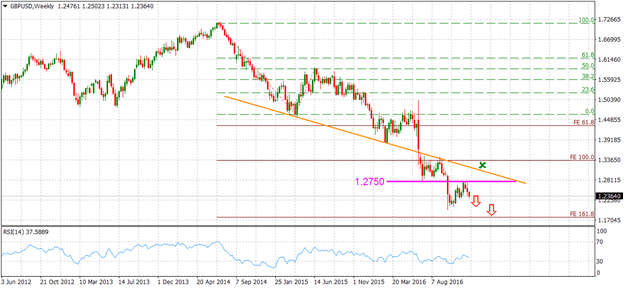
The pair's post-Brexit recovery has been confined below a longer-term descending trend-line, previous support now turned resistance. Moreover, the pair has subsequently broken below an important horizontal support near 1.2750 region. This 1.2750 horizontal area might now restrict any immediate recovery. Momentum above this immediate hurdle could get extended, but might continue to be capped at the descending trend-line support break, turned resistance, near 1.3000 psychological mark.
However, a decisive move above 1.3000 handle should open room for additional recovery further towards an important static support break-point, now turned resistance, around 1.3350 area, representing 100% Fibonacci retracement level of the pair's downslide from June 2014 high to April 2015 and subsequent retracement.
Looking at the bearish scenario, the pair has been able to defend 1.2100 handle on weekly closing basis. Hence, a decisive break below this immediate strong support would turn the pair vulnerable to head back towards testing flash crash swing lows support near 1.20 psychological mark. A follow-through selling pressure would now open room for continuation of the pair's downslide further towards 161.8% Fibonacci expansion level support near 1.1800 region.
GBPUSD Point & Figure Chart

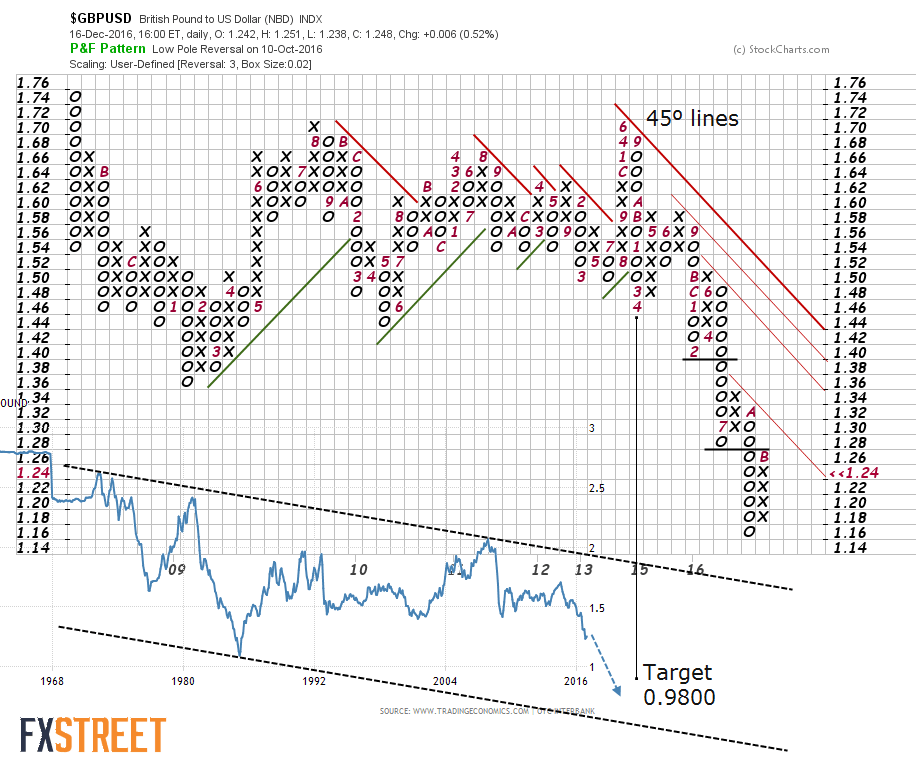
The potential move can best be observed in a long-term line chart where the GBP/USD appears poised for a test of parity. The simple channel lines put the current situation into perspective and provide hints to the extent of the current trend in a larger and more enduring bear market decline.
Author
Haresh Menghani
FXStreet
Haresh Menghani is a detail-oriented professional with 10+ years of extensive experience in analysing the global financial markets.