GBP/USD Weekly Outlook: Pound Sterling bullish potential remains intact
- The Pound Sterling hit over two-month highs above 1.2650 against the US Dollar.
- GBP/USD traders will likely take a breather in a relatively light week on data releases ahead.
- The pair broke above the 100-day SMA barrier; will the 200-day SMA be surpassed next week?


The Pound Sterling (GBP) hit its highest in over two months against the US Dollar (USD) as GBP/USD buyers remained unstoppable on acceptance above the 1.2600 level.
Pound Sterling failed to benefit from hot UK inflation
The third straight weekly decline in the USD strengthened the major's recovery momentum while scaling all major technical hurdles. US President Donald Trump’s tariff threats and geopolitical tensions surrounding Russia and Ukraine peace deal returned but failed to lift the haven demand for the Greenback.
Investors resorted to running for cover in Gold price and US equity indices instead, driving them to record highs.
Trump said midweek that he will announce tariffs related to imports of timber, cars, semiconductors and pharmaceuticals "over the next month or sooner", re-emphasizing his planned announcement a day earlier about imposing auto tariffs "in the neighbourhood of 25%" and similar duties on semiconductors and pharmaceuticals.
In a Fox News interview late Wednesday, US Commerce Secretary Howard Lutnick said that President Trump’s “goal is simple: to abolish the Internal Revenue Service and let all the outsiders pay.”
Meanwhile, tensions loomed between the US and the European Union (EU) after the US excluded Ukraine and the EU from its peace talks to end the Ukraine conflict with Russian top delegates. This put pressure on the EU to form a clear and cohesive response to Trump’s decision to negotiate directly with Russia to end the war in Ukraine.
Further, expectations that the US Federal Reserve (Fed) will likely stay on its two interest-rate cut trajectory this year continued to undermine the sentiment around the US Dollar.
The hawkish Minutes of the Fed’s January meeting also failed to trigger any positive reaction around the buck. The Minutes backed the Fed’s cautious stance on Wednesday as it showed that “many participants noted that the committee could hold the policy rate at a restrictive level if the economy remained strong and inflation remained elevated” in the face of Trump’s trade policies.
The final data release of the week showed that the US S&P Global Composite PMI declined to 50.4 in February's flash estimate from 52.7 in January. This print showed a loss of growth momentum in the private sector's economic activity and made it difficult for the USD outperform its rivals heading into the weekend.
On the Pound Sterling side of the story, the hotter-than-expected UK Consumer Price Index (CPI) data had little to no impact on the market expectations of roughly 50 basis points (bps) of rate cuts by the year-end.
The UK annual inflation rate rose sharply to 3% in January, coming in above expectations of a 2.8% reading, according to the Office for National Statistics (ONS).
This is due to the bigger-than-expected jump in British inflation attributed to one-off or seasonal catalysts such as a steep rebound in airfare prices and the introduction of value-added tax (VAT) on private school fees.
Meanwhile, the ONS said on Tuesday that the UK Unemployment Rate in the three months to December was 4.4%, where it stood in the three months to November, bettering the market forecast of 4.5%.
Tight labor market conditions and the cautious remarks from BoE Governor Andrew Bailey helped the Pound Sterling hold its ground against the US Dollar during the week.
Bailey noted that “the impact of US trade tariffs on inflation is much more ambiguous than their impact on growth if they lead to fragmentation of the world economy.”
Stronger-than-expected jump in UK consumer spending also aided the Pound Sterling’s winning momentum. British Retail Sales rebounded 1.7% month-on-month (MoM) in January after declining 0.6% in December. Markets estimated a 0.3% jump in the reported month.
However, mixed UK business PM data capped the pair’s upside. UK S&P Global Services PMI rose slightly to 51.1 in February, providing a positive surprise. On the other hand, the Manufacturing PMI unexpectedly declined to 46.4 in February.
Eyes on US PCE inflation data and Trump’s tariff talks
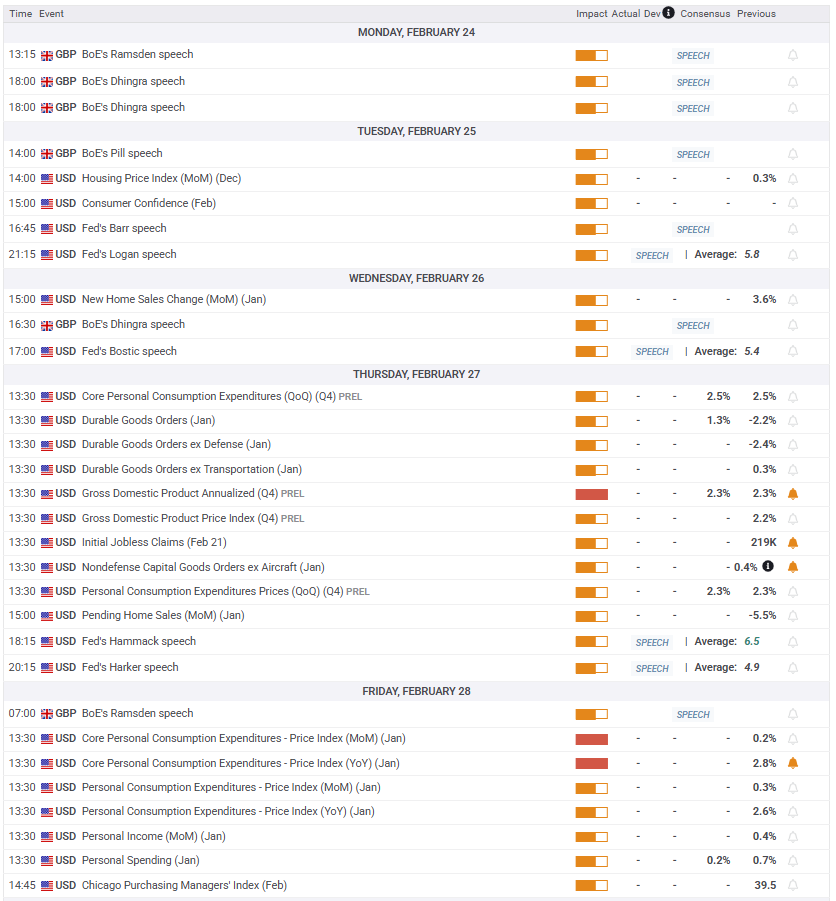
It’s a relatively quiet week for Pound Sterling traders in terms of economic data releases from the United Kingdom (UK), and hence, the focus will remain on the speeches from BoE and Fed policymakers, top-tier US events and Trump’s tariff announcements.
On Monday, BoE Deputy Governor Clare Lombardelli and the Monetary Policy Committee (MPC) member Swati Dhingra are scheduled to make their respective public appearances. At the same time, the data docket is absolutely dry on both sides of the Atlantic.
Tuesday will feature the BoE’s Quarterly Bulletin and the US Conference Board (CB) Consumer Confidence data. BoE Chief Economist Huw Pill will speak that day at the opening bells of the US markets.
BoE official Dhingra is set to speak again this week on Wednesday. Ahead of that, the mid-tier US Homes Sales data could entertain traders.
Thursday starts getting a bit busier, with the US Durable Goods, Jobless Claims and Pending Home Sales data on the calendar.
The January US Personal Consumption Expenditures (PCE) Price Index will stand out on Friday. The pair traders will watch out for the US Q4 Gross Domestic Product (GDP) revision and BoE policymaker Dave Ramsden’s speech for further directional impetus.
GBP/USD: Technical Outlook
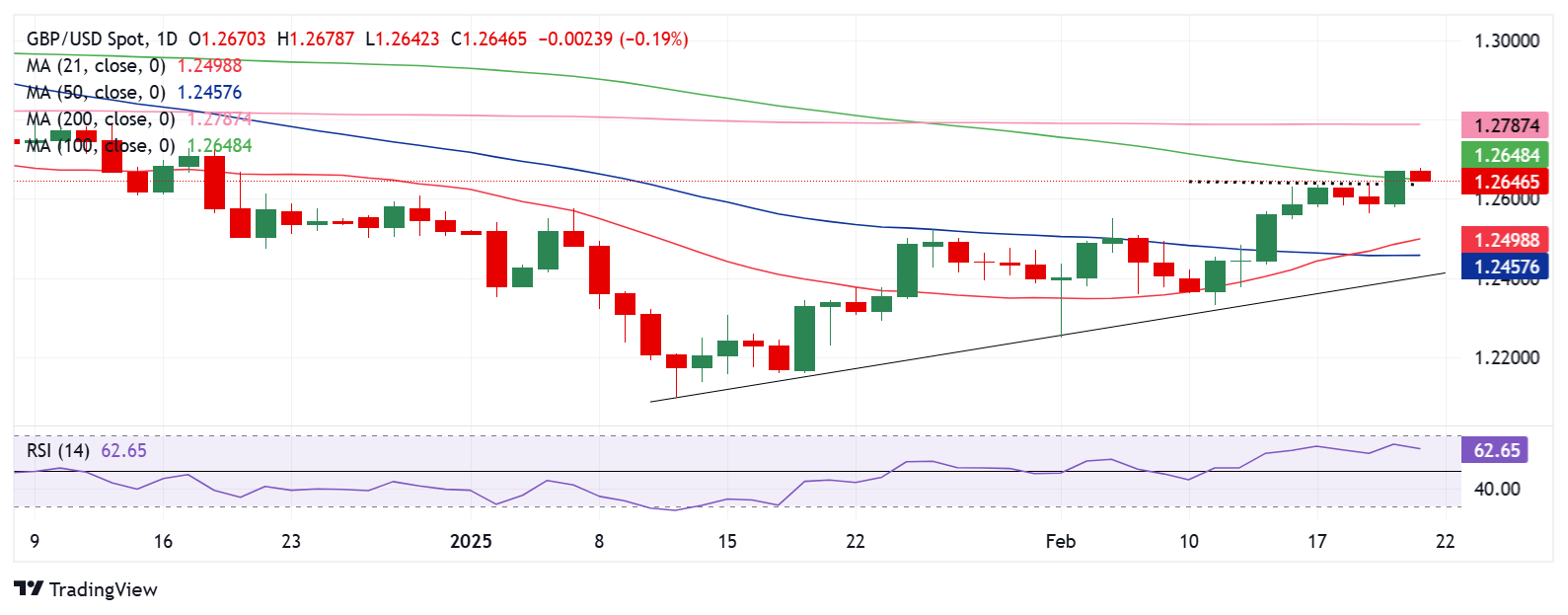
The daily chart shows that GBP/USD finally found acceptance above the static resistance around the 1.2640 region on Thursday.
The upside break also prompted buyers to recapture the 100-day Simple Moving Average (SMA) at 1.2649 on a sustained basis.
The 14-day Relative Strength Index (RSI) remains comfortable above the midline, currently near 65, suggesting that the bullish bias remains intact in the near term.
If the upside gathers traction, the next powerful resistance is at the 200-day SMA of 1.2788. A sustained break above it will initiate a fresh uptrend toward the 1.2850 psychological level.
The 1.2900 round level could challenge the bearish commitments.
If the pair embarks upon a corrective journey, the immediate support is aligned with the weekly low of 1.2563.
Should sellers find a firm foothold underneath that level, the 21-day SMA at 1.2500 will be next on their radars.
Further south, the 50-day SMA at 1.2458 will rescue buyers, below which the rising trendline support near 1.2400 could be challenged.
Pound Sterling FAQs
The Pound Sterling (GBP) is the oldest currency in the world (886 AD) and the official currency of the United Kingdom. It is the fourth most traded unit for foreign exchange (FX) in the world, accounting for 12% of all transactions, averaging $630 billion a day, according to 2022 data. Its key trading pairs are GBP/USD, also known as ‘Cable’, which accounts for 11% of FX, GBP/JPY, or the ‘Dragon’ as it is known by traders (3%), and EUR/GBP (2%). The Pound Sterling is issued by the Bank of England (BoE).
The single most important factor influencing the value of the Pound Sterling is monetary policy decided by the Bank of England. The BoE bases its decisions on whether it has achieved its primary goal of “price stability” – a steady inflation rate of around 2%. Its primary tool for achieving this is the adjustment of interest rates. When inflation is too high, the BoE will try to rein it in by raising interest rates, making it more expensive for people and businesses to access credit. This is generally positive for GBP, as higher interest rates make the UK a more attractive place for global investors to park their money. When inflation falls too low it is a sign economic growth is slowing. In this scenario, the BoE will consider lowering interest rates to cheapen credit so businesses will borrow more to invest in growth-generating projects.
Data releases gauge the health of the economy and can impact the value of the Pound Sterling. Indicators such as GDP, Manufacturing and Services PMIs, and employment can all influence the direction of the GBP. A strong economy is good for Sterling. Not only does it attract more foreign investment but it may encourage the BoE to put up interest rates, which will directly strengthen GBP. Otherwise, if economic data is weak, the Pound Sterling is likely to fall.
Another significant data release for the Pound Sterling is the Trade Balance. This indicator measures the difference between what a country earns from its exports and what it spends on imports over a given period. If a country produces highly sought-after exports, its currency will benefit purely from the extra demand created from foreign buyers seeking to purchase these goods. Therefore, a positive net Trade Balance strengthens a currency and vice versa for a negative balance.
Premium
You have reached your limit of 3 free articles for this month.
Start your subscription and get access to all our original articles.
Author
Dhwani Mehta
FXStreet
Residing in Mumbai (India), Dhwani is a Senior Analyst and Manager of the Asian session at FXStreet. She has over 10 years of experience in analyzing and covering the global financial markets, with specialization in Forex and commodities markets.